It is important to remember that Iran's power structure deviates from the model of a common-sense modern state.
There are those who, referring to Iran as a "sovereign state with elections and a parliament," argue against external judgment. This perspective fails to acknowledge that Iran's power structure deviates from the model of a common-sense modern state.
In Iran, the ultimate decision-maker on state affairs is the Supreme Leader, a cleric. The president's authority is limited in driving major shifts in nuclear policy or foreign policy, and they do not even command the military. Iran's elected officials are, in essence, mere 'window dressing' for the regime; the true power, the "sword and the vault," lies with the Revolutionary Guard Corps (IRGC), a separate military force.
IRGC: A Military-Security-Industrial Complex... Iran's De Facto Operator
While the IRGC is often referred to as a "regime guard," this description is too mild. As explained by the Council on Foreign Relations (CFR), the IRGC is currently the most powerful entity controlling all major economic sectors in Iran.
Following the Iran-Iraq War, this organization entered the economic sphere through reconstruction projects and has since expanded its activities to include banking, shipping, manufacturing, and consumer goods imports. Military, intelligence, security, and economic powers have become intertwined. It is a military-administrative-economic complex that governs the state by leveraging the authority of religious clerics, the core of Iran's theocratic regime.
The most blatant manifestation of this can be seen in the oil sector, the source of national wealth. Reuters reported that the IRGC controls up to 50% of Iran's oil exports as of the end of 2024, a significant increase from approximately 20% three years ago.
The IRGC has been circumventing sanctions by utilizing a fleet of phantom ships, logistics networks, and front companies in China, encroaching on the territory of state-owned oil organizations. Looking at the flow of money clearly reveals who the real power holders in the regime are. The nation's largest source of foreign currency is more strongly tied to the IRGC's informal networks than to the government's administrative control.
The IRGC as a Monster... Backer of Anti-US Forces Abroad
Recently, President Masoud Pezeshkian, known for his moderate and pragmatic stance, offered an apologetic expression of regret to Gulf nations, hinting at restraint and cessation of attacks. This move was met with fierce backlash from the IRGC and hardline clerics, forcing him to backtrack. This demonstrates that the president, elected by popular vote, cannot autonomously maintain even a single diplomatic message.
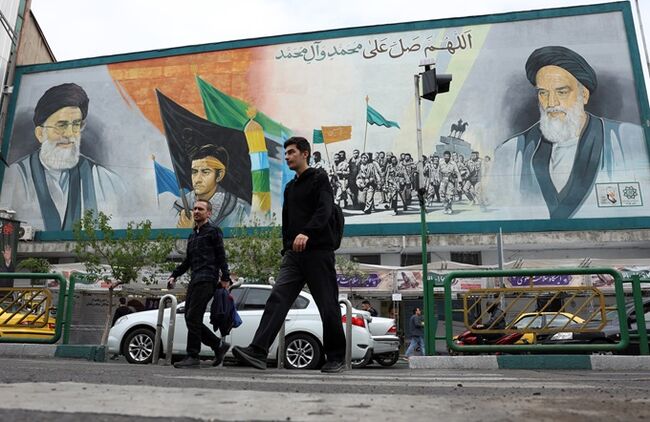 In Iran, the ultimate decision-maker on state affairs is the Supreme Leader, a cleric.
A leaked WikiLeaks diplomatic cable from late 2010 even recounted a shocking incident where Mahmoud Ahmadinejad, the then-president, was slapped by the IRGC commander. Crucially, this is not an isolated overreach but a systemic constant. Despite voters' surprise election of the non-mainstream candidate Pezeshkian in the presidential election two years ago, there is little more they can do.
As reported by Reuters, the IRGC pushed through the selection of Mojtaba Khamenei as the Supreme Leader last month, overcoming the hesitation of clerics and pragmatic political factions. Concerns were also raised by former reformist officials and insiders of the regime that Iran could lean further towards becoming a "military state with a thin veneer of religious legitimacy." Another source also pointed out that "the operator of Iran is the IRGC." While the selection of the Supreme Leader is constitutionally the responsibility of the Assembly of Experts, the IRGC is the de facto 'kingmaker.'
Through control over appointments, intelligence, finances, succession plans, and security decision-making, the state is being systematically infiltrated. Is this "long-term insidious coup" any less dangerous than a classic coup involving tanks on the streets? For nearly half a century since the revolution, Iran has been undergoing a process akin to an institutionalized "constant coup" by the IRGC. While this is one interpretation, the supporting facts continue to accumulate.
The UN's independent international fact-finding mission on Iran warned last month that the situation in Iran constitutes "an unprecedented level of institutionalized repression" and "violations that may amount to crimes against humanity." It is also a well-known fact that the IRGC backs anti-American armed groups.
The regime has prioritized providing funds, weapons, technology, and training to groups like Hezbollah, Hamas, the Houthis, and Iraqi militias over the welfare of its own citizens. To dismiss the transgressions of these forces by saying, "It is a sovereign state's internal affairs, and we cannot interfere," is to misunderstand sovereignty as a 'license for monopolizing oppression.'
Moral and Strategic Aspects of Trump's Hardline Policy Towards Iran
There are sufficient reasons for the international community to raise clearer moral objections regarding Iran's reality. In this context, Trump's hardline policy is justifiable. The White House announced its objective in February 2025 to restore "maximum pressure" to block Iran's path to nuclear armament, deter missile and asymmetric capabilities, and neutralize terrorist networks.
In February 2026, additional executive orders and fact sheets were released to address threats from the Iranian government. The pressure to cut off the IRGC's oil smuggling and its funding channels through shipping, insurance, and proxy forces is morally and strategically understandable. The regime has, for decades, made elected officials puppets, monopolized industry and security, and operated extraterritorial armed networks. To label a hardline policy against such a regime as "imperialist interference" would be suspicious.
Meanwhile, a "two-week ceasefire" was agreed upon approximately 90 minutes before Trump's final deadline and took effect on the 7th, but the situation remains unstable. The Strait of Hormuz has not yet normalized, and most major shipping companies are still in a wait-and-see mode. Oil prices, which had plummeted immediately after the ceasefire, are again moving erratically.
The effectiveness of the ceasefire itself has been shaken by Israel's airstrikes on Lebanon. The primary theater for Hezbollah, which has been harassing Israel, is the southern Lebanese border. Israel and the U.S. have made it clear that "Lebanon is not included in this ceasefire."
However, it is noteworthy that the market recognized the possibility of Trump's warning translating into actual action, and that Iran also judged that further resistance could lead to the simultaneous severance of its financial lifelines and breathing room.

◆ Dr. Im Myung-shin
Doctor of Chinese Studies, Northeast Asia Researcher
Former Deputy Director of International Affairs, SKY Daily

 [Statement by the Seo-beo-kka Korea Military Academy Save-the-Nation Comrades Association] ㉛ Recount the Votes Publicly, as the Previous Recount Concealed Election Fraud
Tongyeong Mayoral Election Recount [Photo=Yonhap News]South Korea's liberal democracy is dying. The National Election Commission (NEC) and the judiciary, which have plummeted into criminal syndicates
[Statement by the Seo-beo-kka Korea Military Academy Save-the-Nation Comrades Association] ㉛ Recount the Votes Publicly, as the Previous Recount Concealed Election Fraud
Tongyeong Mayoral Election Recount [Photo=Yonhap News]South Korea's liberal democracy is dying. The National Election Commission (NEC) and the judiciary, which have plummeted into criminal syndicates
 What is the significance of the "Trump 2028" red hats that keep making a comeback?
It is noteworthy that President Donald Trump is "intentionally" fueling controversy over whether he can actually run in the 2028 presidential election, even though it is "highly likely he is seriously
What is the significance of the "Trump 2028" red hats that keep making a comeback?
It is noteworthy that President Donald Trump is "intentionally" fueling controversy over whether he can actually run in the 2028 presidential election, even though it is "highly likely he is seriously
 Jin Cummings: “North Korea says it will increase the number of spies, so what is the government doing?”
U.S. political columnist Gene Cummings has publicly questioned the South Korean government, asking, "North Korea is declaring that it will increase its number of spies, so what is the South Kore
Jin Cummings: “North Korea says it will increase the number of spies, so what is the government doing?”
U.S. political columnist Gene Cummings has publicly questioned the South Korean government, asking, "North Korea is declaring that it will increase its number of spies, so what is the South Kore
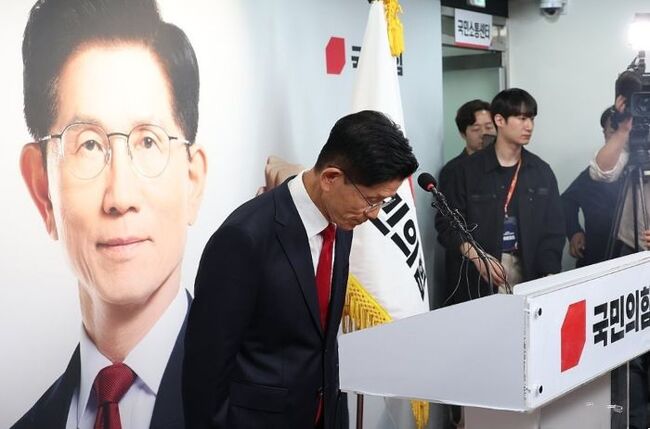 “Too little, too late?…” Kim Moon-soo, who previously conceded his presidential election defeat, now demands a special counsel investigation into ‘allegations of election fraud in the 2025 presidential election’
People Power Party presidential candidate Kim Moon-soo concedes defeat during a press conference at the party headquarters in Yeouido, Seoul, on June 4, 2025. [Joint Press Corps]As allegations emerge
“Too little, too late?…” Kim Moon-soo, who previously conceded his presidential election defeat, now demands a special counsel investigation into ‘allegations of election fraud in the 2025 presidential election’
People Power Party presidential candidate Kim Moon-soo concedes defeat during a press conference at the party headquarters in Yeouido, Seoul, on June 4, 2025. [Joint Press Corps]As allegations emerge
 Stock Market Crash 'Black Tuesday'… KOSPI down 10.8%, KOSDAQ down 7.7%
The KOSPI fell by more than 5% in early trading on the 28th, triggering a sell-side sidecar.On the 28th, the KOSPI plunged by more than 10%.Due to the sharp decline, a sell-side sidecar—a temporary
Stock Market Crash 'Black Tuesday'… KOSPI down 10.8%, KOSDAQ down 7.7%
The KOSPI fell by more than 5% in early trading on the 28th, triggering a sell-side sidecar.On the 28th, the KOSPI plunged by more than 10%.Due to the sharp decline, a sell-side sidecar—a temporary
 [World Heritage Committee] 25 New World Heritage Sites Inscribed in Busan… South Korea Successfully Expands 'Getbol' Listing
The Chairperson of the World Heritage Committee speaks at the plenary session of the 48th session of the World Heritage Committee, held at BEXCO in Busan on the 20th. [Photo: Yonhap News]A total of 25
[World Heritage Committee] 25 New World Heritage Sites Inscribed in Busan… South Korea Successfully Expands 'Getbol' Listing
The Chairperson of the World Heritage Committee speaks at the plenary session of the 48th session of the World Heritage Committee, held at BEXCO in Busan on the 20th. [Photo: Yonhap News]A total of 25
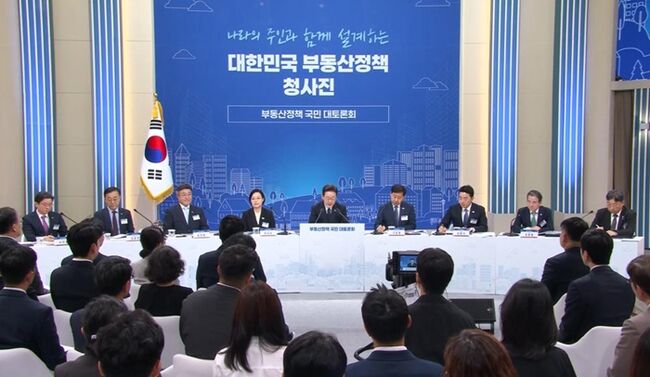 [Liberal Democratic Party Statement] Calling it a Grand Real Estate Debate… It Was Nothing More Than a Private Party Among Themselves
The 'National Grand Debate on Real Estate Policy' held on July 23rd and 27th. [Photo=Yonhap News]The 'National Grand Debate on Real Estate Policy,' hosted by the Lee Jae-myung administration under the
[Liberal Democratic Party Statement] Calling it a Grand Real Estate Debate… It Was Nothing More Than a Private Party Among Themselves
The 'National Grand Debate on Real Estate Policy' held on July 23rd and 27th. [Photo=Yonhap News]The 'National Grand Debate on Real Estate Policy,' hosted by the Lee Jae-myung administration under the
 [Photo] Evidence of Election Fraud Flooding U.S. Media… Trump Had 2.7 Million Votes Stolen
 [Video] U.S. Semiquincentennial Air Show... 'Art in the Sky' streaks across New York
 [Editorial Cartoon] A Draconian Law That Undermines Freedom of Expression

 List
List