In previous installments, we examined how cartels privatize the state for the benefit of specific groups (Part 1) and how the Neo-Confucian cartel paralyzes the national system under the guise of ideology (Part 2). This third installment dissects North Korea's top structure, the 'Supreme Leader Cartel,' described as the most bizarre and solidified form of collusion on Earth.
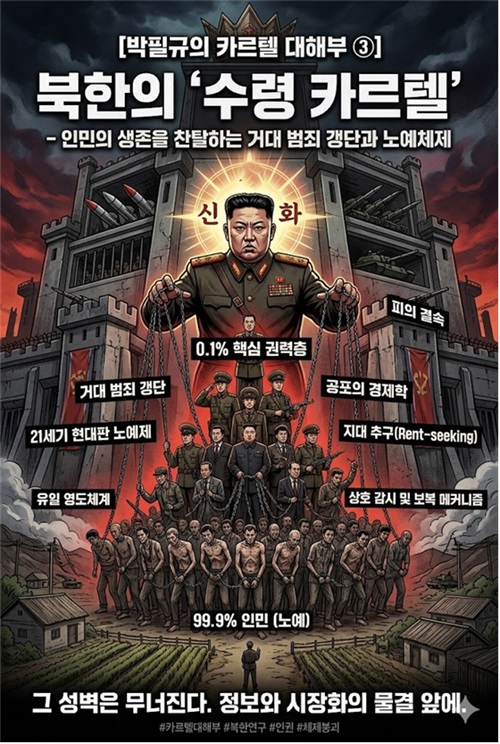
North Korea transcends the categories of ordinary dictatorships or totalitarian states. In reality, it resembles a 'giant criminal syndicate' where the core power elite, with the Supreme Leader at its apex, enslaves its 25 million people and privatizes state assets by using the public facade of the state as a tool.
The most potent weapon maintaining the North Korean cartel is the 'deification of the Baekdu Bloodline,' which pushes information asymmetry to its extreme. However, when this veil of mysticism is lifted, its essence is not a governing philosophy, but merely the elevation of the 'code of silence' and 'blood pacts,' observable in Mafia or cartel organizations, to a religious level.
Within this structure, the Supreme Leader does not act as the head of state operations, but rather as the 'Boss' who distributes benefits to organization members and executes traitors.
The core power elite, sharing a special spatial community of interest called Pyongyang, establishes an 'iron triangle' by rotating key positions in the party, military, and government. For them, the people are not citizens to be protected, but 'state-owned slaves' endlessly exploitable to fill the organization's lavish lifestyle and weapons depots.
This predatory structure leads to the tragic reality of a '21st-century modern slavery.' North Korea's Supreme Leader cartel deprives its people of freedom of movement, freedom of occupation, and even freedom of thought, channeling them into forced labor solely for the cartel's safety and regime maintenance. This is the most brutal variant of 'rent-seeking' discussed in Part 1.
State budgets squeezed from the people's sweat are prioritized not for public welfare, but for weapons development, which is key to securing the loyalty of the military, the cartel's core power, and for the procurement of luxury goods for the top structure. Furthermore, a new class of capitalists, known as 'donju' (money owners), parasite on the lower structure of this cartel, offering bribes in exchange for the right to survive. This is not normal economic activity, but a system of 'protection money,' extorted by gangs from merchants in their territory, expanded to a national scale.
The greatest threat to the survival of the Supreme Leader cartel is internal betrayal and the influx of free information. To fundamentally block this, the North Korean Supreme Leader cartel operates an 'mutual surveillance and retribution mechanism' unprecedented in human history. The public security apparatus, represented by the Ministry of State Security and the Ministry of People's Security, is not a shield to maintain state order, but has degenerated into the organization's 'enforcers' who eliminate those who break the cartel's rules or challenge the Supreme Leader's absolute power.
Instead of the separation of powers that forms the basis of modern democracy, the 'monolithic leadership system' has turned laws and institutions into weapons tailored to the cartel's whims. The law is not a safeguard for the people, but a cleaver used to execute slaves who oppose the cartel's interests. Brutal purges and modern-day collective punishment imprint the 'economics of fear' onto the minds of its members, teaching them that obedience is far more profitable than betrayal.
Ultimately, North Korea's 'Supreme Leader Cartel' is a closed group that has built an 'invisible wall' for the 0.1% of the upper structure, thoroughly alienating the 99.9% of its people. They threaten the international community with nuclear weapons as hostages to extend the organization's lifespan, but history clearly foretells the outcome: gang-like organizations that cut off communication with the outside and sustain themselves by squeezing the lifeblood of their internal members will eventually collapse at the critical point of resource depletion and internal fissures.
Just as the Neo-Confucian cartel of Joseon fell into dogmatism and led to national ruin, North Korea's predatory gang cartel also faces the immense waves of information influx and marketization.
The lesson we witness from North Korea's case is clear. When power loses transparency and degenerates into a tool to protect the private interests of a specific group, the state is no longer a state but a massive criminal organization, and society transforms into a living prison. North Korea's 'Supreme Leader Cartel' is a living human slaughterhouse, showcasing the most tragic and inhumane endpoint that a cartel reaches when it completely seizes state power.
This tragic play, where the ruling power centered around Kim Jong Un, the 0.1%, survives on the tears of the 99.9%, can never be sustainable, and the moment that wall crumbles, we will face the horrific ruins left behind by the cartel.
◆ Park Pil-kyu
Editorial Board Member, Hankyoreh
40th graduating class, Korea Military Academy

 [Statement by the Seo-beo-kka Korea Military Academy Save-the-Nation Comrades Association] ㉛ Recount the Votes Publicly, as the Previous Recount Concealed Election Fraud
Tongyeong Mayoral Election Recount [Photo=Yonhap News]South Korea's liberal democracy is dying. The National Election Commission (NEC) and the judiciary, which have plummeted into criminal syndicates
[Statement by the Seo-beo-kka Korea Military Academy Save-the-Nation Comrades Association] ㉛ Recount the Votes Publicly, as the Previous Recount Concealed Election Fraud
Tongyeong Mayoral Election Recount [Photo=Yonhap News]South Korea's liberal democracy is dying. The National Election Commission (NEC) and the judiciary, which have plummeted into criminal syndicates
 What is the significance of the "Trump 2028" red hats that keep making a comeback?
It is noteworthy that President Donald Trump is "intentionally" fueling controversy over whether he can actually run in the 2028 presidential election, even though it is "highly likely he is seriously
What is the significance of the "Trump 2028" red hats that keep making a comeback?
It is noteworthy that President Donald Trump is "intentionally" fueling controversy over whether he can actually run in the 2028 presidential election, even though it is "highly likely he is seriously
 Jin Cummings: “North Korea says it will increase the number of spies, so what is the government doing?”
U.S. political columnist Gene Cummings has publicly questioned the South Korean government, asking, "North Korea is declaring that it will increase its number of spies, so what is the South Kore
Jin Cummings: “North Korea says it will increase the number of spies, so what is the government doing?”
U.S. political columnist Gene Cummings has publicly questioned the South Korean government, asking, "North Korea is declaring that it will increase its number of spies, so what is the South Kore
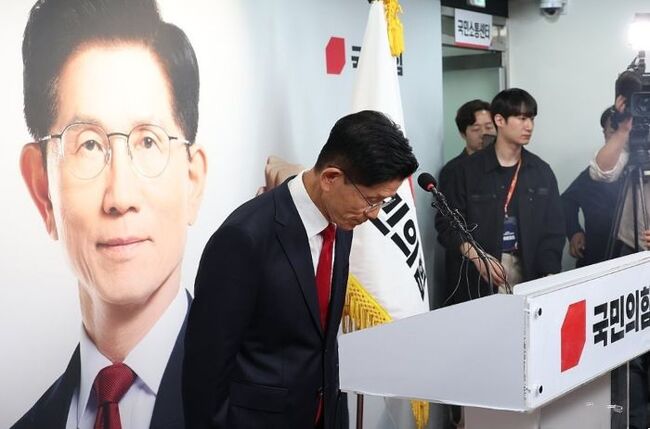 “Too little, too late?…” Kim Moon-soo, who previously conceded his presidential election defeat, now demands a special counsel investigation into ‘allegations of election fraud in the 2025 presidential election’
People Power Party presidential candidate Kim Moon-soo concedes defeat during a press conference at the party headquarters in Yeouido, Seoul, on June 4, 2025. [Joint Press Corps]As allegations emerge
“Too little, too late?…” Kim Moon-soo, who previously conceded his presidential election defeat, now demands a special counsel investigation into ‘allegations of election fraud in the 2025 presidential election’
People Power Party presidential candidate Kim Moon-soo concedes defeat during a press conference at the party headquarters in Yeouido, Seoul, on June 4, 2025. [Joint Press Corps]As allegations emerge
 Stock Market Crash 'Black Tuesday'… KOSPI down 10.8%, KOSDAQ down 7.7%
The KOSPI fell by more than 5% in early trading on the 28th, triggering a sell-side sidecar.On the 28th, the KOSPI plunged by more than 10%.Due to the sharp decline, a sell-side sidecar—a temporary
Stock Market Crash 'Black Tuesday'… KOSPI down 10.8%, KOSDAQ down 7.7%
The KOSPI fell by more than 5% in early trading on the 28th, triggering a sell-side sidecar.On the 28th, the KOSPI plunged by more than 10%.Due to the sharp decline, a sell-side sidecar—a temporary
 [World Heritage Committee] 25 New World Heritage Sites Inscribed in Busan… South Korea Successfully Expands 'Getbol' Listing
The Chairperson of the World Heritage Committee speaks at the plenary session of the 48th session of the World Heritage Committee, held at BEXCO in Busan on the 20th. [Photo: Yonhap News]A total of 25
[World Heritage Committee] 25 New World Heritage Sites Inscribed in Busan… South Korea Successfully Expands 'Getbol' Listing
The Chairperson of the World Heritage Committee speaks at the plenary session of the 48th session of the World Heritage Committee, held at BEXCO in Busan on the 20th. [Photo: Yonhap News]A total of 25
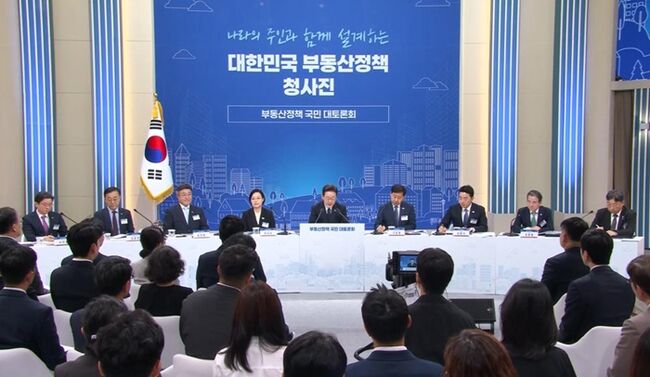 [Liberal Democratic Party Statement] Calling it a Grand Real Estate Debate… It Was Nothing More Than a Private Party Among Themselves
The 'National Grand Debate on Real Estate Policy' held on July 23rd and 27th. [Photo=Yonhap News]The 'National Grand Debate on Real Estate Policy,' hosted by the Lee Jae-myung administration under the
[Liberal Democratic Party Statement] Calling it a Grand Real Estate Debate… It Was Nothing More Than a Private Party Among Themselves
The 'National Grand Debate on Real Estate Policy' held on July 23rd and 27th. [Photo=Yonhap News]The 'National Grand Debate on Real Estate Policy,' hosted by the Lee Jae-myung administration under the
 [Photo] Evidence of Election Fraud Flooding U.S. Media… Trump Had 2.7 Million Votes Stolen
 [Video] U.S. Semiquincentennial Air Show... 'Art in the Sky' streaks across New York
 [Editorial Cartoon] A Draconian Law That Undermines Freedom of Expression

 List
List