Illicit remittances to North Korea are not an issue that concludes solely within South Korean courtrooms. It is an international matter involving UN sanctions against North Korea, the international financial order, and allied cooperation on North Korea.
The UN Security Council Resolution 1718 sanctions regime imposes an obligation on member states to block North Korea's evasion of sanctions and illicit financial activities. The U.S. Department of the Treasury's Office of Foreign Assets Control (OFAC) has also made it clear that foreign financial institutions conducting or facilitating significant North Korea-related transactions can be subject to sanctions.
South Korea has its own laws, and the United States has its own. South Korea, as a sovereign nation, cannot allow its ally, the United States, to arbitrarily interfere in its domestic affairs and judicial processes. This much is fundamental to the international order.
However, when the dimension escalates to the global order, the narrative changes.
Sanctions against North Korea are not a domestic policy of a specific country but an international norm that originated from UN resolutions. Blocking North Korea's illicit funding channels is a crucial pillar of the global order.
Therefore, illicit remittances to North Korea are not an incident that concludes within South Korea; from that moment on, it transitions into an issue of international sanctions and international finance.
Consequently, the United States' silence on this matter cannot be explained solely by the virtue of non-interference in internal affairs.
Between respect for South Korea and responsibility for the international sanctions regime, the United States must now answer which principle it prioritizes.
In the past year, Hanmi Ilbo, through interviews and follow-up articles, has intensively highlighted the fact that Pastor Shin Dong-young reported the Lee Jae-myung remittance case to the U.S. Department of the Treasury's OFAC and the United Nations.
Therefore, the U.S.'s excuse of "having no knowledge of this case at all" loses its credibility.
Why is the United States, which is more stringent than anyone else regarding illicit financial activities related to North Korea, publicly silent on South Korea's illicit remittance case, especially one for which a guilty verdict has been confirmed by the Supreme Court?
Up until recently, the United States has repeatedly imposed sanctions on North Korea's overseas financial facilitators, money laundering networks, and sanctions evasion structures. The principle of cutting off North Korea's funding sources remains alive.
However, if only this specific case remains quiet, it is difficult to explain solely by prudence.
Of course, U.S. sanctions are not automatic. The structure is not such that a South Korean court's judgment is immediately converted into OFAC sanctions. The United States acts entirely based on its own laws and government judgments.
However, even so, the flow of South Korea's judicial judgments cannot be regarded as mere light reference material.
When assessing whether a transaction is significant in relation to North Korea, allied investigative materials and court judgments are grounds that are difficult to ignore. If the United States is truly acting in accordance with its principles, it has a responsibility to explain, at the very least, why this case is not at the forefront of sanctions review.
Silence is not neutrality. Especially silence on the issue of North Korea's funding is a suspension of principles or an intervention of politics.
What is more unsettling are the internal movements within South Korea.
In South Korea, attempts to shake the already confirmed Supreme Court ruling are continuing. Yet, the United States remains silent. One cannot help but ask why the United States, which is more sensitive than anyone else to North Korea's funding channels, remains silent only in this case.
This is because if the United States truly views issues of illicit funds related to North Korea as matters of international security and financial order, this case can by no means be treated lightly.
Only three interpretations remain.
Either the United States is still conducting an undisclosed review, or it is buying time to avoid a direct clash with allied politics, or it is selectively applying its principles while outwardly proclaiming them.
If it is the first, there should be action soon. If it is the second or third, it is uncharacteristic of the United States.
The United States has always stated that it does not distinguish between friends and foes when it comes to North Korea's funding channels. However, if it remains silent on the issue of illicit remittances to North Korea due to allied politics, that is a diplomatic calculation, not a principle of sanctions.
The MAGA spirit, championed by the Trump administration, is also incompatible with such silence.
What makes America great is not just its wealth. America truly becomes great when it is a country where justice and principles are alive, and where standards are applied without regard to friend or foe.
A silent United States in the face of North Korea's illicit funding is neither a strong America nor a great America.
This case is a violation of UN sanctions.
Furthermore, it is a dangerous case where the fate of an ally can be shaken by a single word from North Korea.
If the United States remains silent even in the face of such an issue, it is not an attitude of protecting the security of the alliance, but an attitude of neglecting the international order.
The United States must provide an answer. Whether its silence is a result of principle or a calculation of politics.

 [Statement by the Seo-beo-kka Korea Military Academy Save-the-Nation Comrades Association] ㉛ Recount the Votes Publicly, as the Previous Recount Concealed Election Fraud
Tongyeong Mayoral Election Recount [Photo=Yonhap News]South Korea's liberal democracy is dying. The National Election Commission (NEC) and the judiciary, which have plummeted into criminal syndicates
[Statement by the Seo-beo-kka Korea Military Academy Save-the-Nation Comrades Association] ㉛ Recount the Votes Publicly, as the Previous Recount Concealed Election Fraud
Tongyeong Mayoral Election Recount [Photo=Yonhap News]South Korea's liberal democracy is dying. The National Election Commission (NEC) and the judiciary, which have plummeted into criminal syndicates
 What is the significance of the "Trump 2028" red hats that keep making a comeback?
It is noteworthy that President Donald Trump is "intentionally" fueling controversy over whether he can actually run in the 2028 presidential election, even though it is "highly likely he is seriously
What is the significance of the "Trump 2028" red hats that keep making a comeback?
It is noteworthy that President Donald Trump is "intentionally" fueling controversy over whether he can actually run in the 2028 presidential election, even though it is "highly likely he is seriously
 Jin Cummings: “North Korea says it will increase the number of spies, so what is the government doing?”
U.S. political columnist Gene Cummings has publicly questioned the South Korean government, asking, "North Korea is declaring that it will increase its number of spies, so what is the South Kore
Jin Cummings: “North Korea says it will increase the number of spies, so what is the government doing?”
U.S. political columnist Gene Cummings has publicly questioned the South Korean government, asking, "North Korea is declaring that it will increase its number of spies, so what is the South Kore
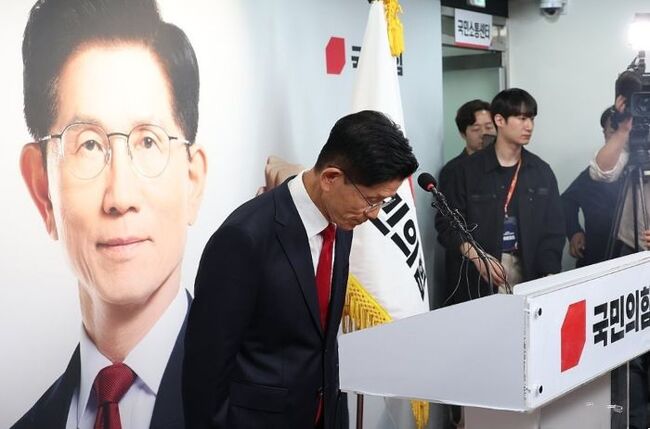 “Too little, too late?…” Kim Moon-soo, who previously conceded his presidential election defeat, now demands a special counsel investigation into ‘allegations of election fraud in the 2025 presidential election’
People Power Party presidential candidate Kim Moon-soo concedes defeat during a press conference at the party headquarters in Yeouido, Seoul, on June 4, 2025. [Joint Press Corps]As allegations emerge
“Too little, too late?…” Kim Moon-soo, who previously conceded his presidential election defeat, now demands a special counsel investigation into ‘allegations of election fraud in the 2025 presidential election’
People Power Party presidential candidate Kim Moon-soo concedes defeat during a press conference at the party headquarters in Yeouido, Seoul, on June 4, 2025. [Joint Press Corps]As allegations emerge
 Stock Market Crash 'Black Tuesday'… KOSPI down 10.8%, KOSDAQ down 7.7%
The KOSPI fell by more than 5% in early trading on the 28th, triggering a sell-side sidecar.On the 28th, the KOSPI plunged by more than 10%.Due to the sharp decline, a sell-side sidecar—a temporary
Stock Market Crash 'Black Tuesday'… KOSPI down 10.8%, KOSDAQ down 7.7%
The KOSPI fell by more than 5% in early trading on the 28th, triggering a sell-side sidecar.On the 28th, the KOSPI plunged by more than 10%.Due to the sharp decline, a sell-side sidecar—a temporary
 [World Heritage Committee] 25 New World Heritage Sites Inscribed in Busan… South Korea Successfully Expands 'Getbol' Listing
The Chairperson of the World Heritage Committee speaks at the plenary session of the 48th session of the World Heritage Committee, held at BEXCO in Busan on the 20th. [Photo: Yonhap News]A total of 25
[World Heritage Committee] 25 New World Heritage Sites Inscribed in Busan… South Korea Successfully Expands 'Getbol' Listing
The Chairperson of the World Heritage Committee speaks at the plenary session of the 48th session of the World Heritage Committee, held at BEXCO in Busan on the 20th. [Photo: Yonhap News]A total of 25
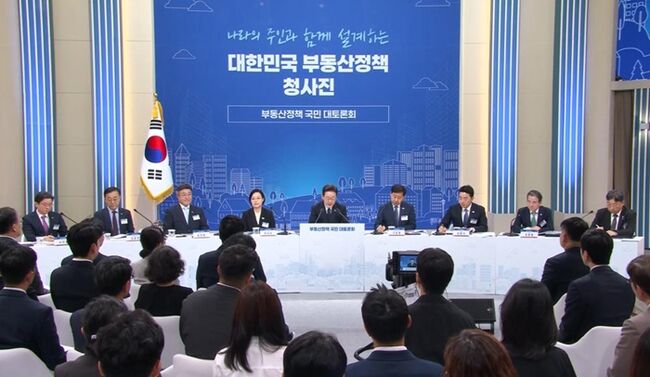 [Liberal Democratic Party Statement] Calling it a Grand Real Estate Debate… It Was Nothing More Than a Private Party Among Themselves
The 'National Grand Debate on Real Estate Policy' held on July 23rd and 27th. [Photo=Yonhap News]The 'National Grand Debate on Real Estate Policy,' hosted by the Lee Jae-myung administration under the
[Liberal Democratic Party Statement] Calling it a Grand Real Estate Debate… It Was Nothing More Than a Private Party Among Themselves
The 'National Grand Debate on Real Estate Policy' held on July 23rd and 27th. [Photo=Yonhap News]The 'National Grand Debate on Real Estate Policy,' hosted by the Lee Jae-myung administration under the
 [Photo] Evidence of Election Fraud Flooding U.S. Media… Trump Had 2.7 Million Votes Stolen
 [Video] U.S. Semiquincentennial Air Show... 'Art in the Sky' streaks across New York
 [Editorial Cartoon] A Draconian Law That Undermines Freedom of Expression

 List
List