Hungarian Prime Minister Viktor Orbán [AP=Yonhap News]
The Orbán government was defeated in Hungary's general election on the 12th (local time).
More significant than the end of a 16-year regime is the wavering of a symbolic forward outpost that the Trump camp had established within the European Union. In this election, Péter Magyar's Tisza (Respect and Freedom) party secured 138 out of 199 seats, or two-thirds, enough for constitutional amendments.
However, it would be hasty to interpret this defeat as a fundamental shift in Hungary's national direction. Magyar himself is a center-right figure who split from within the Orbán camp. While he speaks of restoring relations with the European Union (EU), he also promised to maintain a hardline stance on immigration control. Furthermore, he opposed the rapid promotion of Ukraine's EU accession, suggesting a referendum, and indicated a stance of maintaining practical relations with Russia for the time being.
In short, it is too early to view the results of this general election as a victory for the social democratic globalism and the anti-Christian liberalism pursued by the EU's mainstream elite. It is more appropriate to see it as an event where the representative of the 'Hungarian Conservative State Model,' exclusively enshrined in Hungary's constitution, institutions, and symbols, has changed, and a judgment of skepticism has been passed on the effectiveness of Orbán's governing style.
Why Orbán Was Strong for So Long
Orbán emerged as an anti-communist youth icon in 1989 by publicly calling for the withdrawal of Soviet troops. He became prime minister at the age of thirty-five in 1998, and after regaining power in 2010, he effectively united the Hungarian right into a single long-ruling bloc.
Following the 2015 refugee crisis, he became a symbol of effective conservatism by advocating for border control, the protection of Christian civilization, and family policies promoting childbirth. This is why conservatives from the United States visited Budapest to observe his political experiments. It was no coincidence that Trump considered Orbán an ally.
Orbán's excellence can be attributed to his ability to weave together the wounded national sentiments of Hungarians, the fatigue after the collapse of the communist bloc, resentment towards EU bureaucracy, and anxieties surrounding immigration and cultural wars into a single narrative.
He pointed out the limits of 'borderless humanitarianism' much earlier than Western Europe, and his conservative value politics, centered on Christianity and family, were also clear. His steadfast stance against EU pressure was also seen by his supporters as the 'courage of a leader of a small nation.' Thus, Orbán became a star of European conservatism, perceived as a European precursor to Trumpism.
When Strengths Turned into Weaknesses
However, his sense of reality gradually solidified into a governing manual, and the banner of sovereignty protection began to be criticized as a political shield to cover up economic stagnation and fatigue from corruption. His rhetoric, which clearly articulated the meaning of borders, the costs of unlimited immigration, EU bureaucracy, and the emptiness of globalist elite politics, started to become fuel for a long-standing regime.
Let's summarize the reasons for his defeat. First, economic failure. Orbán was sharp in his criticism of the EU but failed to create a growth model to replace EU dependence. Hungary's economy remained deeply tied to European funds and markets, especially its manufacturing supply chains, and amid clashes with the EU, funds worth €17 to 18 billion were frozen.
The European Commission, the EU's executive arm, projected Hungary's growth rate at 0.4% in 2025 and about 2% in 2026, while the OECD pointed out that investment had decreased by about 20% over the past two years. High inflation, a large fiscal deficit, and weakened policy predictability combined to prevent the language of 'sovereignty' from translating into tangible improvements in people's livelihoods.
The market's reaction immediately after Orbán's defeat, with the strengthening of the Hungarian currency (forint) and rising asset prices, was also due to an initial reading of practical expectations.
Second, the aging power structure. Long-term regimes inevitably lose internal feedback over time. The longer the judiciary, media, administration, and party structures are controlled, the less responsive the government becomes not only to external criticism but also to internal warning signs. The Orbán regime accumulated domestic fatigue amid controversies over democratic backsliding.
Third, the challenger's nature. The winner of this election, Magyar, is not a typical liberal opposition figure but comes from within the Orbán camp. This allowed him to dismantle Orbán's monopoly on the anti-elite, anti-EU narrative from the inside.
Fourth, generational change. Although the election saw a record turnout of about 80%, the results showed a stark abandonment by the youth. The Fidesz party's 8% support rate among 18-29 year olds is symbolic. While he was a hero of regime change in the past, he appears to have become established power in the eyes of the younger generation. Long-term rule involves a coexistence of ennui and stability, but ennui has now outweighed the benefits of stability.
The Spillover Benefits Warsaw Will Reap
Under Orbán, Hungary was an 'exceptional state' that destabilized the EU and Ukraine. If that axis crumbles, regional politics will more naturally gravitate towards Poland.
In terms of security, Poland has solidified its image as the front line against Russian containment. Trump even promised an additional 1,000 US troops in Poland during his 2019 White House meeting with Andrzej Duda, and they intended to call the deployment a 'Fort Trump' locally. Last September, the new president, Karol Nawrocki, reaffirmed this relationship of trust with Trump at the White House.
Economically, while Hungary is expected to grow by around 2%, Poland is projected to grow by 3.5% by 2026, leveraging EU fund absorption for growth. If the Hungarian voters' choice is perceived as the departure of a key ally for Trump in Europe, there could be future repercussions. Depending on Hungary's trajectory, Poland is likely to benefit from increased US trust and reap spillover gains in security and growth.
Hungarian voters may also come to their senses as they see who is actually bringing them benefits. This is the same logic as how the more anti-American sentiment is fostered in South Korean society, the greater Japan's strategic value becomes to the US.

◆ Park Im-myung
Ph.D. in Chinese Studies, Northeast Asia Researcher
Former International Deputy Director, Sky Daily

 [Statement by the Seo-beo-kka Korea Military Academy Save-the-Nation Comrades Association] ㉛ Recount the Votes Publicly, as the Previous Recount Concealed Election Fraud
Tongyeong Mayoral Election Recount [Photo=Yonhap News]South Korea's liberal democracy is dying. The National Election Commission (NEC) and the judiciary, which have plummeted into criminal syndicates
[Statement by the Seo-beo-kka Korea Military Academy Save-the-Nation Comrades Association] ㉛ Recount the Votes Publicly, as the Previous Recount Concealed Election Fraud
Tongyeong Mayoral Election Recount [Photo=Yonhap News]South Korea's liberal democracy is dying. The National Election Commission (NEC) and the judiciary, which have plummeted into criminal syndicates
 What is the significance of the "Trump 2028" red hats that keep making a comeback?
It is noteworthy that President Donald Trump is "intentionally" fueling controversy over whether he can actually run in the 2028 presidential election, even though it is "highly likely he is seriously
What is the significance of the "Trump 2028" red hats that keep making a comeback?
It is noteworthy that President Donald Trump is "intentionally" fueling controversy over whether he can actually run in the 2028 presidential election, even though it is "highly likely he is seriously
 Jin Cummings: “North Korea says it will increase the number of spies, so what is the government doing?”
U.S. political columnist Gene Cummings has publicly questioned the South Korean government, asking, "North Korea is declaring that it will increase its number of spies, so what is the South Kore
Jin Cummings: “North Korea says it will increase the number of spies, so what is the government doing?”
U.S. political columnist Gene Cummings has publicly questioned the South Korean government, asking, "North Korea is declaring that it will increase its number of spies, so what is the South Kore
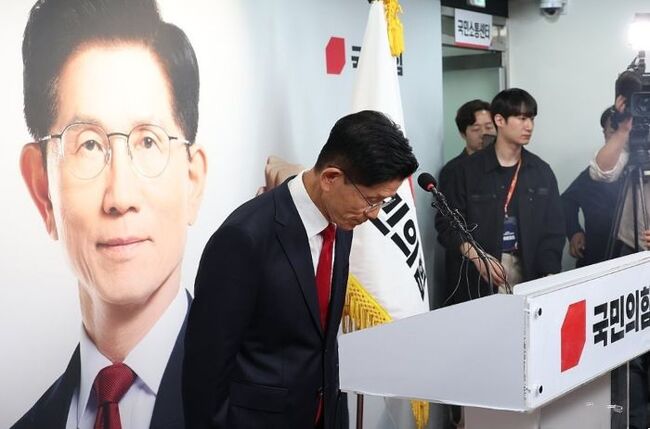 “Too little, too late?…” Kim Moon-soo, who previously conceded his presidential election defeat, now demands a special counsel investigation into ‘allegations of election fraud in the 2025 presidential election’
People Power Party presidential candidate Kim Moon-soo concedes defeat during a press conference at the party headquarters in Yeouido, Seoul, on June 4, 2025. [Joint Press Corps]As allegations emerge
“Too little, too late?…” Kim Moon-soo, who previously conceded his presidential election defeat, now demands a special counsel investigation into ‘allegations of election fraud in the 2025 presidential election’
People Power Party presidential candidate Kim Moon-soo concedes defeat during a press conference at the party headquarters in Yeouido, Seoul, on June 4, 2025. [Joint Press Corps]As allegations emerge
 Stock Market Crash 'Black Tuesday'… KOSPI down 10.8%, KOSDAQ down 7.7%
The KOSPI fell by more than 5% in early trading on the 28th, triggering a sell-side sidecar.On the 28th, the KOSPI plunged by more than 10%.Due to the sharp decline, a sell-side sidecar—a temporary
Stock Market Crash 'Black Tuesday'… KOSPI down 10.8%, KOSDAQ down 7.7%
The KOSPI fell by more than 5% in early trading on the 28th, triggering a sell-side sidecar.On the 28th, the KOSPI plunged by more than 10%.Due to the sharp decline, a sell-side sidecar—a temporary
 [World Heritage Committee] 25 New World Heritage Sites Inscribed in Busan… South Korea Successfully Expands 'Getbol' Listing
The Chairperson of the World Heritage Committee speaks at the plenary session of the 48th session of the World Heritage Committee, held at BEXCO in Busan on the 20th. [Photo: Yonhap News]A total of 25
[World Heritage Committee] 25 New World Heritage Sites Inscribed in Busan… South Korea Successfully Expands 'Getbol' Listing
The Chairperson of the World Heritage Committee speaks at the plenary session of the 48th session of the World Heritage Committee, held at BEXCO in Busan on the 20th. [Photo: Yonhap News]A total of 25
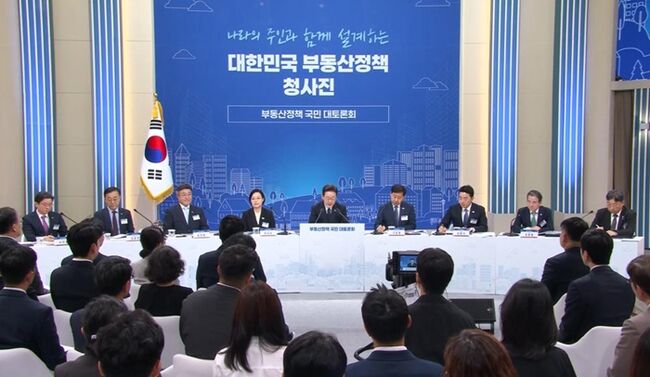 [Liberal Democratic Party Statement] Calling it a Grand Real Estate Debate… It Was Nothing More Than a Private Party Among Themselves
The 'National Grand Debate on Real Estate Policy' held on July 23rd and 27th. [Photo=Yonhap News]The 'National Grand Debate on Real Estate Policy,' hosted by the Lee Jae-myung administration under the
[Liberal Democratic Party Statement] Calling it a Grand Real Estate Debate… It Was Nothing More Than a Private Party Among Themselves
The 'National Grand Debate on Real Estate Policy' held on July 23rd and 27th. [Photo=Yonhap News]The 'National Grand Debate on Real Estate Policy,' hosted by the Lee Jae-myung administration under the
 [Photo] Evidence of Election Fraud Flooding U.S. Media… Trump Had 2.7 Million Votes Stolen
 [Video] U.S. Semiquincentennial Air Show... 'Art in the Sky' streaks across New York
 [Editorial Cartoon] A Draconian Law That Undermines Freedom of Expression

 List
List