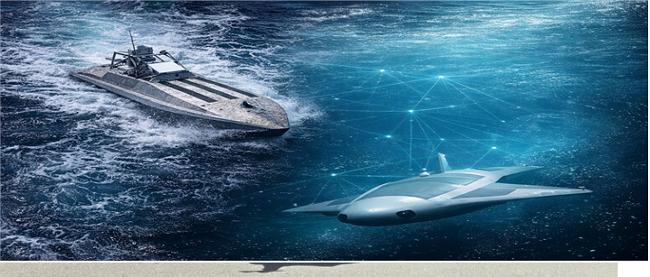
The order of warfare is changing. Once, symbols of military might were faster fighter jets, longer-range missiles, and more expensive warships.
However, recently on the battlefield, the ability to deploy a large number of expendable unmanned systems and link them into a single network has become more important than preserving a few expensive platforms for a long time. The U.S. Department of Defense's announcement of its Replicator initiative to rapidly field a large number of autonomous systems across multiple domains reflects this shift.
The core concept is "precise mass production." This means not just building many weapons, but rapidly deploying the right quantities to the right places to saturate the battlefield.
The "numbers" referred to here are not simply about launching more drones. The key is to break down the battlefield into numerous nodes. A node is an individual unit within a network.
A single unmanned aerial vehicle, an unmanned surface vessel, or a single underwater sensor can all be nodes. Some nodes will detect, some will relay information, some will bridge communication gaps, and some will deliver the final strike.
Recent analyses suggest that a large number of low-cost unmanned systems are as effective at exhausting an adversary's air defenses and expending expensive interceptors as they are at direct destruction. Numbers become a tool for cost pressure and fatigue of defensive systems.
However, numbers alone will not change warfare. If unmanned systems are dispersed and operate independently, they are merely targets. Therefore, what is more important is the "network." A network refers to the structure that links each unmanned system into a single, distributed surveillance and strike grid.
A distributed structure where the remaining systems continue the mission even if some nodes are destroyed becomes the core of future battlefields.
This is why the U.S. Defense Advanced Research Projects Agency (DARPA) is pursuing adaptive communication systems through its Communications-at-the-Edge (C2E) program. This program focuses on enabling multiple systems to connect with each other even amidst jamming and communication disruptions.
The first technology supporting this operational principle is low-cost, mass-producible platforms.
In unmanned warfare, quantity and replaceability are more important than the perfection of a single unit. The term often used here is "expendable autonomous systems." This refers to autonomous unmanned systems that can be deployed in large numbers at a relatively low cost, so that the loss of one unit does not jeopardize the entire operation.
The value of unmanned systems is likely to shift from "how expensive they are" to "how quickly and in what quantities they can be produced."
The second technology is sensor fusion.
Sensor fusion is a technology that combines different sensing modalities such as cameras, infrared, radar, electronic signals, and acoustic sensors to more accurately identify targets. Simply observing a lot is not enough.
What is observed must be quickly distinguished, and real targets must be differentiated from decoys. DARPA's Targeting Recognition and Adaptation (TRACE) program also targets this point, aiming for a system that can recognize targets in real-time with low power consumption even in a jammed environment.
The third technology is a mesh network, which refers to a resilient communication structure.
A mesh network is a communication structure where each unmanned system does not rely on a single central communication network but connects with each other like relays, creating alternative paths. Its advantage is that the entire network does not collapse even if some connections are lost.
Since jamming and satellite link disruptions are common on the battlefield, the survivability of future unmanned battlefields depends on the resilience of connections rather than the speed of platforms.
The fourth technology is autonomous navigation that can operate without Global Positioning System (GPS).
Autonomous navigation refers to the ability to estimate one's position and maintain a course even when external position signals are unstable or lost. Unmanned aerial vehicles must be able to fly without GPS, unmanned surface vessels must maintain their course even when satellite signals weaken, and unmanned underwater vehicles must operate in environments where GPS signals are inaccessible from the outset.
DARPA's Positioning, Navigation, and Timing in Contested Environments (STOIC) program assumes such scenarios. The survivability of future unmanned systems will depend on their ability to stay on course as much as their ability to observe.
The fifth technology is cooperative autonomy.
Cooperative autonomy refers to the ability of multiple unmanned systems to divide roles and work together to accomplish a single mission.
What is important now is not how smart a single unit is, but whether multiple units can divide roles and operate as a single combat system. For example, some drones might be responsible for reconnaissance, others for relaying communications, and yet others for striking.
Once this structure is established, humans will focus on mission priorities and approvals rather than manually controlling each individual platform.
This trend is also evident in actual battlefields.
Reports of the U.S. deploying Global Autonomous Reconnaissance Craft (GARC) in an operation against Iran indicate that unmanned surface vessels are no longer in the testing phase but have entered actual conflict zones. GARC is a type of unmanned high-speed surface vessel that performs surveillance and reconnaissance missions without a human crew.
Recently, the operation of drones with improved anti-jamming capabilities and navigation performance has also been discussed. Anti-jamming refers to the ability to withstand enemy electronic jamming. This demonstrates the simultaneous advancement of anti-jamming and autonomous navigation in the air, and long-endurance unmanned operation and distributed sensing at sea.
The future direction is relatively clear. Unmanned aerial vehicles are likely to evolve towards being cheaper and mass-produced. Unmanned surface vessels will be used for coastal surveillance, reconnaissance, deception, and kamikaze attacks. Unmanned underwater vehicles will likely focus on stealth, long endurance, and low power consumption.
And these three domains are unlikely to develop in isolation but are likely to become increasingly integrated into a single network.
When unmanned systems in the air, on the sea, and underwater share information and divide roles, the very concept of the battlefield changes.
Ultimately, the essence of future weapons is not a single, stronger unit. A structure that links hundreds of cheaper nodes into an unbroken network, allowing the entire mission to continue even if some units are lost, is approaching the standard for future battlefields.
The heart of the unmanned battlefield is not the platform, but the structure. And that structure is called numbers and networks.

 [Statement by the Seobeokka KMA Patriots Association] ㉛ Recount the ballots openly, as the previous recount covered up election fraud
Recount of the Tongyeong mayoral election [Photo=Yonhap News]South Korea's liberal democracy is dying. The National Election Commission (NEC), which has degraded into a criminal organization through t
[Statement by the Seobeokka KMA Patriots Association] ㉛ Recount the ballots openly, as the previous recount covered up election fraud
Recount of the Tongyeong mayoral election [Photo=Yonhap News]South Korea's liberal democracy is dying. The National Election Commission (NEC), which has degraded into a criminal organization through t
 What is the significance of the "Trump 2028" red hat that keeps reappearing?
It is noteworthy that while it is "highly likely" that President Donald Trump is "seriously considering" a run for the presidency in 2028, he is also "deliberately" fueling speculation regarding wheth
What is the significance of the "Trump 2028" red hat that keeps reappearing?
It is noteworthy that while it is "highly likely" that President Donald Trump is "seriously considering" a run for the presidency in 2028, he is also "deliberately" fueling speculation regarding wheth
 First U.S. Ambassador of Trump's Second Term to Arrive This Week… Will It Provide Momentum to Resolve Pending Issues?
U.S. Ambassador to South Korea Michelle Steel speaks at the opening ceremony of the Korea-U.S. Shipbuilding Cooperation Center held at the Mayflower Hotel in Washington, D.C., on the 23rd (local time)
First U.S. Ambassador of Trump's Second Term to Arrive This Week… Will It Provide Momentum to Resolve Pending Issues?
U.S. Ambassador to South Korea Michelle Steel speaks at the opening ceremony of the Korea-U.S. Shipbuilding Cooperation Center held at the Mayflower Hotel in Washington, D.C., on the 23rd (local time)
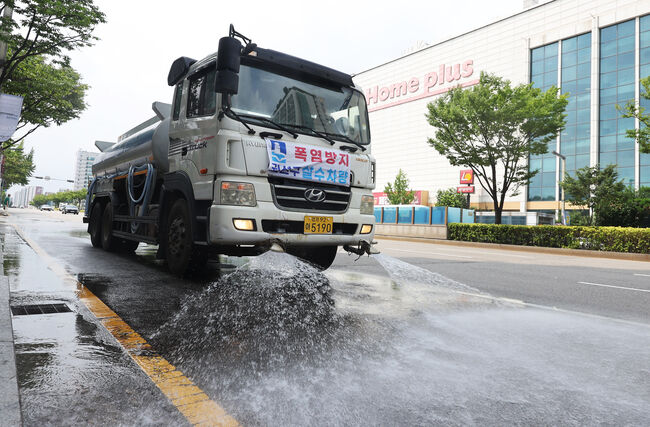 The Korean Peninsula wrapped in a thick blanket of scorching high pressure… Will the 1994 record be broken?
On the 28th, as the heatwave continues, a water sprinkler truck sprays water on Hyowon-ro, Gwonseon-gu, Suwon, Gyeonggi Province. [Photo = Yonhap News]The hottest years on record are considered to be
The Korean Peninsula wrapped in a thick blanket of scorching high pressure… Will the 1994 record be broken?
On the 28th, as the heatwave continues, a water sprinkler truck sprays water on Hyowon-ro, Gwonseon-gu, Suwon, Gyeonggi Province. [Photo = Yonhap News]The hottest years on record are considered to be
 Stock Market Crash 'Black Tuesday'… KOSPI down 10.8%, KOSDAQ down 7.7%
The KOSPI fell by more than 5% in early trading on the 28th, triggering a sell-side sidecar.On the 28th, the KOSPI plunged by more than 10%.Due to the sharp decline, a sell-side sidecar—a temporary
Stock Market Crash 'Black Tuesday'… KOSPI down 10.8%, KOSDAQ down 7.7%
The KOSPI fell by more than 5% in early trading on the 28th, triggering a sell-side sidecar.On the 28th, the KOSPI plunged by more than 10%.Due to the sharp decline, a sell-side sidecar—a temporary
 [World Heritage Committee] 25 New World Heritage Sites Inscribed in Busan… South Korea Successfully Expands 'Getbol' Listing
The Chairperson of the World Heritage Committee speaks at the plenary session of the 48th session of the World Heritage Committee, held at BEXCO in Busan on the 20th. [Photo: Yonhap News]A total of 25
[World Heritage Committee] 25 New World Heritage Sites Inscribed in Busan… South Korea Successfully Expands 'Getbol' Listing
The Chairperson of the World Heritage Committee speaks at the plenary session of the 48th session of the World Heritage Committee, held at BEXCO in Busan on the 20th. [Photo: Yonhap News]A total of 25
 [Cho Yang-geon Column] The NEC: Facing a Fate of "Discarding the Dog After the Hunt"
Banner calling for the "dissolution of the NEC" posted by the Democratic Party. [AI-generated image]Banners calling for the "dissolution of the National Election Commission (NEC)" posted by the Democr
[Cho Yang-geon Column] The NEC: Facing a Fate of "Discarding the Dog After the Hunt"
Banner calling for the "dissolution of the NEC" posted by the Democratic Party. [AI-generated image]Banners calling for the "dissolution of the National Election Commission (NEC)" posted by the Democr
 [Photo] Evidence of Election Fraud Flooding U.S. Media… Trump Had 2.7 Million Votes Stolen
 [Video] U.S. Semiquincentennial Air Show... 'Art in the Sky' streaks across New York
 [Editorial Cartoon] A Draconian Law That Undermines Freedom of Expression

 List
List