The Samsung Electronics Super Union, which obtained its first majority union status at Samsung Electronics, held a large-scale struggle resolution rally in front of the Pyeongtaek campus on the afternoon of the 23rd. [Photo = Yonhap News]
Did the union not realize that demanding a 15% operating profit performance bonus could lead to legal controversy as a reason for a strike?
Was the counter-rally by approximately 20 minority shareholders at the union rally site merely a coincidence?
Were the subsequent remarks by Industry, Trade and Energy Minister Kim Jeong-kwan just a general expression of concern from the minister in charge of industry?
This Samsung Electronics strike scenario begins with these three questions.
This Samsung Electronics strike scenario begins with these three questions.
|
On the surface, there are performance bonus negotiations. However, as the dates unfold, the scene becomes much clearer.
On April 23rd, the Samsung Electronics union held a large-scale rally in front of the Samsung Electronics Pyeongtaek Campus in Pyeongtaek, Gyeonggi Province, and fully pushed for the abolition of the performance bonus ceiling and the distribution of 15% of operating profit as performance bonus resources.
On the same day, a counter-rally by minority shareholders was also held near the site. Regarding the minority shareholder rally, the union's rebuttal states it was an "ad hoc organization with about 10 participants on site."
While the scale was not large, around 20 people according to media reports, its symbolism was significant.
The moment the union framed "operating profit as employee performance," shareholders essentially raised an opposing frame on the streets: "That profit is connected to shareholder value, future investment funds, and the National Pension Service."
Four days later, on April 27th, Industry, Trade and Energy Minister Kim Jeong-kwan made his remarks.
Minister Kim stated, "Samsung Electronics' achievements are linked to its partner companies, over 4 million minority shareholders, and the National Pension Service," adding, "We need to consider whether the current profits are issues that can be shared solely among the company's internal members."
These remarks elevated the Samsung Electronics labor-management conflict from a performance bonus dispute within a private company to a national industrial risk.
Samsung Electronics is not a public enterprise. It is a private company owned by private shareholders, with its board of directors responsible for management. Therefore, the Samsung Electronics labor-management conflict, in principle, falls within the realm of autonomous negotiation between the company and the labor union.
However, given that semiconductors are a national strategic industry and Samsung Electronics' investment decisions impact partner companies, the National Pension Service, minority shareholders, and the entire Korean stock market, it is true that it is difficult for the government to view this issue solely as an internal dispute of a private company.
The union's demand for 15% of operating profit was effective in raising the negotiation baseline. "15% of operating profit" is much clearer and more conducive to member mobilization than "improvement of the performance bonus calculation formula."
However, this demand also carries legal vulnerabilities, it is pointed out.
While improving the performance bonus system can be linked to wages and working conditions, the demand to allocate a certain percentage of the company's operating profit to current employees can conflict with the areas of profit distribution, future investment funds, shareholder value, and board of directors' decisions.
This is why the management side views it as an "excessive demand that cannot be a target for a strike."
In this regard, Choi Seung-ho, Chairman of the Samsung Electronics Branch of the Super Union, stated in a phone call with Hanmi Daily, "You might see it that way based on media reports, but from what I've heard from the mediation committee members involved in the negotiations, I understand there are no legal issues."
The issue is not whether performance bonuses can be demanded. The core issue is whether the demand to distribute a certain percentage of operating profit to current employees can be enforced through a strike.
The moment this line is crossed, performance bonus negotiations can move beyond the realm of labor disputes and escalate into legal conflicts over management rights, shareholder rights, and future investment funds.
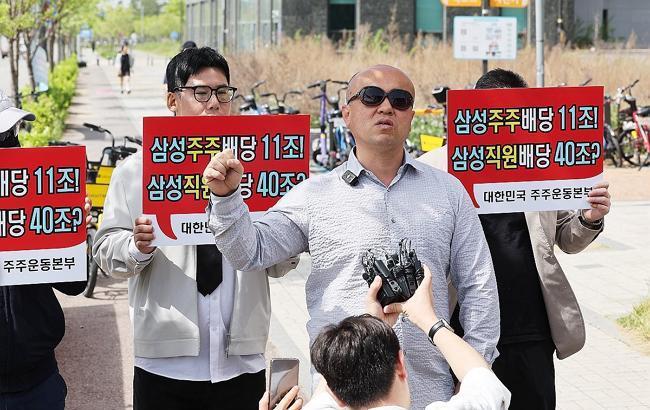 On April 23rd, officials from the Shareholders' Movement Headquarters of Korea opposing the union's rally near the Samsung Electronics Pyeongtaek Campus in Pyeongtaek City. They had reported to the police that they would hold a rally in front of Chairman Lee's residence in Hannam-dong, Yongsan-gu, Seoul, from 10:00 AM to 11:30 AM on May 21st. [Photo = Yonhap News]
So, why did the union present this card?
It's hard to believe they didn't know. A 15% operating profit demand is less of a realistic agreement and more of a maximum demand to inflate the negotiation table.
Through this demand, the union is pressuring the management and bringing Samsung Electronics' profit distribution structure into the social agenda. The problem is that the front has become too wide.
Expansion of the Front… ‘Intentional or Coincidental?’
Initially, it was an issue between the union and management. However, shareholders appeared, the National Pension Service and partner companies were mentioned, and the government framed it as an industrial risk.
The union gained negotiation power, but simultaneously expanded the opponent from Samsung Electronics management to shareholders, the government, the National Pension Service, and the entire cooperative ecosystem.
Adding to this is a crucial schedule overlap.
The total strike Samsung Electronics' union has announced is from May 21st to June 7th.
However, May 21st is the official start date for the election campaign of the 9th National Simultaneous Local Elections, May 29th-30th are early voting days, and June 3rd is the main election day. The period of the strike announcement essentially overlaps with the entire key schedule of the local elections.
In response, Chairman Choi stated firmly, "Our decision to strike has nothing to do with the political schedule." This can be interpreted as meaning that if there is no progress in negotiations, the strike will proceed as planned.
However, this schedule narrows the government's options.
If a total strike at Samsung Electronics materializes during the official election campaign period for the local elections, the election landscape could be shaken beyond labor issues to include semiconductor competitiveness, shareholder rights, the National Pension Service, and the survival of partner companies.
For the ruling party, the image of directly suppressing the union is burdensome, but the image of ignoring 4 million minority shareholders, the National Pension Service, and the semiconductor ecosystem is even more so.
Therefore, the most natural scenario is not a full-scale confrontation but a dramatic compromise.
Background Appearing as a Scenario
• The union raises the negotiation price by presenting a maximum demand of 15% of operating profit.
• Management establishes a legal defense line.
• Shareholders raise issues regarding damage to shareholder value.
• The government positions itself as a mediator under the guise of managing national industrial risks.
If this flow is managed well, each party has something to gain.
• The Lee Jae-myung administration can claim credit for managing a crisis in a critical national industry ahead of the local elections.
• Chairman Lee Jae-yong of Samsung Electronics and minority shareholders gain the justification of having protected future investment funds and shareholder value.
• The union can secure the tangible benefit of achieving the highest performance bonus and system improvements in history after increasing the pressure until just before the total strike.
Although they appear to be in conflict, the outcome is a structure where each can claim victory.
"The greater the crisis, the brighter the achievement of crisis management."
Power often falls prey to this temptation.
However, this does not mean we can conclude that the government is behind the announced Samsung Electronics strike and orchestrated this scenario. Such claims have not been confirmed by facts.
However, the flow so far gives a strange sense of déjà vu.
This is because the union's maximum demand, the minority shareholders' counter-rally, the Minister of Industry's remarks, and the local election schedule are all fitting together too precisely within a single scene.
What to Watch
Ultimately, the point of observation is not whether the strike actually occurs. It is about who emerges as a mediator just before the strike, who creates the justification for concessions, and who reaps the rewards of crisis management.
The Samsung Electronics strike announcement has already transcended labor-management conflict to become a political and industrial drama on the eve of the local elections.
The strike appears to be less of a means to go all the way to the end and more of a leverage to increase the price of compromise.
A scenario can be created where the government intervenes seemingly without intervening, management concedes as if not yielding, and the union compromises as if not backing down.
Therefore, this Samsung Electronics strike announcement looks like a well-written script.
Whether the actual outcome will be a total strike or a dramatic compromise cannot be definitively stated yet. However, based on the flow so far, the stage has already been set, and the characters are finding their roles.

 [Statement by the Seobeokka KMA Patriots Association] ㉛ Recount the ballots openly, as the previous recount covered up election fraud
Recount of the Tongyeong mayoral election [Photo=Yonhap News]South Korea's liberal democracy is dying. The National Election Commission (NEC), which has degraded into a criminal organization through t
[Statement by the Seobeokka KMA Patriots Association] ㉛ Recount the ballots openly, as the previous recount covered up election fraud
Recount of the Tongyeong mayoral election [Photo=Yonhap News]South Korea's liberal democracy is dying. The National Election Commission (NEC), which has degraded into a criminal organization through t
 What is the significance of the "Trump 2028" red hat that keeps reappearing?
It is noteworthy that while it is "highly likely" that President Donald Trump is "seriously considering" a run for the presidency in 2028, he is also "deliberately" fueling speculation regarding wheth
What is the significance of the "Trump 2028" red hat that keeps reappearing?
It is noteworthy that while it is "highly likely" that President Donald Trump is "seriously considering" a run for the presidency in 2028, he is also "deliberately" fueling speculation regarding wheth
 First U.S. Ambassador of Trump's Second Term to Arrive This Week… Will It Provide Momentum to Resolve Pending Issues?
U.S. Ambassador to South Korea Michelle Steel speaks at the opening ceremony of the Korea-U.S. Shipbuilding Cooperation Center held at the Mayflower Hotel in Washington, D.C., on the 23rd (local time)
First U.S. Ambassador of Trump's Second Term to Arrive This Week… Will It Provide Momentum to Resolve Pending Issues?
U.S. Ambassador to South Korea Michelle Steel speaks at the opening ceremony of the Korea-U.S. Shipbuilding Cooperation Center held at the Mayflower Hotel in Washington, D.C., on the 23rd (local time)
 The Korean Peninsula wrapped in a thick blanket of scorching high pressure… Will the 1994 record be broken?
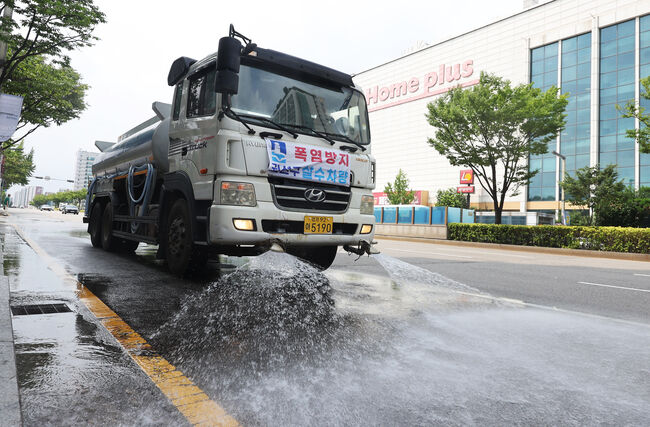
On the 28th, as the heatwave continues, a water sprinkler truck sprays water on Hyowon-ro, Gwonseon-gu, Suwon, Gyeonggi Province. [Photo = Yonhap News]The hottest years on record are considered to be
The Korean Peninsula wrapped in a thick blanket of scorching high pressure… Will the 1994 record be broken?
On the 28th, as the heatwave continues, a water sprinkler truck sprays water on Hyowon-ro, Gwonseon-gu, Suwon, Gyeonggi Province. [Photo = Yonhap News]The hottest years on record are considered to be
 Stock Market Crash 'Black Tuesday'… KOSPI down 10.8%, KOSDAQ down 7.7%
The KOSPI fell by more than 5% in early trading on the 28th, triggering a sell-side sidecar.On the 28th, the KOSPI plunged by more than 10%.Due to the sharp decline, a sell-side sidecar—a temporary
Stock Market Crash 'Black Tuesday'… KOSPI down 10.8%, KOSDAQ down 7.7%
The KOSPI fell by more than 5% in early trading on the 28th, triggering a sell-side sidecar.On the 28th, the KOSPI plunged by more than 10%.Due to the sharp decline, a sell-side sidecar—a temporary
 [World Heritage Committee] 25 New World Heritage Sites Inscribed in Busan… South Korea Successfully Expands 'Getbol' Listing
The Chairperson of the World Heritage Committee speaks at the plenary session of the 48th session of the World Heritage Committee, held at BEXCO in Busan on the 20th. [Photo: Yonhap News]A total of 25
[World Heritage Committee] 25 New World Heritage Sites Inscribed in Busan… South Korea Successfully Expands 'Getbol' Listing
The Chairperson of the World Heritage Committee speaks at the plenary session of the 48th session of the World Heritage Committee, held at BEXCO in Busan on the 20th. [Photo: Yonhap News]A total of 25
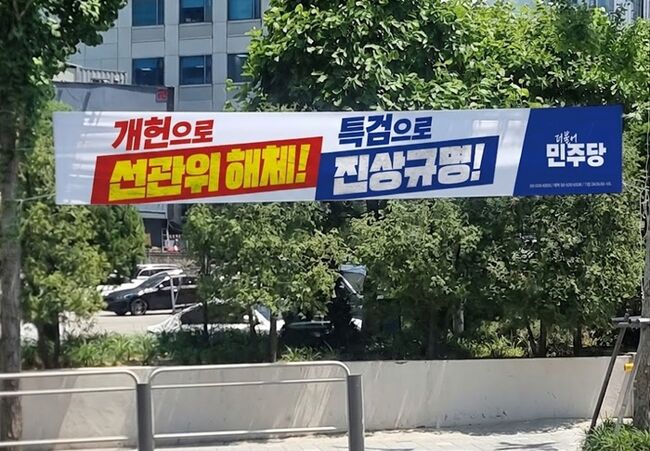 [Cho Yang-geon Column] The NEC: Facing a Fate of "Discarding the Dog After the Hunt"
Banner calling for the "dissolution of the NEC" posted by the Democratic Party. [AI-generated image]Banners calling for the "dissolution of the National Election Commission (NEC)" posted by the Democr
[Cho Yang-geon Column] The NEC: Facing a Fate of "Discarding the Dog After the Hunt"
Banner calling for the "dissolution of the NEC" posted by the Democratic Party. [AI-generated image]Banners calling for the "dissolution of the National Election Commission (NEC)" posted by the Democr
 [Photo] Evidence of Election Fraud Flooding U.S. Media… Trump Had 2.7 Million Votes Stolen
 [Video] U.S. Semiquincentennial Air Show... 'Art in the Sky' streaks across New York
 [Editorial Cartoon] A Draconian Law That Undermines Freedom of Expression

 List
List