Kim Jong-tae (left) and Lee Moon-kyu, who were sentenced to death in 1970 for the Revolutionary Party for National Unification incident.
The trial of the Revolutionary Party for National Unification (Tonghyokdang), which spanned from 1968 to 1971, holds a significant place in modern Korean political history. Based solely on court records, it appears to be a case of an anti-state organization. However, in the memory of the pro-democracy movement, it was later reframed as an incident of suppression of democracy. The same event acquired a different name.
It is precisely at this point that an old survival strategy of the Korean left becomes clearly evident: reducing organizational responsibility, altering the nature of the trial, and reversing the meaning of the verdict. The Tonghyokdang trial was the first instance where this technique was truly applied.
The Revolutionary Party for National Unification, or Tonghyokdang for short, was a secret underground organization formed in the mid-1960s. According to the Korean Central Intelligence Agency's (KCIA) announcement, Tonghyokdang began recruiting members around 1964 in cities such as Seoul, Daegu, Jeonju, and Gwangju. The person identified as the leader was Kim Jong-tae.
Kim Jong-tae, from Yeongcheon, Gyeongsangbuk-do, is listed in the investigation records as the key figure responsible for organizing the political line of the group and consolidating its lower-level networks. Among those indicted alongside Kim Jong-tae as core members of Tonghyokdang were Kim Jil-rak, Lee Moon-kyu, Lee Gwan-hak, Shin Young-bok, and Park Sung-joon. These are names that would later be repeatedly invoked by student activists and civil society groups.
On August 24, 1968, the KCIA officially announced the discovery of the Tonghyokdang incident. The announcement stated that 158 people were apprehended, 98 were booked, and 73 were indicted. By the standards of the time, this was a considerable scale. The KCIA announced that this organization aimed to establish an underground revolutionary party within South Korea in line with the North Korean Workers' Party's United Front Department's directives.
The investigators explained that they were attempting to penetrate student circles and labor sites, produce anti-government propaganda, and escalate social unrest to build a foundation for regime subversion. The government at the time characterized this incident as a "North Korean-linked underground party case."
The year 1968, when this incident occurred, was no ordinary year. On January 21, 31 armed North Korean commandos belonging to Unit 124 attempted to infiltrate the Blue House. Just two days later, on January 23, the U.S. Navy intelligence ship Pueblo was captured by North Korea. In October, 120 armed North Korean commandos infiltrated Uljin and Samcheok.
There were three major North Korean armed provocations within a single year. This explains why South Korean society was so sensitive to North Korea-related incidents at the time. While criticism that the Tonghyokdang investigation was excessive is certainly possible, the reason this incident was treated so significantly cannot be explained without considering the security environment of the time.
The prosecution applied charges of violating the National Security Act, Anti-Communist Act, and conspiracy to commit rebellion against key defendants like Kim Jong-tae. The prosecution's logic was that Tonghyokdang was not a social gathering but a political organization, and not a forum for ideological discussion but an organization for action.
The prosecution asserted, based on confiscated documents, organizational charts, and statements, that "they did not just think about it; they actually acted." The logic was that recruiting students, producing anti-government documents, and spreading North Korean revolutionary ideology within the organization were acts of execution, not mere expressions.
The defendants presented a different argument. While they did say, "We are not spies," their more prominent slogan was, "This trial is a political trial." This is where the nature of the Tonghyokdang trial began to shift. The prosecution argued for the existence of an organization, while the defendants invoked the regime.
The prosecution presented documents, and the defense spoke of torture and coercive investigations. The prosecution explained the organizational structure, and the defense brought up the dictatorship of the Park Chung-hee regime. The focus of the courtroom shifted from the defendants' actions to the nature of the regime.
This shift was very important. This is because people tend to remember simple slogans more quickly than complex indictments. "Violation of the National Security Act" is long and difficult. "Political trial" is short and powerful. "Anti-state organization" requires explanation. "Suppression by dictatorship" is immediately understandable. The Tonghyokdang defendants seized precisely this language. They created a narrative that was not legally advantageous but did not lose in public opinion.
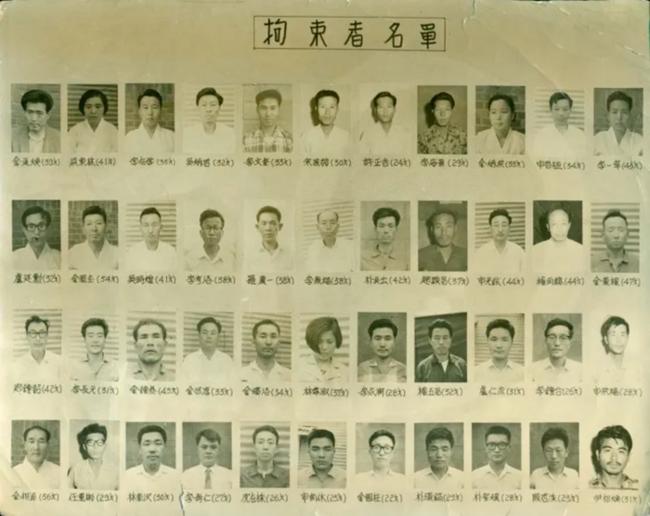 List of Revolutionary Party for National Unification members announced by the KCIA.
In 1970, the first-instance verdict was delivered. Kim Jong-tae, Kim Jil-rak, and Lee Moon-kyu were sentenced to death. In 1971, the Supreme Court upheld the guilty verdicts for the key defendants. And on July 10, 1971, the death sentences for Kim Jong-tae, Kim Jil-rak, and Lee Moon-kyu were carried out. The government announced them as "leaders of an anti-state organization that attempted to subvert the nation." These numbers and names were clearly published in the newspapers at the time.
However, as time passed, what remained in people's memories was not the verdict. What remained were different words. Kim Jong-tae began to be referred to not as a death-row inmate but as "a victim of the dictatorial regime." Some of the individuals involved with Tonghyokdang were reintroduced as "pro-democracy figures" and "political prisoners." The epithets given by the pro-democracy movement spread more widely than the charges the court imposed.
Here, the Korean left learned an important technique: the calculation that one can win politically even if found guilty. It is not necessary to win in court. It is acceptable to go to jail. Instead, one must first seize the narrative that will remain in society. This involves transforming "spy" into "unification activist," "anti-state activities" into "pro-democracy movement," and "guilty verdict" into "record of suppression by dictatorship." It is a method of not erasing facts, but of overlaying different names upon them.
This technique also changed the meaning of prison. Originally, prison is a place for those who have been punished. However, in the world of the pro-democracy movement after Tonghyokdang, prison began to be seen as a political credential.
The number of years served, the case for which one was imprisoned, and the individuals with whom one was incarcerated became part of one's resume. Imprisonment became an experience, not a stigma. This is why those involved in Tonghyokdang were referred to as "seniors who have been to prison" among student activists and civil society groups after their release.
Despite the clear records of 158 apprehended in 1968, 73 indicted, 3 death sentences, and numerous heavy sentences, in the leaflets of university campuses and writings from civil society in the late 1970s, this incident was more frequently referred to as a "case of suppression of pro-democracy figures" than as a "North Korean-linked underground organization case." The records remained the same, but the explanation changed. The discourse used to interpret the event, rather than the content of the event itself, had changed.
This approach did not end with Tonghyokdang. The same grammar was repeated in the 1974 Revolutionary Group for the Reconstruction of the People, the 1979 South Korean People's Liberation Front (Namminjeon) incident, and the 1981 Burim incident. It is a method that prioritizes torture over charges, suppression over organization, prison over verdict, and victimhood over guilt. The Tonghyokdang trial served as its first textbook.
The core of the Tonghyokdang trial is not the verdict itself. More important is the new explanation attached to it. Tonghyokdang was found guilty by the court. However, the pro-democracy movement did not let that guilt translate into defeat. Instead, they transformed it into a credential. It was here that they first truly learned the method of making prison a badge of honor, turning a verdict into a resume, and covering up responsibility with the term "political trial." This method, which began in the Seoul courtroom in 1968, later became an established technique that drove the entire Korean pro-democracy movement.
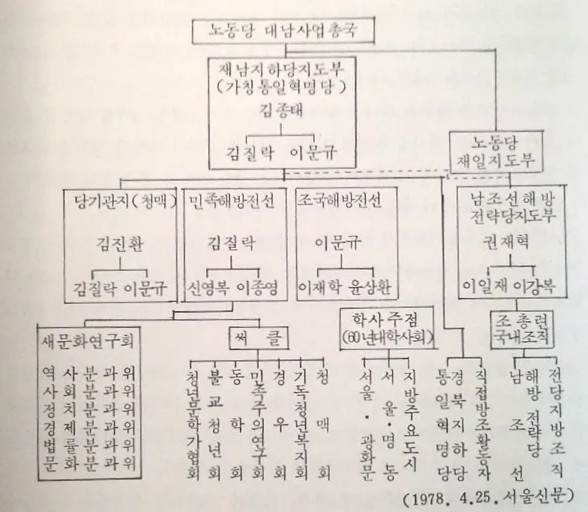 Organizational chart of the Revolutionary Party for National Unification announced by the KCIA.
◆ Songsan
Poet and researcher of history and philosophy. Former director of the Rhee Syngman Institute. Currently serves as a research advisor for the Korean Modern and Contemporary History Research Association and as the representative of the philosophy forum Lyceum. He has published four poetry collections, co-translated "Heroes of Hukou," and published "Joseon that Became Myth" and "Humanities on Tatami." He is currently actively engaged in the research and practice of liberal cultural movements. Songsan is a pen name.

 Iranian Foreign Ministry: "Continuing Message Exchanges with the U.S. and Activities of Mediating Countries"
Esmaeil Baghaei, Spokesperson for the Iranian Ministry of Foreign Affairs [Xinhua, Yonhap News file photo]Esmaeil Baghaei, spokesperson for the Iranian Ministry of Foreign Affairs, stated on the 26th
Iranian Foreign Ministry: "Continuing Message Exchanges with the U.S. and Activities of Mediating Countries"
Esmaeil Baghaei, Spokesperson for the Iranian Ministry of Foreign Affairs [Xinhua, Yonhap News file photo]Esmaeil Baghaei, spokesperson for the Iranian Ministry of Foreign Affairs, stated on the 26th
 President Yoon: "Do You Think You Are Safe from the Special Counsel?"... Final Statement Video Released
President Yoon Suk Yeol rebuking the special prosecutor on the 24th. [Court video / @birds_justice X account subtitle GIF] A video of President Yoon Suk Yeol's closing statement at his trial rega
President Yoon: "Do You Think You Are Safe from the Special Counsel?"... Final Statement Video Released
President Yoon Suk Yeol rebuking the special prosecutor on the 24th. [Court video / @birds_justice X account subtitle GIF] A video of President Yoon Suk Yeol's closing statement at his trial rega
 President Yoon, regarding the first-instance ruling on the Public Official Election Act: “An excessive political verdict that distorts the facts… We will appeal immediately.”
The first-instance sentencing hearing for President Yoon Suk Yeol regarding violations of the Public Official Election Act is being broadcast live at Seoul Station on the 27th. [Photo=Yonhap News]Pres
President Yoon, regarding the first-instance ruling on the Public Official Election Act: “An excessive political verdict that distorts the facts… We will appeal immediately.”
The first-instance sentencing hearing for President Yoon Suk Yeol regarding violations of the Public Official Election Act is being broadcast live at Seoul Station on the 27th. [Photo=Yonhap News]Pres
 WSJ: "SK Hynix ADR Premium Is a Sign of AI Trading Overheat"
Advertisement for SK Hynix ADR listing in New York's Times Square [Reuters=Yonhap News file photo]The Wall Street Journal (WSJ) has pointed out that the price of SK Hynix’s American Depositary Recei
WSJ: "SK Hynix ADR Premium Is a Sign of AI Trading Overheat"
Advertisement for SK Hynix ADR listing in New York's Times Square [Reuters=Yonhap News file photo]The Wall Street Journal (WSJ) has pointed out that the price of SK Hynix’s American Depositary Recei
 'Godfather of Japanese Mystery Novels' Keigo Higashino Passes Away After Battle with Cancer at 68
Famous Japanese mystery novelist Keigo Higashino [AFP=Yonhap News]It has been belatedly reported that Keigo Higashino, the "godfather of Japanese mystery novels" and author of bestsellers such as "The
'Godfather of Japanese Mystery Novels' Keigo Higashino Passes Away After Battle with Cancer at 68
Famous Japanese mystery novelist Keigo Higashino [AFP=Yonhap News]It has been belatedly reported that Keigo Higashino, the "godfather of Japanese mystery novels" and author of bestsellers such as "The
 [Park Pil-kyu Security Column] To the Ignorant Trying to Clothe a Beast in Sheep's Clothing
Rep. Kim Byung-joo of the Democratic Party of Korea [Photo=Yonhap News]“The Air Force Academy doesn't teach you how to fly a plane!” “The Army, Navy, and Air Force academies are exactly the
[Park Pil-kyu Security Column] To the Ignorant Trying to Clothe a Beast in Sheep's Clothing
Rep. Kim Byung-joo of the Democratic Party of Korea [Photo=Yonhap News]“The Air Force Academy doesn't teach you how to fly a plane!” “The Army, Navy, and Air Force academies are exactly the
 [Issue Diagnosis] Two Effects of the Election Petition Review
 [Photo] Evidence of Election Fraud Flooding U.S. Media… Trump Had 2.7 Million Votes Stolen
 [Video] U.S. Semiquincentennial Air Show... 'Art in the Sky' streaks across New York
 [Editorial Cartoon] A Draconian Law That Undermines Freedom of Expression

 List
List