Director Lee Man-hee's film adaptation of 'The Road to Sampo' [Photo = Korean Film Archive]Literature does not teach people like a textbook. It does not directly explain, "This is right," or "That is wrong."
Instead, it tells a story. It introduces characters, makes one cry, and makes another hit. Then, before the reader even thinks, they feel who is good, who is bad, and who to take sides with.
This is literature's most powerful button: 'automatic invocation of justice.' Readers have not yet fully understood. Yet, they have already made a judgment. "That person is pitiful." "That person is wicked." Psychological and emotional judgments come before thought.
'Psychological' and 'Emotional' Judgments Faster Than 'Thought'
This button is pressed very quickly. Literature prevents readers from overthinking. It first moves the heart and makes the reader take a side before they can carefully consider. Thus, literature tames reactions before teaching thought. Readers believe they are making their own judgments, but in many cases, they are simply following the button that the work pressed first.
This power is very evident in Korean novels. Hwang Sok-yong's 'The Road to Sampo' is a clear example. This novel features characters named Yeong-dal, Jeong-ssi, and Baek-hwa.
Yeong-dal and Jeong-ssi, laborers drifting from construction sites, have little. Baek-hwa is a woman who ran away from a bar. These three walk together on a snow-covered road. The story is not long. Yet, the reader quickly takes their side. Why? They are poor, drifting, exhausted, and have nowhere to go.
By initially portraying these three as vulnerable people, the work makes the reader automatically empathize with them. Even when Yeong-dal speaks roughly, the reader understands; even when Jeong-ssi grumbles, the reader feels sorry; when Baek-hwa cries, the reader's heart immediately goes out to her. The reader has already taken their side without fully knowing why these three live such lives.
Conversely, the world that pushes these three away, even without a clear depiction, appears cold and bad. The construction site, the bar owner, the city's order, the world of money – even without detailed explanations, they are read as heartless. The work prioritizes arrangement over explanation. It places the three poor individuals in the foreground and the world that pushed them away in the background. Readers make judgments faster than they think. This is the automatic invocation of justice.
Cho Se-hui's 'The Dwarf Strikes a Small Ball' presses this button even more forcefully. The dwarf father, mother, Yeong-su, Yeong-ho, and Yeong-hee. This family, centered around the short-statured father, endures a life of poverty. Their house is slated for demolition, their neighborhood is displaced, and the family is driven out.
As soon as the reader begins the novel, they take the dwarf family's side. They are poor, small, displaced, and oppressed. Conversely, the redevelopment agents, corporations, systems, and urban powers are almost automatically read as cold and cruel. Here, readers do not learn about complex economic structures.
They do not delve into why redevelopment occurs, why cities expand, or why industrialization was so harsh. The first thought that arises is simply, "That family is pitiful," and "That society is too much." The work aims precisely for this rapid judgment.
The reason this novel is powerful is that it angers the reader before it makes them think. Reading about the dwarf family being evicted, the reader becomes enraged first. Then, they look for the reasons. The order is reversed. Right and wrong are determined first, and explanations are added later. This is the frightening power of literature.
The Schema of the Weak Being Unconditionally a Victim
Lee Mun-yeol's 'Our Twisted Hero' operates in a similar fashion. Upon first reading, most people side with Han Byeong-tae. Han Byeong-tae, a student from Seoul, encounters the class president, Eom Seok-dae, at a rural school. Eom Seok-dae runs the classroom as he pleases. He lines up the students, earns points in front of teachers, and lords over the children.
As soon as readers see Eom Seok-dae, they think, "He's a bad guy." Han Byeong-tae is weak, unfamiliar, and lonely. Therefore, he automatically becomes the victim. Conversely, Eom Seok-dae has power, controls the classroom, and manipulates others. Thus, he automatically becomes the perpetrator.
However, what makes this novel interesting is that it appears slightly different as time passes. Eom Seok-dae is clearly the power holder in the classroom. Yet, the children in the classroom also lived comfortably by relying on Eom Seok-dae. The children were not just oppressed; they also secured their own share within Eom Seok-dae's order.
Here, the reader must reconsider their initial judgment. However, many people do not go that far. They simply conclude, "Eom Seok-dae is a dictator, and Han Byeong-tae is a resistor." Although the work posed complex questions, readers often end up pressing only the quickest moral buttons. This is the problem with rapid judgment. Literature poses deeper questions, but readers take away only the easiest judgments.
Victor Hugo's 'Les Misérables' is also a prime example. Jean Valjean is imprisoned for stealing a loaf of bread. In this opening scene, the reader is already on Jean Valjean's side. A person who stole bread for his hungry nephew. This single setup immediately moves the reader. Conversely, Inspector Javert, who relentlessly pursues Jean Valjean, is read as a cold and frightening person, even though he is a law-abiding officer.
Why is that? Jean Valjean is hungry, and Javert is the pursuer. Readers see hunger before the law. Jean Valjean, despite being a criminal, is seen as pitiful first, while Javert, despite being an agent of authority, is seen as heartless first. The work precisely presses this button.
When this structure is repeated, readers look at positions before looking at people. If someone is poor, they seem inherently good; if someone has power, they are immediately viewed with suspicion. Laborers appear righteous first, and bosses appear bad first. Students are read as victims first, and police officers are read as perpetrators first. What they actually did comes later. Position makes the judgment first.
This point is also well-illustrated in Shin Kyung-sook's 'A Distant Shore.' The story is told through the eyes of a young female factory worker. The reader first sees how young, how lonely, and how exhausted the protagonist is. Then, the factory automatically appears cold, the machines cruel, and the adults indifferent. The reasons why the factory had to operate, or why industry grew so large, are pushed to the background. The reader is first captivated by the girl's fatigue. And then, they read the world only through those eyes.
Good Literature Makes You Question Again
This method makes people move quickly. They cry quickly, get angry quickly, and take sides quickly. That is why it is powerful. However, rapid judgments always miss something. They miss the context and the magnitude of responsibility. Who did what and why. Literature can make readers move first. The problem is that readers who move too quickly do not look beyond that.
Someone who quickly invokes justice appears admirable. They seem like someone who gets angry immediately in the face of injustice. However, the justice button pressed too quickly is often coarse. It easily solidifies into a mindset where the weak are always right, and the strong are always wrong. Then, the ability to understand people diminishes, and only the habit of quickly categorizing people remains.
Literature can make readers deep, or it can make them hasty. Good literature makes you question the initial moral button later. It makes you ask again, "Why did I side with this person?" "Why did I hate that person?" "Perhaps I judged too quickly." Conversely, shallow literature does not waver from the initially pressed button until the end. It keeps the reader angry, keeps them crying, and keeps them looking only at one side.
This is why literature is frightening. People think they finish a book and the story is over. However, what truly remains is the reaction, not the plot. The habit of seeing someone who cries as a victim first, and seeing someone who gives orders as evil first, remains. The book is over, but the button remains. Literature is precisely the art of planting that button.

◆ Songsan
A poet and researcher of history and philosophy. Former director of the Rhee Syngman Institute. Currently serves as an honorary researcher at the Korean Modern and Contemporary History Research Society and as the representative of the philosophy forum Lyceum. He has published four poetry collections, co-translated 'Heroes of the Hook Coast,' and authored the humanities books 'Joseon, the Nation That Became a Myth,' 'Humanities on a Tatami Mat,' and 'A Liberal's Reading of Gramsci.' Songsan is a pen name.

 Trump pressures for rate cut again ahead of FOMC... "Should be the lowest in the world"
U.S. President Donald Trump. [Photo = The White House] U.S. President Donald Trump once again pressured the Federal Reserve, the U.S. central bank, to lower interest rates on the 27th (local time
Trump pressures for rate cut again ahead of FOMC... "Should be the lowest in the world"
U.S. President Donald Trump. [Photo = The White House] U.S. President Donald Trump once again pressured the Federal Reserve, the U.S. central bank, to lower interest rates on the 27th (local time
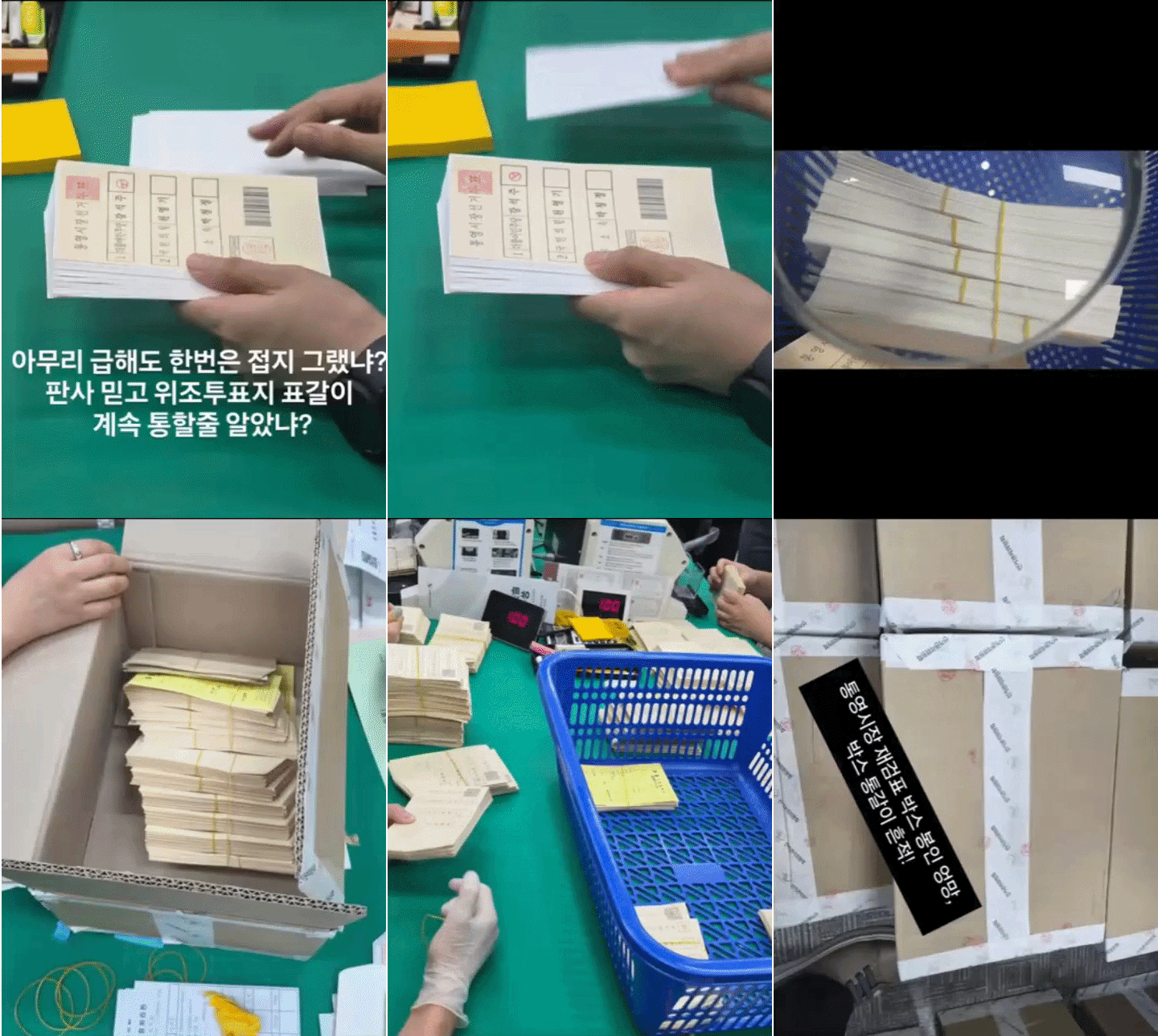 “Ignoring crisp ballots and damaged seals”… Tongyeong mayoral recount concludes with ‘no change in outcome,’ leaving suspicions and public outrage behind
Suspected counterfeit ballots discovered in Tongyeong [GIF from social media of Representative Hwang Kyo-ahn / Attorney Park Joo-hyun]During a recount of the Tongyeong mayoral election in South Gyeong
“Ignoring crisp ballots and damaged seals”… Tongyeong mayoral recount concludes with ‘no change in outcome,’ leaving suspicions and public outrage behind
Suspected counterfeit ballots discovered in Tongyeong [GIF from social media of Representative Hwang Kyo-ahn / Attorney Park Joo-hyun]During a recount of the Tongyeong mayoral election in South Gyeong
 President Yoon, regarding the first-instance ruling on the Public Official Election Act: “An excessive political verdict that distorts the facts… We will appeal immediately.”
The first-instance sentencing hearing for President Yoon Suk Yeol regarding violations of the Public Official Election Act is being broadcast live at Seoul Station on the 27th. [Photo=Yonhap News]Pres
President Yoon, regarding the first-instance ruling on the Public Official Election Act: “An excessive political verdict that distorts the facts… We will appeal immediately.”
The first-instance sentencing hearing for President Yoon Suk Yeol regarding violations of the Public Official Election Act is being broadcast live at Seoul Station on the 27th. [Photo=Yonhap News]Pres
 WSJ: "SK Hynix ADR Premium Is a Sign of AI Trading Overheat"
Advertisement for SK Hynix ADR listing in New York's Times Square [Reuters=Yonhap News file photo]The Wall Street Journal (WSJ) has pointed out that the price of SK Hynix’s American Depositary Recei
WSJ: "SK Hynix ADR Premium Is a Sign of AI Trading Overheat"
Advertisement for SK Hynix ADR listing in New York's Times Square [Reuters=Yonhap News file photo]The Wall Street Journal (WSJ) has pointed out that the price of SK Hynix’s American Depositary Recei
 'Godfather of Japanese Mystery Novels' Keigo Higashino Passes Away After Battle with Cancer at 68
Famous Japanese mystery novelist Keigo Higashino [AFP=Yonhap News]It has been belatedly reported that Keigo Higashino, the "godfather of Japanese mystery novels" and author of bestsellers such as "The
'Godfather of Japanese Mystery Novels' Keigo Higashino Passes Away After Battle with Cancer at 68
Famous Japanese mystery novelist Keigo Higashino [AFP=Yonhap News]It has been belatedly reported that Keigo Higashino, the "godfather of Japanese mystery novels" and author of bestsellers such as "The
 [Park Pil-kyu Security Column] To the Ignorant Trying to Clothe a Beast in Sheep's Clothing
Rep. Kim Byung-joo of the Democratic Party of Korea [Photo=Yonhap News]“The Air Force Academy doesn't teach you how to fly a plane!” “The Army, Navy, and Air Force academies are exactly the
[Park Pil-kyu Security Column] To the Ignorant Trying to Clothe a Beast in Sheep's Clothing
Rep. Kim Byung-joo of the Democratic Party of Korea [Photo=Yonhap News]“The Air Force Academy doesn't teach you how to fly a plane!” “The Army, Navy, and Air Force academies are exactly the
 [Issue Diagnosis] Two Effects of the Election Petition Review
 [Photo] Evidence of Election Fraud Flooding U.S. Media… Trump Had 2.7 Million Votes Stolen
 [Video] U.S. Semiquincentennial Air Show... 'Art in the Sky' streaks across New York
 [Editorial Cartoon] A Draconian Law That Undermines Freedom of Expression

 List
List