K-6 heavy machine gun. [Photo=Yonhap News material]The economy as felt by the public is moving in the exact opposite direction of the government's explanations. In June, consumer prices rose by 3.2% compared to the same month last year, and the cost of living index increased by 3.4%. Seoul apartment prices have risen for 76 consecutive weeks, and the KOSPI plummeted by 16.17% over two days on July 28 and 29.
Prices for daily necessities are soaring, the dream of homeownership is becoming more distant, and the financial assets of the public have collapsed.
It is not that the Lee Jae-myung administration has failed to put forward countermeasures. It has announced a series of policies for price stabilization, real estate regulation, and the stock market. However, what the public is asking for is not the number of press releases. They are asking what was predicted, what was prevented, and who took responsibility when the results were poor.
Blaming international oil prices, overseas interest rates, the previous administration, and market overheating might serve as an explanation for the causes, but it cannot be considered a achievement of state administration. Taking office is not about gaining the right to make excuses, but about assuming the obligation to take responsibility for results.
In terms of national security, even more baffling events have occurred. A plan to replace the firearms of sentries in frontline units with non-lethal equipment such as batons was pushed forward, only to be retracted following public controversy.
It was also revealed that at GP/GOP units under the Army's 1st Corps, sentries had been performing guard duties with K6 heavy machine guns that were not loaded with live ammunition, with the ammo boxes kept to the side. The Joint Chiefs of Staff could not even properly identify by whose decision such guidelines were issued.
Yet, such an administration speaks of self-reliant national defense. The number of field maneuvers during this year's combined ROK-U.S. exercises has been significantly reduced. The government explains that it has merely distributed the training throughout the year. If that is the case, it should disclose whether the personnel, equipment, duration, and intensity of the overall training have truly been maintained.
If field exercises were reduced to avoid provoking North Korea, this is not a military decision, but a political one.
The transition of wartime operational control (OPCON) does not in itself mean the dissolution of the ROK-U.S. alliance. However, the situation changes if the government prioritizes its own political timetable over military conditions and rushes the transition while weakening the substance of combined exercises and the combined command structure.
North Korea is strengthening its military cooperation with China and Russia while maintaining its nuclear weapons. Reducing South Korea’s training and the alliance’s deterrence when the threats from North Korea, China, and Russia remain unchanged is not self-reliant national defense. It is a path toward abandoning the risks previously shared by the alliance onto the South Korean public alone and inviting strategic isolation.
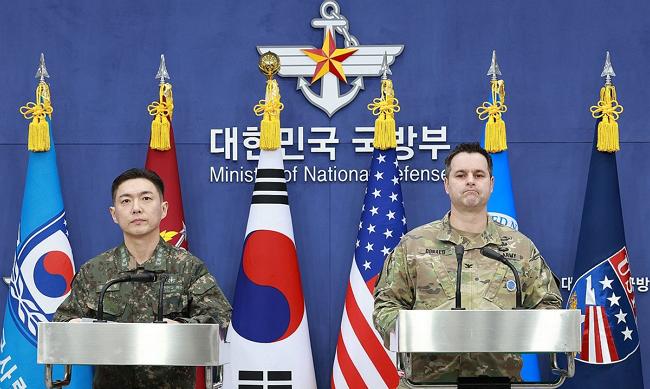 Jang Do-young, spokesperson for the Joint Chiefs of Staff, and Ryan Donald, spokesperson for the U.S. Forces Korea, hold a joint briefing on the 2026 Freedom Shield (FS) exercise plan at the Ministry of National Defense in Yongsan-gu, Seoul, on the 25th. 2026.2.25 [Photo=Yonhap News]
The claim that "peace is the economy" also reads reality backwards.
Replacing the Armistice Agreement with a peace treaty does not automatically lower prices, stabilize housing costs, or keep factories running. Economic risks are reduced only when North Korean nuclear weapons are removed, the risk of provocation is lowered, and there is the strength to verify and punish violations of the agreement.
A peace treaty should be the result of resolved security risks. Seeking peace by reducing our own defensive measures while leaving North Korea's nuclear weapons and the military relations between North Korea, China, and Russia intact does not revive the economy but rather increases national risk.
The achievements of pro-China diplomacy must also be coldly evaluated.
As much as South Korea has opened diplomatic space to China, what corresponding measures has China offered regarding the deterrence of North Korean nuclear weapons, the lifting of the ban on Korean cultural content (Hallyu), and the resolution of issues in the Yellow Sea?
The expectation that China, which does not even fully trust North Korea, will control North Korea for the sake of South Korea is not a strategy—it is wishful thinking. China acts according to its own national interests, not the goodwill of South Korea.
In trade, the costs of this are becoming concrete.
The European Union has introduced a system banning the sale, import, and export of goods produced through forced labor within its territory. The United States is also using the issue of forced labor as a basis for tariffs under Section 301 of the Trade Act.
However, South Korea has left regulations on goods produced by forced labor to the discretion of individual companies. This institutional vacuum has provided a pretext for the U.S. to impose a 12.5% tariff on Korean-made goods.
South Korea also faces the risk of additional Section 301 tariffs due to overproduction issues. The government must answer whether it is South Korean exporters who are paying the price for ignoring changes in international trade norms out of concern for China.
The attitude toward democracy is also selective.
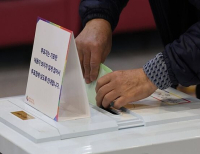
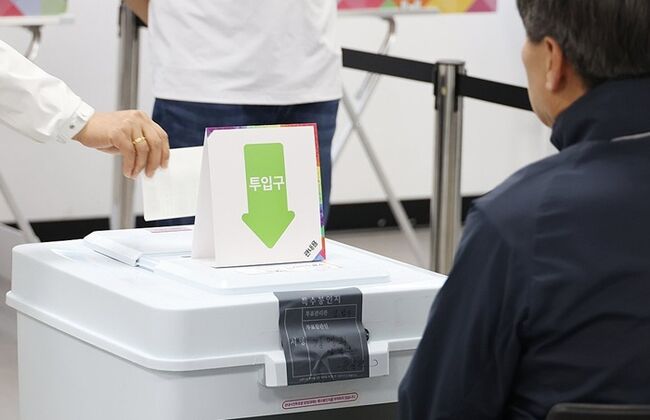
During the June 3 local elections, 7,194 ballots were missing across 91 polling stations nationwide, and voting was halted in 26 locations. The longest suspension lasted 105 minutes. It has not even been properly investigated whether there were voters who left without casting their ballots, or the true extent of the infringement on suffrage.
While remaining silent on the collapse of the public's right to vote, the government is accelerating legislation to overhaul power institutions.
Consequently, the laws created in the name of reform have invited ridicule, with many questioning whether they are intended to "secure a safety net for the ruling power after its term ends rather than expanding the rights of the people."
Democracy is not proven by creating systems that favor the regime, but by protecting the rights of the people even when it is disadvantageous to the regime.
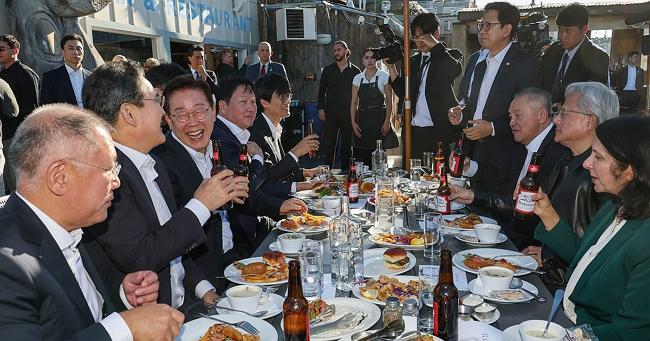 President Lee Jae-myung engages in conversation at the Global AI Leaders' Dinner held at The Lamp restaurant in San Francisco, USA, on the 24th (local time). [Photo=Yonhap News]Overseas visits themselves cannot be wrong. Summit diplomacy for the national interest is necessary.
However, in a situation where high inflation, skyrocketing housing prices, a crashing stock market, controversies over frontline readiness, and infringements on suffrage are all erupting simultaneously at home, the top leader of the government should have first explained the causes of the crisis, the countermeasures, and where the responsibility lies to the people.
The problem with this regime is not that there have been no announced countermeasures.
There were many countermeasures, but they yielded no results; when the results were poor, there were excuses; and at the moment when someone had to take responsibility, no one was to be found.
A government that failed to protect the people's livelihoods speaks of the economy, and a regime that has not shown it is prepared to handle the North Korea-China-Russia axis speaks of self-reliant defense. It talks of peace while reducing our own deterrents, and it calls for reform while turning a blind eye to the reality that citizens' voting was halted.
Self-reliant defense and peace are not evil in themselves.
However, the story changes if one talks of self-reliant defense while using batons and empty guns, and if one promotes the idea that "peace is the economy" while reducing combined exercises even as North Korea’s nuclear weapons and the military cooperation between North Korea, China, and Russia remain unchanged.
To advocate for the most dangerous disarmament using the most virtuous language—that is the devil's temptation.

 [Statement by the ROK Military Academy National Salvation Comrades Association] ㉜Jang Dong-hyuk and Kim Moon-soo must stake their lives on eradicating election fraud
Former Minister of Labor Kim Moon-soo (left) and People Power Party representative Jang Dong-hyuk. [Photo = Yonhap News]The Republic of Korea cannot take a single step forward without eradicating elec
[Statement by the ROK Military Academy National Salvation Comrades Association] ㉜Jang Dong-hyuk and Kim Moon-soo must stake their lives on eradicating election fraud
Former Minister of Labor Kim Moon-soo (left) and People Power Party representative Jang Dong-hyuk. [Photo = Yonhap News]The Republic of Korea cannot take a single step forward without eradicating elec
 Altman Visits U.S. Congress… Discusses AI Regulation Amidst 'GPT Hacking' Shock
OpenAI CEO Sam Altman visits the U.S. Capitol in Washington, D.C., on the 29th (local time) for meetings with U.S. senators. [Getty Images/AFP=Yonhap News]Sam Altman, CEO of ChatGPT developer OpenAI,
Altman Visits U.S. Congress… Discusses AI Regulation Amidst 'GPT Hacking' Shock
OpenAI CEO Sam Altman visits the U.S. Capitol in Washington, D.C., on the 29th (local time) for meetings with U.S. senators. [Getty Images/AFP=Yonhap News]Sam Altman, CEO of ChatGPT developer OpenAI,
 The National Election Commission investigation committee has been extended by 30 days… Tentative agreement reached to conduct a recount as early as the 18th of next month
Kang Dong-wan, Acting Secretary-General of the National Election Commission (third from left), attends the second hearing of the 'Special Committee on Parliamentary Investigation into the Infringement
The National Election Commission investigation committee has been extended by 30 days… Tentative agreement reached to conduct a recount as early as the 18th of next month
Kang Dong-wan, Acting Secretary-General of the National Election Commission (third from left), attends the second hearing of the 'Special Committee on Parliamentary Investigation into the Infringement
 Throughout the lunch hour when voters were flocking to the polls, the count remained at '0'… Controversy arises over voter turnout tallies in Pyeongtaek, Guri, and other regions
In some local governments, such as Pyeongtaek and Guri in Gyeonggi Province, the number of voters during early and main voting failed to increase during certain time slots or recorded abnormally low f
Throughout the lunch hour when voters were flocking to the polls, the count remained at '0'… Controversy arises over voter turnout tallies in Pyeongtaek, Guri, and other regions
In some local governments, such as Pyeongtaek and Guri in Gyeonggi Province, the number of voters during early and main voting failed to increase during certain time slots or recorded abnormally low f
 'Gap investment' with no capital leads to 67 billion won in stolen jeonse deposits… 15-year prison sentence upheld in second trial
Real estate gap investment [Yonhap News file photo]A businessman who swindled approximately 67 billion won from 349 victims through a "no-capital" gap investment scheme has been handed a heavy sentenc
'Gap investment' with no capital leads to 67 billion won in stolen jeonse deposits… 15-year prison sentence upheld in second trial
Real estate gap investment [Yonhap News file photo]A businessman who swindled approximately 67 billion won from 349 victims through a "no-capital" gap investment scheme has been handed a heavy sentenc
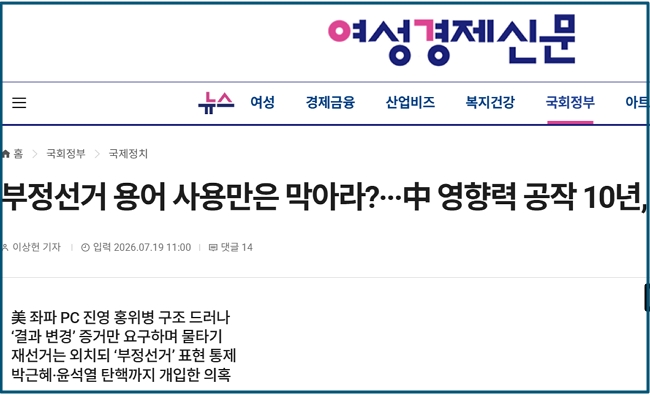 [Media Criticism] From an estimate of ‘100 people’ to ‘far-right led’ and ‘China connections’… What is the basis for the All-Gong report?
Screenshot of the Women's Economic Daily websiteKim Sang-soon, a Ph.D. in International Relations from Peking University and an expert on Chinese affairs, has filed a formal request with the Press Arb
[Media Criticism] From an estimate of ‘100 people’ to ‘far-right led’ and ‘China connections’… What is the basis for the All-Gong report?
Screenshot of the Women's Economic Daily websiteKim Sang-soon, a Ph.D. in International Relations from Peking University and an expert on Chinese affairs, has filed a formal request with the Press Arb
 [Cho Yang-geon Column] We are players on the field! Not spectators
It is time for everyone to join the struggle with a 'do-or-die' determination. ⒸThe HanmiilboI sometimes speak with acquaintances who are so-called "well-being right-wingers." Knowing that I am invo
[Cho Yang-geon Column] We are players on the field! Not spectators
It is time for everyone to join the struggle with a 'do-or-die' determination. ⒸThe HanmiilboI sometimes speak with acquaintances who are so-called "well-being right-wingers." Knowing that I am invo
 [Photo] Evidence of Election Fraud Flooding U.S. Media… Trump Had 2.7 Million Votes Stolen
 [Video] U.S. Semiquincentennial Air Show... 'Art in the Sky' streaks across New York
 [Editorial Cartoon] A Draconian Law That Undermines Freedom of Expression

 List
List