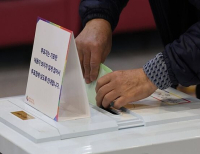
Unlike humans, pets do not judge based on conditions. They do not evaluate social status, educational background, or wealth. [Yonhap News file photo]
The increasing presence of pets cannot be viewed merely as a result of economic growth. It is also a mirror that reflects the psychology and ideology of humans living in modern capitalist society.
In traditional society, human identity was formed within families, kinship groups, villages, and religious communities. However, as capitalism and urbanization progressed, individuals became increasingly independent from these communities. While freedom expanded, so did isolation. The individual autonomy championed by liberal philosophers enhanced human dignity, but it simultaneously amplified the loneliness of humans living on their own.
Psychologist Erich Fromm believed that humans experience loneliness and anxiety even while gaining freedom. Although freedom is a blessing, humans struggle to endure it. Consequently, they seek new objects of attachment. Pets have become one of the most stable sources for filling that void.
Even when viewed through John Bowlby’s attachment theory, humans need stable objects of attachment throughout their lives. In childhood, this object is the parents; in adulthood, it expands to include spouses, friends, and children. Yet, in modern society, these relationships are becoming increasingly fragile. Marriages are declining, birth rates are falling, and interactions with neighbors are dwindling. As a result, pets have established themselves as new objects of attachment.
Unlike humans, pets do not judge based on conditions. They do not evaluate social status, educational background, or wealth. In psychology, it is believed that such relationships provide humans with a strong sense of emotional stability. There are many studies suggesting that stress hormones decrease and people feel more secure when they are with animals rather than other people.
Interestingly, capitalism itself did not create this phenomenon. Capitalism did not manipulate human psychology; it simply accepted and institutionalized an existing human nature. Humans are inherently beings that desire attachment, and the market has merely provided various options to satisfy that need.
Philosophically, this also represents a change in the view of humanity. Before the modern era, there was a strong belief that humans were masters of nature. In the modern era, however, the perception that humans and animals are part of a shared biological community is spreading. We have moved from an era where animals were viewed solely as property to an era where they are respected as living beings.
However, another interpretation is possible. Modern people fear being hurt in human relationships. Relationships with people carry the potential for conflict, responsibility, and betrayal. Conversely, pets pose almost no such risks. Psychology often explains this as a tendency to seek an emotional "safe zone." In other words, the increase in pets may be a signal of the fatigue of human relationships rather than a success in human connection.
Therefore, pet culture is not just a story about dogs or cats. It is a matter of intellectual history and psychology that illustrates how modern people endure loneliness, with whom they form attachments, and what they accept as family.
The era of rising pet ownership may be a time when humans love animals more, but it may also be a time when humans find relationships with other humans more difficult than before. In that sense, pet culture is less a product of modern capitalism and more a mirror reflecting the minds of modern people.
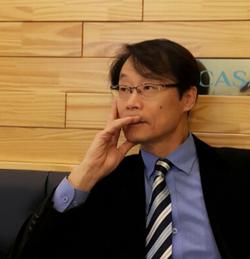
◆ Songsan Jung Kwang-je
A poet and researcher of history and philosophy. Former board member of the Syngman Rhee Institute. Currently serving as a research advisor to the Korea Modern and Contemporary History Research Association and as the representative of the philosophy forum "Lyceum." He has published four volumes of poetry, co-translated "Heroes of Pork Chop Hill," and authored humanities books such as "Joseon That Became a Myth," "Humanities on Tatami," and "A Liberal’s Reading of Gramsci."

 [Statement by the ROK Military Academy National Salvation Comrades Association] ㉜Jang Dong-hyuk and Kim Moon-soo must stake their lives on eradicating election fraud
Former Minister of Labor Kim Moon-soo (left) and People Power Party representative Jang Dong-hyuk. [Photo = Yonhap News]The Republic of Korea cannot take a single step forward without eradicating elec
[Statement by the ROK Military Academy National Salvation Comrades Association] ㉜Jang Dong-hyuk and Kim Moon-soo must stake their lives on eradicating election fraud
Former Minister of Labor Kim Moon-soo (left) and People Power Party representative Jang Dong-hyuk. [Photo = Yonhap News]The Republic of Korea cannot take a single step forward without eradicating elec
 Altman Visits U.S. Congress… Discusses AI Regulation Amidst 'GPT Hacking' Shock
OpenAI CEO Sam Altman visits the U.S. Capitol in Washington, D.C., on the 29th (local time) for meetings with U.S. senators. [Getty Images/AFP=Yonhap News]Sam Altman, CEO of ChatGPT developer OpenAI,
Altman Visits U.S. Congress… Discusses AI Regulation Amidst 'GPT Hacking' Shock
OpenAI CEO Sam Altman visits the U.S. Capitol in Washington, D.C., on the 29th (local time) for meetings with U.S. senators. [Getty Images/AFP=Yonhap News]Sam Altman, CEO of ChatGPT developer OpenAI,
 The National Election Commission investigation committee has been extended by 30 days… Tentative agreement reached to conduct a recount as early as the 18th of next month
Kang Dong-wan, Acting Secretary-General of the National Election Commission (third from left), attends the second hearing of the 'Special Committee on Parliamentary Investigation into the Infringement
The National Election Commission investigation committee has been extended by 30 days… Tentative agreement reached to conduct a recount as early as the 18th of next month
Kang Dong-wan, Acting Secretary-General of the National Election Commission (third from left), attends the second hearing of the 'Special Committee on Parliamentary Investigation into the Infringement
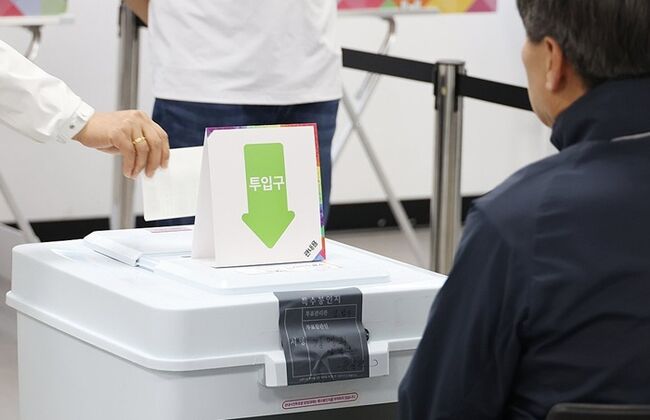 Throughout the lunch hour when voters were flocking to the polls, the count remained at '0'… Controversy arises over voter turnout tallies in Pyeongtaek, Guri, and other regions
In some local governments, such as Pyeongtaek and Guri in Gyeonggi Province, the number of voters during early and main voting failed to increase during certain time slots or recorded abnormally low f
Throughout the lunch hour when voters were flocking to the polls, the count remained at '0'… Controversy arises over voter turnout tallies in Pyeongtaek, Guri, and other regions
In some local governments, such as Pyeongtaek and Guri in Gyeonggi Province, the number of voters during early and main voting failed to increase during certain time slots or recorded abnormally low f
 'Gap investment' with no capital leads to 67 billion won in stolen jeonse deposits… 15-year prison sentence upheld in second trial
Real estate gap investment [Yonhap News file photo]A businessman who swindled approximately 67 billion won from 349 victims through a "no-capital" gap investment scheme has been handed a heavy sentenc
'Gap investment' with no capital leads to 67 billion won in stolen jeonse deposits… 15-year prison sentence upheld in second trial
Real estate gap investment [Yonhap News file photo]A businessman who swindled approximately 67 billion won from 349 victims through a "no-capital" gap investment scheme has been handed a heavy sentenc
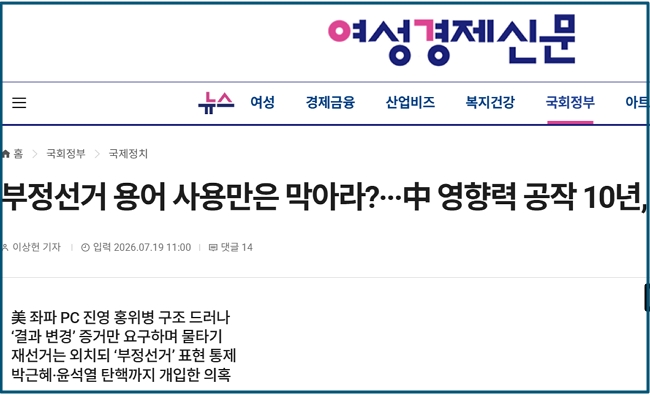 [Media Criticism] From an estimate of ‘100 people’ to ‘far-right led’ and ‘China connections’… What is the basis for the All-Gong report?
Screenshot of the Women's Economic Daily websiteKim Sang-soon, a Ph.D. in International Relations from Peking University and an expert on Chinese affairs, has filed a formal request with the Press Arb
[Media Criticism] From an estimate of ‘100 people’ to ‘far-right led’ and ‘China connections’… What is the basis for the All-Gong report?
Screenshot of the Women's Economic Daily websiteKim Sang-soon, a Ph.D. in International Relations from Peking University and an expert on Chinese affairs, has filed a formal request with the Press Arb
 [Photo] Evidence of Election Fraud Flooding U.S. Media… Trump Had 2.7 Million Votes Stolen
 [Video] U.S. Semiquincentennial Air Show... 'Art in the Sky' streaks across New York
 [Editorial Cartoon] A Draconian Law That Undermines Freedom of Expression

 List
List