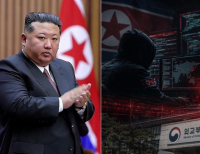
US strategic nuclear submarine. Yonhap News TV capture
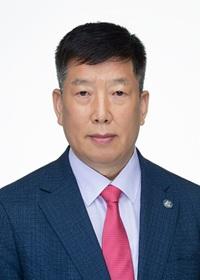 Editorial Board Member, Korea Military Academy Class of '84The phrase 'denuclearization' has disappeared from Trump's second National Security Strategy (NSS). The existing 'complete, verifiable, and irreversible denuclearization (CVID)' has been retired. Following the NSS, Harry Kazianis, a realist security expert in the United States, stated, "Now is the time to give South Korea the green light for nuclear armament."
"Now that the US has virtually acknowledged North Korea's nuclear weapons, there is no reason why South Korea cannot arm itself with nuclear weapons," Kazianis stated his conviction. "Allowing South Korea to develop nuclear weapons if it desires is the attitude of a true ally. If South Korea possesses nuclear deterrence, the ROK-US alliance will become a more realistic and balanced structure."
North Korea's nuclear weapons have reached the deployment stage. It now appears that the US focus has shifted from eliminating North Korea's nuclear weapons to controlling them through arms control. If this happens, North Korea's nuclear weapons will be semi-recognized internationally, and the threat will become South Korea's reality. The more cruel fact is that the direct target of North Korea's nuclear weapons is the Republic of Korea.
North Korea has established itself as a de facto nuclear power with all forms of nuclear capabilities, including tactical nuclear weapons, ICBMs, and SLBMs. Through military cooperation with Russia, North Korea is expanding its nuclear and missile production capabilities while enjoying wartime special benefits.
1. A nation enjoys peace commensurate with its people's level of awareness
Despite the harsh and urgent reality, the government and politicians remain trapped in the illusion of 'peace-firstism.' History repeatedly proves that peace policies cannot prevent war, yet the government's security policy makers are unyielding. Peace without strength and preparation is an illusion, and dialogue without deterrence leads to submission. Lowering tensions in the name of peace is not peace, but a mirage and delusion of peace.
A nation facing a nuclear-armed adversary must negotiate with nuclear weapons. No matter how much the current government pursues dialogue, North Korea will only engage in talks when it's necessary and will turn away when it's not. This is precisely the current situation. In such circumstances, dialogue and peace strategies, and strategic ambiguity, will not work. For this reason, the discussion on nuclear armament is no longer a radical proposition.
2. Mutual benefits if the US allows South Korea to arm itself with nuclear weapons
Just as the US allowed South Korea to pursue nuclear submarines to counter China, if it allows South Korea to arm itself with nuclear weapons for the purpose of deterring North Korea's nuclear program, both South Korea and the US will gain three key benefits.
First, strengthening the ROK-US alliance. South Korea's nuclear armament can be an opportunity to reshape the structure of the ROK-US alliance into a stronger and more efficient strategic alliance. South Korea, with its world-class shipbuilding and naval capabilities, can expand strategic cooperation with the US in areas such as warship repair, joint construction, and aircraft carrier resupply in return for permission to develop nuclear weapons. This will allow the US to maintain an advantage in its maritime competition with China and resolve internal skepticism about the "nuclear umbrella" in South Korea, thereby solidifying the alliance's foundation of trust.
Second, reducing the cost of deterring North Korea. If South Korea secures its own nuclear deterrence, the US can significantly reduce the cost of maintaining extended deterrence against North Korea and the risk of military intervention. The cost of deterring North Korea refers to the overall military deployments, maintenance of US forces in Korea, diplomatic adjustments, and consumption of strategic resources that the US expends to deter North Korea. It is reported that the US spends 13 to 20 trillion won annually to deter North Korea. If South Korea possesses its own nuclear deterrence, it can save 8 to 13 trillion won of this amount and focus on countering China.
Third, expanding the strategic flexibility of US Forces in Korea. If South Korea deters North Korea on its own, the US will have less need to "fix" US Forces in Korea to the defense of the Korean Peninsula and can focus more broadly on its original strategic objective of countering China. As a result, the US can reinvest resources allocated for North Korea into priority fronts of its Indo-Pacific strategy, such as Taiwan and the South China Sea.
3. Prerequisite for independent nuclear armament: national consensus and a declaration of the will to national survival
South Korea's nuclear armament is not a destruction of the ROK-US alliance, but an upgrade. South Korea's nuclear armament must proceed through a specific roadmap: nuclear sharing, cooperation with the US on reprocessing nuclear waste and securing nuclear fuel, independent nuclear armament, and arms control. Our nuclear weapons are a means to suppress North Korea and deter China, and they will strengthen the ROK-US alliance. What is needed before South Korea discusses independent nuclear armament is a declaration of the will to national survival at the national level, a resolve to protect ourselves. The will to survive is a prerequisite and driving force for nuclear armament, and it is the first condition for peace.
When this will becomes clear, nuclear armament will become a strategy rather than an option, extended deterrence will evolve from protection to cooperation, and the ROK-US alliance will develop from dependence to a structure of mutual deterrence.
Nuclear armament is the ultimate safety net to prevent war. Deterrence that is internally divided cannot exert any external pressure. There is a need for a common security will and national consensus that transcends partisan divisions and distinctions between progressives and conservatives, stating, "The Republic of Korea will bear any sacrifice for its survival." Pro-North Korea factions and submissive forces, who act as stooges for the enemy, cannot even mention independent nuclear armament. I propose that the question of whether to pursue independent nuclear armament be put to a national referendum in next year's local elections.
There is a need for a resolve that South Korea will be responsible for its own security. With the disappearance of any possibility of North Korea abandoning its nuclear weapons, South Korea's peace can no longer depend on external factors. If the government has a genuine will for peace, it must review the Republic of Korea's independent nuclear armament, persuade allies of the mutual benefits, and declare it after a national referendum. All citizens must become Don Quixotes, equipped with the courage and wisdom to pursue independent nuclear armament.
Editorial Board Member, Hanmi Ilbo

 [Statement by the Seo-beo-kka Korea Military Academy Save-the-Nation Comrades Association] ㉛ Recount the Votes Publicly, as the Previous Recount Concealed Election Fraud
Tongyeong Mayoral Election Recount [Photo=Yonhap News]South Korea's liberal democracy is dying. The National Election Commission (NEC) and the judiciary, which have plummeted into criminal syndicates
[Statement by the Seo-beo-kka Korea Military Academy Save-the-Nation Comrades Association] ㉛ Recount the Votes Publicly, as the Previous Recount Concealed Election Fraud
Tongyeong Mayoral Election Recount [Photo=Yonhap News]South Korea's liberal democracy is dying. The National Election Commission (NEC) and the judiciary, which have plummeted into criminal syndicates
 What is the significance of the "Trump 2028" red hats that keep making a comeback?
It is noteworthy that President Donald Trump is "intentionally" fueling controversy over whether he can actually run in the 2028 presidential election, even though it is "highly likely he is seriously
What is the significance of the "Trump 2028" red hats that keep making a comeback?
It is noteworthy that President Donald Trump is "intentionally" fueling controversy over whether he can actually run in the 2028 presidential election, even though it is "highly likely he is seriously
 Jin Cummings: “North Korea says it will increase the number of spies, so what is the government doing?”
U.S. political columnist Gene Cummings has publicly questioned the South Korean government, asking, "North Korea is declaring that it will increase its number of spies, so what is the South Kore
Jin Cummings: “North Korea says it will increase the number of spies, so what is the government doing?”
U.S. political columnist Gene Cummings has publicly questioned the South Korean government, asking, "North Korea is declaring that it will increase its number of spies, so what is the South Kore
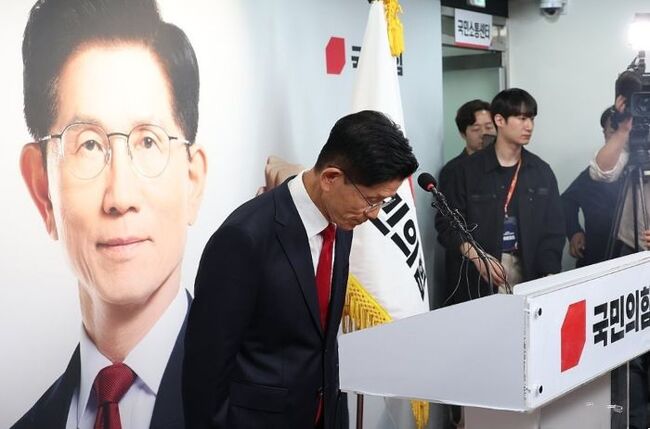 “Too little, too late?…” Kim Moon-soo, who previously conceded his presidential election defeat, now demands a special counsel investigation into ‘allegations of election fraud in the 2025 presidential election’
People Power Party presidential candidate Kim Moon-soo concedes defeat during a press conference at the party headquarters in Yeouido, Seoul, on June 4, 2025. [Joint Press Corps]As allegations emerge
“Too little, too late?…” Kim Moon-soo, who previously conceded his presidential election defeat, now demands a special counsel investigation into ‘allegations of election fraud in the 2025 presidential election’
People Power Party presidential candidate Kim Moon-soo concedes defeat during a press conference at the party headquarters in Yeouido, Seoul, on June 4, 2025. [Joint Press Corps]As allegations emerge
 Stock Market Crash 'Black Tuesday'… KOSPI down 10.8%, KOSDAQ down 7.7%
The KOSPI fell by more than 5% in early trading on the 28th, triggering a sell-side sidecar.On the 28th, the KOSPI plunged by more than 10%.Due to the sharp decline, a sell-side sidecar—a temporary
Stock Market Crash 'Black Tuesday'… KOSPI down 10.8%, KOSDAQ down 7.7%
The KOSPI fell by more than 5% in early trading on the 28th, triggering a sell-side sidecar.On the 28th, the KOSPI plunged by more than 10%.Due to the sharp decline, a sell-side sidecar—a temporary
 [World Heritage Committee] 25 New World Heritage Sites Inscribed in Busan… South Korea Successfully Expands 'Getbol' Listing
The Chairperson of the World Heritage Committee speaks at the plenary session of the 48th session of the World Heritage Committee, held at BEXCO in Busan on the 20th. [Photo: Yonhap News]A total of 25
[World Heritage Committee] 25 New World Heritage Sites Inscribed in Busan… South Korea Successfully Expands 'Getbol' Listing
The Chairperson of the World Heritage Committee speaks at the plenary session of the 48th session of the World Heritage Committee, held at BEXCO in Busan on the 20th. [Photo: Yonhap News]A total of 25
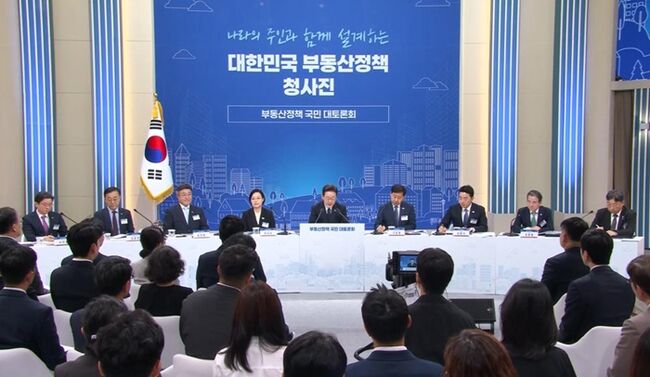 [Liberal Democratic Party Statement] Calling it a Grand Real Estate Debate… It Was Nothing More Than a Private Party Among Themselves
The 'National Grand Debate on Real Estate Policy' held on July 23rd and 27th. [Photo=Yonhap News]The 'National Grand Debate on Real Estate Policy,' hosted by the Lee Jae-myung administration under the
[Liberal Democratic Party Statement] Calling it a Grand Real Estate Debate… It Was Nothing More Than a Private Party Among Themselves
The 'National Grand Debate on Real Estate Policy' held on July 23rd and 27th. [Photo=Yonhap News]The 'National Grand Debate on Real Estate Policy,' hosted by the Lee Jae-myung administration under the
 [Photo] Evidence of Election Fraud Flooding U.S. Media… Trump Had 2.7 Million Votes Stolen
 [Video] U.S. Semiquincentennial Air Show... 'Art in the Sky' streaks across New York
 [Editorial Cartoon] A Draconian Law That Undermines Freedom of Expression

 List
List