'Deungmyeongdae' in Bukchon Village, Jeju's Jocheon. Bullet marks from the April 3rd incident remain. ⒸHanmi Ilbo
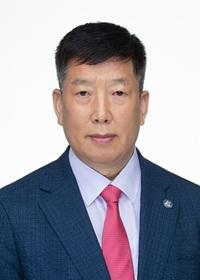 Editorial writer Park Pil-gyu, ROK Military Academy Class of 40Last month, the Ministry of Patriots and Veterans Affairs officially designated Colonel Park Jin-kyung as a national merit recipient for his contributions during the Korean War. This decision, based on the Eulji Military Merit Medal awarded in 1950, military service records, and numerous official government documents, is a rightful outcome of veteran administration that has accumulated over 75 years of national judgment.
Nevertheless, the president's directive to review the 'revocation of merit recipient status' after only a month represents a significant intervention in history and administration, attempting to overturn judgments the nation itself has established through political means.
Colonel Park Jin-kyung, serving as the commander of the 11th Regiment of the Republic of Korea Army in Jeju in 1948, issued a clear directive: "Do not regard civilians as enemies." Objective records indicate that during his tenure (May 6, 1948 - June 18, 1948), the scale of civilian casualties was significantly lower compared to subsequent periods.
Conversely, the 'Jeju Island People's Guerrilla Struggle Report,' an internal document of the South Korean Labor Party, clearly records an assassination plan designating Regimental Commander Park Jin-kyung as a 'purged target.' He was indeed assassinated by a South Korean Labor Party cell infiltrated within the military. This serves as clear historical evidence that he was a significant operational obstacle to the armed rebellion forces.
Historical Truth Must Not Be Distorted for Political Purposes
Colonel Park Jin-kyung was assassinated while carrying out rear area operations to counter the armed uprising that aimed to disrupt the establishment of the Republic of Korea government and the May 10 general elections. These facts have been repeatedly confirmed for decades through military records, investigation materials, and government reports since the incident, and the designation as a national merit recipient was the culmination of these accumulated judgments.
To negate the honor officially bestowed by the nation through established procedures, without new judicial rulings or decisive evidence, is not merely a matter of historical interpretation but an act that shakes the very foundation of national trust, the legitimacy of veteran administration, and the rule of law.
The 'Report on the Truth of the Jeju April 3rd Incident,' compiled during the Roh Moo-hyun administration, also characterized Colonel Park Jin-kyung not as a 'mass murderer of residents' but as a 'rescuer of residents.'
The report at the time described his focus on guiding residents down the mountains and engaging in pacification efforts rather than suppression, and noted that large-scale casualties intensified only after his assassination, presenting this as a crucial historical context. If evaluations can drastically change based on the administration, even when examining the same historical materials and statistics, it constitutes political interference in history.
Does the directive to review Colonel Park Jin-kyung's national merit recipient status signal an intention to portray a soldier who defended the nation as a murderer and elevate the members of the South Korean Labor Party, the instigators of armed rebellion, to the status of martyrs? If not such a rebellious intent, then the factual history must not be distorted in reverse.
Propaganda Through Historical Distortion is Anti-National Behavior
Some arguments surrounding the April 3rd incident are the result of distorting and reinterpreting the event while deliberately excluding the extremely precarious security environment faced by the nascent Republic of Korea.
Prior to the Korean War, organized rebellions and infiltrations by communist armed forces posed a real threat in rear areas such as Jeolla, Gyeongsang, and Jeju, which is confirmed by military records and government documents of the time.
Had these armed forces in the rear areas not been controlled in time, the ROK military would have been forced to spread its combat power across the front and rear lines during the early stages of the Korean War, leading to a fatal collapse.
Nevertheless, to overturn verified records and question national merit recipient status based solely on some distorted testimonies or the unilateral claims of a single perpetrator is not historical reflection but rather political incitement aimed at reversing even the history of national security. Historical advice provided to rulers by those around them must be exercised with caution.
If those who have neither directly experienced the situation at the time nor possess a deep understanding of history, with their biased perspectives and pro-North Korean stances aligned with North Korea's claims, attempt to overturn already verified records, this constitutes political incitement through historical distortion and an act of treason.
The idea of shaking the qualifications of merit recipients based on selectively distorted statements, contradicting the veteran recognition judgments independently established by the nation, is a clear insult to history, administrative violence, and an anti-national act.
Directive to Undermine National Merit Recipients' Honor Must Be Reviewed
When selecting national merit recipients, the nation makes a public promise to record and protect their honor. If this promise is withdrawn simply because political interpretations have changed, honor will be reduced from a reward for dedication to a mere tool of the regime's preference. Today it is Colonel Park Jin-kyung, but tomorrow another national merit recipient could be erased in the same manner.
The directive to review the revocation of Colonel Park Jin-kyung's national merit recipient status is not a matter of historical debate. To deliberately distort history based on regime interests is an act against the laws of human civilization and the spirit of history, and it is a transgression by the current government that signals its intent to dismantle the nation's past commitments.
A nation that cannot protect the honor of its national merit recipients ultimately cannot protect its national identity and continuity. We demand that the president withdraw the directive to review the national merit recipient status, after considering and consolidating the opinions of reservist soldiers.
Editorial Writer, Hanmi Ilbo

 [Statement by the Seo-beo-kka Korea Military Academy Save-the-Nation Comrades Association] ㉛ Recount the Votes Publicly, as the Previous Recount Concealed Election Fraud
Tongyeong Mayoral Election Recount [Photo=Yonhap News]South Korea's liberal democracy is dying. The National Election Commission (NEC) and the judiciary, which have plummeted into criminal syndicates
[Statement by the Seo-beo-kka Korea Military Academy Save-the-Nation Comrades Association] ㉛ Recount the Votes Publicly, as the Previous Recount Concealed Election Fraud
Tongyeong Mayoral Election Recount [Photo=Yonhap News]South Korea's liberal democracy is dying. The National Election Commission (NEC) and the judiciary, which have plummeted into criminal syndicates
 What is the significance of the "Trump 2028" red hats that keep making a comeback?
It is noteworthy that President Donald Trump is "intentionally" fueling controversy over whether he can actually run in the 2028 presidential election, even though it is "highly likely he is seriously
What is the significance of the "Trump 2028" red hats that keep making a comeback?
It is noteworthy that President Donald Trump is "intentionally" fueling controversy over whether he can actually run in the 2028 presidential election, even though it is "highly likely he is seriously
 Jin Cummings: “North Korea says it will increase the number of spies, so what is the government doing?”
U.S. political columnist Gene Cummings has publicly questioned the South Korean government, asking, "North Korea is declaring that it will increase its number of spies, so what is the South Kore
Jin Cummings: “North Korea says it will increase the number of spies, so what is the government doing?”
U.S. political columnist Gene Cummings has publicly questioned the South Korean government, asking, "North Korea is declaring that it will increase its number of spies, so what is the South Kore
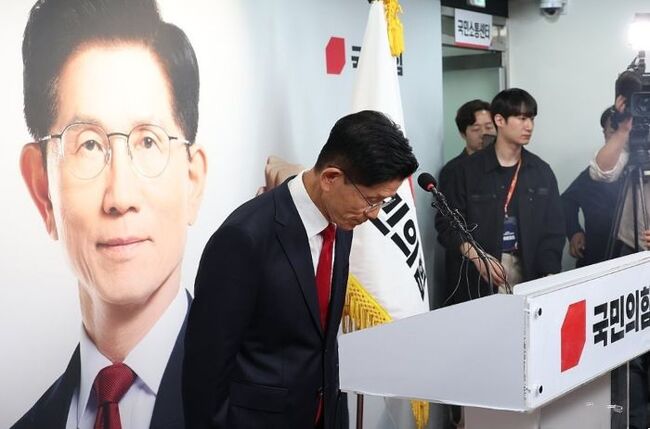 “Too little, too late?…” Kim Moon-soo, who previously conceded his presidential election defeat, now demands a special counsel investigation into ‘allegations of election fraud in the 2025 presidential election’
People Power Party presidential candidate Kim Moon-soo concedes defeat during a press conference at the party headquarters in Yeouido, Seoul, on June 4, 2025. [Joint Press Corps]As allegations emerge
“Too little, too late?…” Kim Moon-soo, who previously conceded his presidential election defeat, now demands a special counsel investigation into ‘allegations of election fraud in the 2025 presidential election’
People Power Party presidential candidate Kim Moon-soo concedes defeat during a press conference at the party headquarters in Yeouido, Seoul, on June 4, 2025. [Joint Press Corps]As allegations emerge
 Stock Market Crash 'Black Tuesday'… KOSPI down 10.8%, KOSDAQ down 7.7%
The KOSPI fell by more than 5% in early trading on the 28th, triggering a sell-side sidecar.On the 28th, the KOSPI plunged by more than 10%.Due to the sharp decline, a sell-side sidecar—a temporary
Stock Market Crash 'Black Tuesday'… KOSPI down 10.8%, KOSDAQ down 7.7%
The KOSPI fell by more than 5% in early trading on the 28th, triggering a sell-side sidecar.On the 28th, the KOSPI plunged by more than 10%.Due to the sharp decline, a sell-side sidecar—a temporary
 [World Heritage Committee] 25 New World Heritage Sites Inscribed in Busan… South Korea Successfully Expands 'Getbol' Listing
The Chairperson of the World Heritage Committee speaks at the plenary session of the 48th session of the World Heritage Committee, held at BEXCO in Busan on the 20th. [Photo: Yonhap News]A total of 25
[World Heritage Committee] 25 New World Heritage Sites Inscribed in Busan… South Korea Successfully Expands 'Getbol' Listing
The Chairperson of the World Heritage Committee speaks at the plenary session of the 48th session of the World Heritage Committee, held at BEXCO in Busan on the 20th. [Photo: Yonhap News]A total of 25
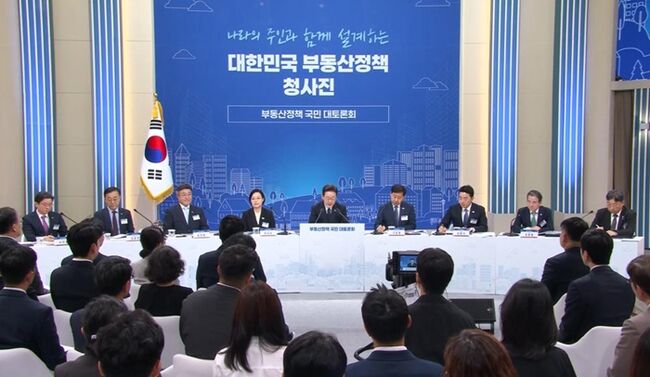 [Liberal Democratic Party Statement] Calling it a Grand Real Estate Debate… It Was Nothing More Than a Private Party Among Themselves
The 'National Grand Debate on Real Estate Policy' held on July 23rd and 27th. [Photo=Yonhap News]The 'National Grand Debate on Real Estate Policy,' hosted by the Lee Jae-myung administration under the
[Liberal Democratic Party Statement] Calling it a Grand Real Estate Debate… It Was Nothing More Than a Private Party Among Themselves
The 'National Grand Debate on Real Estate Policy' held on July 23rd and 27th. [Photo=Yonhap News]The 'National Grand Debate on Real Estate Policy,' hosted by the Lee Jae-myung administration under the
 [Photo] Evidence of Election Fraud Flooding U.S. Media… Trump Had 2.7 Million Votes Stolen
 [Video] U.S. Semiquincentennial Air Show... 'Art in the Sky' streaks across New York
 [Editorial Cartoon] A Draconian Law That Undermines Freedom of Expression

 List
List