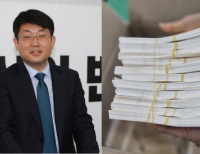
RE100 and the Korean Small Modular Reactor (SMR). [Graphic Synthesis = Hanmi Ilbo]
This article stems from the concern that "national policies, if they malfunction, can lead to long-term losses."
On December 21st, the high-level government-party-presidential office consultation announced that they would pursue the construction of industrial complexes adopting RE100, a type of campaign aiming for companies to use 100% renewable energy, as a national strategic task and expedite the enactment of a related special law.
This announcement is shocking in that the nation has decided which industrial standards to adopt and who will bear the costs and responsibilities. It is reminiscent of the damage caused by the Moon Jae-in administration's "nuclear phase-out policy."
Thus far, both opposition parties and the industry as a whole have expressed concerns about rising electricity costs regarding the creation of national industrial complexes for RE100. This is because the Lee Jae-myung administration is pushing it through with mandatory measures like a special law, despite the alternative of nuclear power generation.
RE100 is neither an international treaty nor an intergovernmental agreement. It is a campaign led by the UK-based private environmental organizations, The Climate Group and CDP (Carbon Disclosure Project), to encourage voluntary corporate participation. It has no legal binding force and is not a standard designed as a national policy tool.
Here, supply chain refers to the entire transaction relationship, from procurement of components, raw materials, and energy, centered around finished product companies. A single evaluation criterion determines contracts and investments.
As global companies use this as a supply chain evaluation criterion, it is effectively operating as a trading condition.
The most serious aspect to consider is that these systems exhibit contradictions.
ESG, which evaluates global environmental, social, and governance factors, has already included nuclear power as conditionally eco-friendly. ESG is a non-financial criterion for evaluating companies based on "Environment, Social, and Governance" standards, and while not a law, it operates as a de facto rule in the capital markets.
The EU's sustainability classification indicator, Taxonomy, also recognizes nuclear power under the goal of carbon reduction. In other words, there is an international consensus on the goal of "carbon-free."
These entities widely use CDP, which RE100 utilizes, for their evaluations. However, RE100 singularly excludes nuclear power. This results in a conflict where the same company is evaluated as eco-friendly under ESG criteria but deemed unsuitable under RE100 criteria.
In situations of such conflict, the principle is for the government to engage in coordination and mediation. However, the Lee Jae-myung administration is attempting to apply this as a national standard.
The problem becomes even clearer when compared to the United States. The US does not adopt RE100 as a national standard. Instead, it uses the Carbon-Free Energy standard and treats nuclear power and Small Modular Reactors (SMRs) as key power sources for its industrial and security strategy.
While RE100 remains an option for the US and the EU, it functions as a trading condition for manufacturing and exporting countries like Korea. This asymmetrical structure is the essence of the problem.
Even before the foreign exchange crisis, people said, "Why is the exchange rate a problem?" The numbers were complex, and daily life seemed peaceful. However, the danger only became apparent after the exchange rate collapsed.
The issues with the power industry and industrial standards are no different. While it may not be felt now, once a structure is fixed, it cannot be reversed, and its ripple effects spread beyond specific industries to the entire nation.
The choice to fix RE100 as a national strategy is not a policy for today but could be a disaster for tomorrow.
The background behind this standard gaining power is the evaluation structure of global capital.
Global capital has utilized ESG not as a moral value but as a risk management tool.
RE100 is a "convenient indicator" that is easy to measure and disclose. As a result of preferring simple standards over complex technical debates, a private campaign has become the global language of evaluation.
The problem for us is that this language has flowed back into national policy.
The government will explain this as a choice to prevent companies from being eliminated from the global market. However, this is not protection. It is a decision that shifts costs and responsibilities to the private sector while omitting the standard verification that the state should undertake.
Once this standard is fixed as policy through a special law, it will be difficult to reverse even if its flaws are revealed later. The costs of policy failure have always been borne by the public and businesses. We can see this by recalling the significant losses incurred due to the nuclear phase-out policy.
The most dangerous structural problem with RE100 is not the environment but electricity prices.
A standard that demands electricity procurement solely from renewable energy, excluding nuclear power and carbon-free sources, is not technologically neutral. It is an industrial regulation that restricts electricity choices.
As the proportion of highly intermittent power sources increases, costs for grid stabilization, backup power, and transmission/distribution are bound to rise. Electricity unit prices are determined by physics and market outcomes, not by policy declarations.
RE100 is a standard that structurally entails an increase in electricity costs, and this burden will be passed on to the entire manufacturing sector without exception.
When electricity prices rise, energy-intensive industries such as semiconductors, steel, chemicals, and batteries will be the first to lose competitiveness. If profitability falters, investment stops, and new factories move overseas.
This process cannot be stopped by declarations or patriotism.
Industrial hollowing out does not happen overnight, but it begins quietly when electricity costs and stability collapse.
If RE100 is fixed as a special law without sufficiently considering these possibilities, the question converges to one:
"For whom is this special law?"
The environment is important. Carbon reduction is an unavoidable task. However, standards must be verified, and options must remain open.
Given that alternatives like carbon-free standards, including nuclear power, exist, why have we adopted the outdated RE100 as a national strategy?
A policy that rushes ahead without public consensus or comparative analysis of alternatives is not reform. It is a perversion. In the age of AI, the power industry is national sovereignty.

 [Statement by the Seo-beo-kka Korea Military Academy Save-the-Nation Comrades Association] ㉛ Recount the Votes Publicly, as the Previous Recount Concealed Election Fraud
Tongyeong Mayoral Election Recount [Photo=Yonhap News]South Korea's liberal democracy is dying. The National Election Commission (NEC) and the judiciary, which have plummeted into criminal syndicates
[Statement by the Seo-beo-kka Korea Military Academy Save-the-Nation Comrades Association] ㉛ Recount the Votes Publicly, as the Previous Recount Concealed Election Fraud
Tongyeong Mayoral Election Recount [Photo=Yonhap News]South Korea's liberal democracy is dying. The National Election Commission (NEC) and the judiciary, which have plummeted into criminal syndicates
 What is the significance of the "Trump 2028" red hats that keep making a comeback?
It is noteworthy that President Donald Trump is "intentionally" fueling controversy over whether he can actually run in the 2028 presidential election, even though it is "highly likely he is seriously
What is the significance of the "Trump 2028" red hats that keep making a comeback?
It is noteworthy that President Donald Trump is "intentionally" fueling controversy over whether he can actually run in the 2028 presidential election, even though it is "highly likely he is seriously
 Jin Cummings: "North Korea says it will increase the number of spies, so what is the government doing?"
U.S. political columnist Gene Cummings has publicly questioned the South Korean government, asking, "North Korea is announcing plans to increase its number of spies, yet what is the South Korean
Jin Cummings: "North Korea says it will increase the number of spies, so what is the government doing?"
U.S. political columnist Gene Cummings has publicly questioned the South Korean government, asking, "North Korea is announcing plans to increase its number of spies, yet what is the South Korean
 Attorney Do Tae-woo: “Discrepancies in Voter Count and Improper Sealing Confirmed in Tongyeong Mayoral Recount… Official Request for Additional Verification Submitted to Gyeongnam Election Commission”
A bundle of mail-in early voting ballots captured by lawyer Do Tae-woo at the Tongyeong mayoral election recount site. A clear solid line, raising suspicions of election fraud, is visible on the side
Attorney Do Tae-woo: “Discrepancies in Voter Count and Improper Sealing Confirmed in Tongyeong Mayoral Recount… Official Request for Additional Verification Submitted to Gyeongnam Election Commission”
A bundle of mail-in early voting ballots captured by lawyer Do Tae-woo at the Tongyeong mayoral election recount site. A clear solid line, raising suspicions of election fraud, is visible on the side
 Stock Market Crash 'Black Tuesday'… KOSPI down 10.8%, KOSDAQ down 7.7%
The KOSPI fell by more than 5% in early trading on the 28th, triggering a sell-side sidecar.On the 28th, the KOSPI plunged by more than 10%.Due to the sharp decline, a sell-side sidecar—a temporary
Stock Market Crash 'Black Tuesday'… KOSPI down 10.8%, KOSDAQ down 7.7%
The KOSPI fell by more than 5% in early trading on the 28th, triggering a sell-side sidecar.On the 28th, the KOSPI plunged by more than 10%.Due to the sharp decline, a sell-side sidecar—a temporary
 [World Heritage Committee] 25 New World Heritage Sites Inscribed in Busan… South Korea Successfully Expands 'Getbol' Listing
The Chairperson of the World Heritage Committee speaks at the plenary session of the 48th session of the World Heritage Committee, held at BEXCO in Busan on the 20th. [Photo: Yonhap News]A total of 25
[World Heritage Committee] 25 New World Heritage Sites Inscribed in Busan… South Korea Successfully Expands 'Getbol' Listing
The Chairperson of the World Heritage Committee speaks at the plenary session of the 48th session of the World Heritage Committee, held at BEXCO in Busan on the 20th. [Photo: Yonhap News]A total of 25
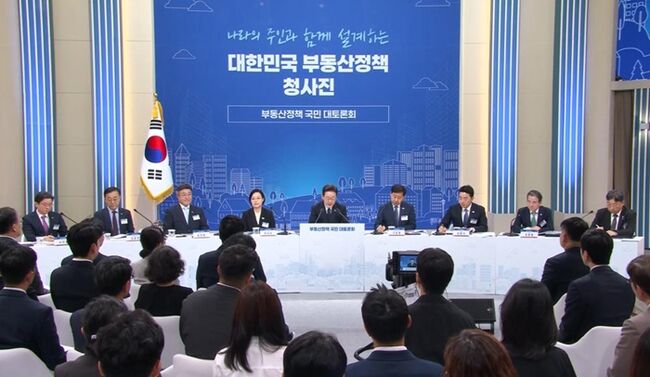 [Liberal Democratic Party Statement] Calling it a Grand Real Estate Debate… It Was Nothing More Than a Private Party Among Themselves
The 'National Grand Debate on Real Estate Policy' held on July 23rd and 27th. [Photo=Yonhap News]The 'National Grand Debate on Real Estate Policy,' hosted by the Lee Jae-myung administration under the
[Liberal Democratic Party Statement] Calling it a Grand Real Estate Debate… It Was Nothing More Than a Private Party Among Themselves
The 'National Grand Debate on Real Estate Policy' held on July 23rd and 27th. [Photo=Yonhap News]The 'National Grand Debate on Real Estate Policy,' hosted by the Lee Jae-myung administration under the
 [Photo] Evidence of Election Fraud Flooding U.S. Media… Trump Had 2.7 Million Votes Stolen
 [Video] U.S. Semiquincentennial Air Show... 'Art in the Sky' streaks across New York
 [Editorial Cartoon] A Draconian Law That Undermines Freedom of Expression

 List
List