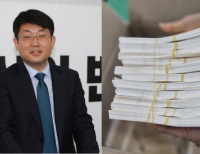
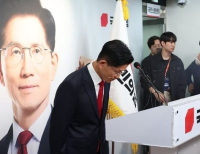
Jang Dong-hyuk, leader of the People Power Party, as the first filibuster speaker against the bill to establish a special court for sedition. He continued his opposing debate for approximately 24 hours from 11 AM on the 22nd to 11 AM on the 23rd. This was the first participation by an opposition party leader and broke the previous record of 17 hours. [Photo=Yonhap News]
Although Christmas is approaching, it's hard to hear carols on the streets. The National Assembly is in constant dispute, and with rising prices, exchange rates, and the Coupang situation overlapping, anxiety is growing. In a word, the political and economic environment at the end of the year is chaotic.
Various opinion polls being released also seem to reflect this atmosphere, with the approval ratings for the Lee Jae-myung administration turning downwards. The prevailing interpretation is that this is not simply a fluctuation in approval ratings, but a result of accumulated fatigue and distrust in politics overall.
A peculiar change is occurring in the public sentiment of the Honam region.
Starting with the President's remarks about "cleansing" the Unification Church, the public opinion in Honam, which had overwhelmingly supported the Lee Jae-myung administration, has begun to waver. It is analyzed that public sentiment, which had shown no significant change even with the discussion of establishing a special court for sedition, is now shifting due to its connection with the Democratic Party's political funds and corruption issues.
The opposition believes that this shift in public sentiment is the main reason behind the Democratic Party's decision to support the special prosecutor bill for the Unification Church. While the People Power Party had been campaigning by framing it as "legislative rampage," it was insufficient to create a turning point in public opinion, and they are seen as having seized an opportunity.
The scene on the 22nd, where Jang Dong-hyuk, leader of the People Power Party, took the floor for a filibuster against the "Bill to Establish a Special Court for Sedition" and delivered intense remarks for 23 hours, exemplifies this political tension.
As the People Power Party strives to slow down the Democratic Party, concerns are being raised within the legal community about the Lee Jae-myung administration's approach, which seems to be crossing the boundaries of the Constitution.
The repeated attempts to invoke special prosecutors when investigations are unsatisfactory and to modify the trial system when trials are deemed unstable are seen as politics redrawing the lines of the separation of powers established by the Constitution.
Legal scholars view this issue from the perspective of "the point and background at which power began to perceive constitutionally independent domains not as objects of trust, but as objects of management." There are concerns that if this change in perception is repeated through legislation, the independence of the judiciary and the guarantee of basic rights could be reduced from constitutional principles to adjustable variables.
The common thread running through these issues is a shift in perception where power treats constitutionally independent domains not as objects of "respect" but as "adjustable areas."
Tracing the traces of this perception by issue leads to special prosecutor bills, the establishment of special courts for sedition, and restrictions on freedom of expression.
The first sign that emerged was the normalization of special prosecutor bills. Special prosecutors are intended as an exceptional measure for when the existing investigative system does not function properly. However, as special prosecutors are invoked like a default option for every politically sensitive issue, the exception has begun to be perceived as the rule.
This goes beyond debates about fairness in individual cases and is interpreted as a withdrawal of trust in political processes from the judicial procedures envisioned by the Constitution. This is why equality before the law and the predictability of procedures are being shaken.
This trend did not stop at the investigative stage. The discussion on establishing a special court for sedition represents an expansion into the realm of trials. Despite the rationale of trial efficiency, attempts to interfere with the composition and allocation of courts through legislation are unavoidable in creating tension with the judiciary.
The dominant view in the legal community is that the flow of creating special prosecutors due to distrust in investigations and redesigning the trial structure due to distrust in trial outcomes directly touches the boundaries of power set by the Constitution.
The same logic is repeated in the area of expression. The discussion on amending the Act on Promotion of Information and Communications Network Utilization and Information Protection, etc., implies a structure that shifts the subject of judgment from individuals and the judiciary to administrative power, under the guise of responding to false information.
The emphasis on pre-emptive blocking rather than post-hoc accountability weakens trust in constitutional values such as freedom of expression and due process. This is why concerns are growing that the perception is spreading that even the domain of fundamental rights protected by the Constitution is being treated as an area to be managed.
Industrial policy is no exception. The promotion of the RE100 Industrial Complex Special Act, regardless of whether one supports or opposes the policy, shows a repetition of recent legislative methods that seek to finalize national strategies prior to sufficient social deliberation.
Although the fields differ, the decision-making methods are similar. The reason for the criticism of so-called "legislative sedition" can be summarized in one sentence: "Decisions and speed precede consensus and explanation." This is a scene where the procedures of democratic legitimacy required by the Constitution are being compressed.
If the politics of South Korea since the inauguration of the Lee Jae-myung administration are to be summarized in one sentence, it is "the public welfare is lost, and power repeatedly attempts to dominate the Constitution."
However, public sentiment is changing direction. What is being shaken now is not the pros and cons of a specific policy or bill. It is the anxiety that power is redrawing the lines on the boundaries of the Constitution.
The majority is not a license. Power gains legitimacy only when exercised within the Constitution, not above it. The moment that principle is shaken, public sentiment is the first to react.

 [Statement by the Seo-beo-kka Korea Military Academy Save-the-Nation Comrades Association] ㉛ Recount the Votes Publicly, as the Previous Recount Concealed Election Fraud
Tongyeong Mayoral Election Recount [Photo=Yonhap News]South Korea's liberal democracy is dying. The National Election Commission (NEC) and the judiciary, which have plummeted into criminal syndicates
[Statement by the Seo-beo-kka Korea Military Academy Save-the-Nation Comrades Association] ㉛ Recount the Votes Publicly, as the Previous Recount Concealed Election Fraud
Tongyeong Mayoral Election Recount [Photo=Yonhap News]South Korea's liberal democracy is dying. The National Election Commission (NEC) and the judiciary, which have plummeted into criminal syndicates
 What is the significance of the "Trump 2028" red hats that keep making a comeback?
It is noteworthy that President Donald Trump is "intentionally" fueling controversy over whether he can actually run in the 2028 presidential election, even though it is "highly likely he is seriously
What is the significance of the "Trump 2028" red hats that keep making a comeback?
It is noteworthy that President Donald Trump is "intentionally" fueling controversy over whether he can actually run in the 2028 presidential election, even though it is "highly likely he is seriously
 Jin Cummings: "North Korea says it will increase the number of spies, so what is the government doing?"
U.S. political columnist Gene Cummings has publicly questioned the South Korean government, asking, "North Korea is announcing plans to increase its number of spies, yet what is the South Korean
Jin Cummings: "North Korea says it will increase the number of spies, so what is the government doing?"
U.S. political columnist Gene Cummings has publicly questioned the South Korean government, asking, "North Korea is announcing plans to increase its number of spies, yet what is the South Korean
 Attorney Do Tae-woo: “Discrepancies in Voter Count and Improper Sealing Confirmed in Tongyeong Mayoral Recount… Official Request for Additional Verification Submitted to Gyeongnam Election Commission”
A bundle of mail-in early voting ballots captured by lawyer Do Tae-woo at the Tongyeong mayoral election recount site. A clear solid line, raising suspicions of election fraud, is visible on the side
Attorney Do Tae-woo: “Discrepancies in Voter Count and Improper Sealing Confirmed in Tongyeong Mayoral Recount… Official Request for Additional Verification Submitted to Gyeongnam Election Commission”
A bundle of mail-in early voting ballots captured by lawyer Do Tae-woo at the Tongyeong mayoral election recount site. A clear solid line, raising suspicions of election fraud, is visible on the side
 Stock Market Crash 'Black Tuesday'… KOSPI down 10.8%, KOSDAQ down 7.7%
The KOSPI fell by more than 5% in early trading on the 28th, triggering a sell-side sidecar.On the 28th, the KOSPI plunged by more than 10%.Due to the sharp decline, a sell-side sidecar—a temporary
Stock Market Crash 'Black Tuesday'… KOSPI down 10.8%, KOSDAQ down 7.7%
The KOSPI fell by more than 5% in early trading on the 28th, triggering a sell-side sidecar.On the 28th, the KOSPI plunged by more than 10%.Due to the sharp decline, a sell-side sidecar—a temporary
 [World Heritage Committee] 25 New World Heritage Sites Inscribed in Busan… South Korea Successfully Expands 'Getbol' Listing
The Chairperson of the World Heritage Committee speaks at the plenary session of the 48th session of the World Heritage Committee, held at BEXCO in Busan on the 20th. [Photo: Yonhap News]A total of 25
[World Heritage Committee] 25 New World Heritage Sites Inscribed in Busan… South Korea Successfully Expands 'Getbol' Listing
The Chairperson of the World Heritage Committee speaks at the plenary session of the 48th session of the World Heritage Committee, held at BEXCO in Busan on the 20th. [Photo: Yonhap News]A total of 25
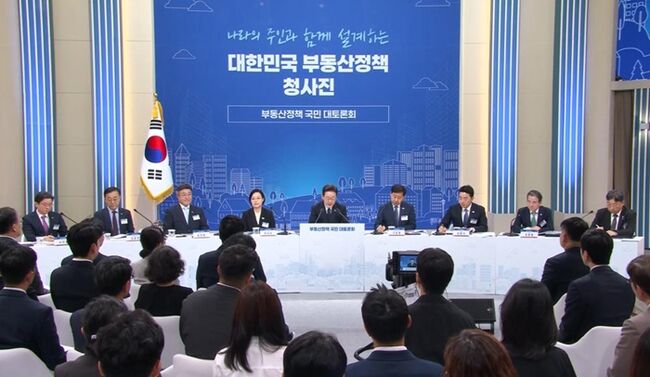 [Liberal Democratic Party Statement] Calling it a Grand Real Estate Debate… It Was Nothing More Than a Private Party Among Themselves
The 'National Grand Debate on Real Estate Policy' held on July 23rd and 27th. [Photo=Yonhap News]The 'National Grand Debate on Real Estate Policy,' hosted by the Lee Jae-myung administration under the
[Liberal Democratic Party Statement] Calling it a Grand Real Estate Debate… It Was Nothing More Than a Private Party Among Themselves
The 'National Grand Debate on Real Estate Policy' held on July 23rd and 27th. [Photo=Yonhap News]The 'National Grand Debate on Real Estate Policy,' hosted by the Lee Jae-myung administration under the
 [Photo] Evidence of Election Fraud Flooding U.S. Media… Trump Had 2.7 Million Votes Stolen
 [Video] U.S. Semiquincentennial Air Show... 'Art in the Sky' streaks across New York
 [Editorial Cartoon] A Draconian Law That Undermines Freedom of Expression

 List
List