‘1984’와 ‘동물농장’의 작가 조지 오웰(George Orwell)은 “국민을 망치는 가장 효율적인 방법은 그들 역사의 의미를 부정하고 말살하는 것”이라는 명언을 남겼다. 역사와 지성, 그리고 독서를 잊은 민족에게는 자유도 미래도 없다는 것이 역사가 증명하는 냉엄한 진리이다.
 General Walton Harris Walker (left) and his biography titled "the man who saved Korea." [Photo=Public Domain]
 Ha Bong-gyu, Professor Emeritus at Pukyong National University, Director of the UN Research InstituteThe 23rd marked the anniversary of the death of General Walton Harris Walker (1889-1950). He is the hero who saved the Republic of Korea from a dire crisis in the early stages of the Korean War as the commander of the U.S. Eighth Army.
There are two books that chronicle the life of General Walker. One of them has the subtitle, "the man who saved Korea."
General Patton Personally Awarded Walker's Stars
The author, who has long lectured on military history and leadership, has focused on the "Naktong River Line (also known as Walker Line)." This is because it was the only decisive victory the U.S. military achieved in its confrontation with Asian communism, following its victories in World War I and World War II. The U.S. military attempted to apply the Walker Line in the Vietnam War but ultimately failed.
General George S. Patton, a renowned warrior of World War II, personally awarded his three-star general insignia to General Walker, famously known by his nickname "Bulldog."
In April 1945, as World War II neared its end, General Patton personally removed his own insignia and placed it on Walker's shoulder, commending his valor, when Walker, a Major General who had achieved swift victories under Patton's command, earning him the moniker "Ghost Division," was promoted to Lieutenant General.
Tragically, both men died after being struck by friendly trucks shortly before Christmas. General Patton passed away first on December 21, 1945, and General Walker followed him on December 23, 1950.
During the Korean War, General Walker, who entered the conflict as the Commander of Ground Forces (Eighth Army) under an urgent order from General Douglas MacArthur, was met with the unexpected strength of the North Korean army.
Outmatched in firepower, including tanks, and in terms of troop numbers, the U.S. and ROK forces suffered repeated defeats, leading to a dire situation where 80% of the nation's territory was ravaged in just one month. The MacArthur Command, which had boasted, "North Korean forces will flee in surprise when they see the U.S. military," ultimately decided on a full retreat.
Do Not Retreat! Defend to the Death!
However, the usually reticent General Walker, in front of the frightened ROK and U.S. soldiers, roared, "I will stay here to protect Korea until my death," and issued the final order, "Stand or die."
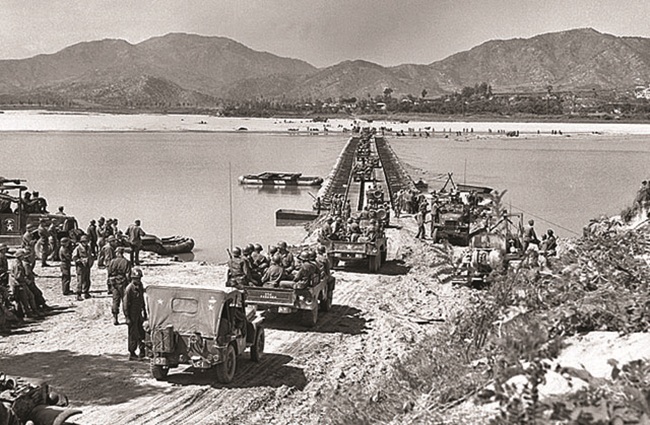 U.S. 24th Division troops crossing the Naktong River via a pontoon bridge during the Naktong River battle, considered the greatest crisis of the Korean War. [Photo=Public Domain]
The Naktong River Line, stretching 90km east to west and 150km north to south, was a massive defensive line combining terrain, urban areas, and strategy. It was a historic turning point, comparable to the 20th-century siege of Alesia by Caesar, where the commander's exceptional strategy and determination to fight to the death converged for a decisive victory.
During the Battle of Alesia, Caesar, with an army of only 50,000, built a double line of fortifications to achieve an immortal feat by decisively defeating the full-scale offensive of the 340,000 Gallic forces (80,000 within the city, 260,000 outside) led by Vercingetorix.
The Naktong River front was a stage of strategic innovation, combining trench warfare by the army with the three-dimensional maneuver warfare of the air force and marines. The courage, leadership, and exceptional strategy displayed by General Walker in this battle saved the Republic of Korea from peril and laid the crucial foundation for the Incheon Landing Operation.
Later, General Walker voiced his opposition to General MacArthur's strategy of a swift advance in relation to the northward push. He advocated for caution, considering the seasonal factor of severe cold and the variables of neighboring countries, but ultimately had to comply with the overall commander's intentions.
As he continued his northward advance, Chinese forces intervened as he had predicted, devastating the ROK forces and causing considerable difficulty in restoring their strength.
Walker's Death Leads to the January 4th Retreat in Korea
General Walker's sudden death while leading the defense of the Seoul metropolitan area against the Chinese offensive delivered a tremendous shock and confusion to the UN forces, which ultimately became one of the causes of the January 4th Retreat.
General Walker, who participated in the Korean War alongside his only son, Sam Walker, formed a special bond with Korea over three generations, as his grandson was later deployed to Korea.
George Orwell, the author of "1984" and "Animal Farm," left the profound statement, "The most effective way to destroy a people is to deny and obliterateiterate the meaning of their history."
The grim truth, as history has proven, is that a nation that forgets its history, intellect, and reading has neither freedom nor future.
Professor Emeritus at Pukyong National University, Director of the UN Research Institute

 [Statement by the Seo-beo-kka Korea Military Academy Save-the-Nation Comrades Association] ㉛ Recount the Votes Publicly, as the Previous Recount Concealed Election Fraud
Tongyeong Mayoral Election Recount [Photo=Yonhap News]South Korea's liberal democracy is dying. The National Election Commission (NEC) and the judiciary, which have plummeted into criminal syndicates
[Statement by the Seo-beo-kka Korea Military Academy Save-the-Nation Comrades Association] ㉛ Recount the Votes Publicly, as the Previous Recount Concealed Election Fraud
Tongyeong Mayoral Election Recount [Photo=Yonhap News]South Korea's liberal democracy is dying. The National Election Commission (NEC) and the judiciary, which have plummeted into criminal syndicates
 What is the significance of the "Trump 2028" red hats that keep making a comeback?
It is noteworthy that President Donald Trump is "intentionally" fueling controversy over whether he can actually run in the 2028 presidential election, even though it is "highly likely he is seriously
What is the significance of the "Trump 2028" red hats that keep making a comeback?
It is noteworthy that President Donald Trump is "intentionally" fueling controversy over whether he can actually run in the 2028 presidential election, even though it is "highly likely he is seriously
 Jin Cummings: "North Korea says it will increase the number of spies, so what is the government doing?"
U.S. political columnist Gene Cummings has publicly questioned the South Korean government, asking, "North Korea is announcing plans to increase its number of spies, yet what is the South Korean
Jin Cummings: "North Korea says it will increase the number of spies, so what is the government doing?"
U.S. political columnist Gene Cummings has publicly questioned the South Korean government, asking, "North Korea is announcing plans to increase its number of spies, yet what is the South Korean
 Attorney Do Tae-woo: “Discrepancies in Voter Count and Improper Sealing Confirmed in Tongyeong Mayoral Recount… Official Request for Additional Verification Submitted to Gyeongnam Election Commission”
A bundle of mail-in early voting ballots captured by lawyer Do Tae-woo at the Tongyeong mayoral election recount site. A clear solid line, raising suspicions of election fraud, is visible on the side
Attorney Do Tae-woo: “Discrepancies in Voter Count and Improper Sealing Confirmed in Tongyeong Mayoral Recount… Official Request for Additional Verification Submitted to Gyeongnam Election Commission”
A bundle of mail-in early voting ballots captured by lawyer Do Tae-woo at the Tongyeong mayoral election recount site. A clear solid line, raising suspicions of election fraud, is visible on the side
 Stock Market Crash 'Black Tuesday'… KOSPI down 10.8%, KOSDAQ down 7.7%
The KOSPI fell by more than 5% in early trading on the 28th, triggering a sell-side sidecar.On the 28th, the KOSPI plunged by more than 10%.Due to the sharp decline, a sell-side sidecar—a temporary
Stock Market Crash 'Black Tuesday'… KOSPI down 10.8%, KOSDAQ down 7.7%
The KOSPI fell by more than 5% in early trading on the 28th, triggering a sell-side sidecar.On the 28th, the KOSPI plunged by more than 10%.Due to the sharp decline, a sell-side sidecar—a temporary
 [World Heritage Committee] 25 New World Heritage Sites Inscribed in Busan… South Korea Successfully Expands 'Getbol' Listing
The Chairperson of the World Heritage Committee speaks at the plenary session of the 48th session of the World Heritage Committee, held at BEXCO in Busan on the 20th. [Photo: Yonhap News]A total of 25
[World Heritage Committee] 25 New World Heritage Sites Inscribed in Busan… South Korea Successfully Expands 'Getbol' Listing
The Chairperson of the World Heritage Committee speaks at the plenary session of the 48th session of the World Heritage Committee, held at BEXCO in Busan on the 20th. [Photo: Yonhap News]A total of 25
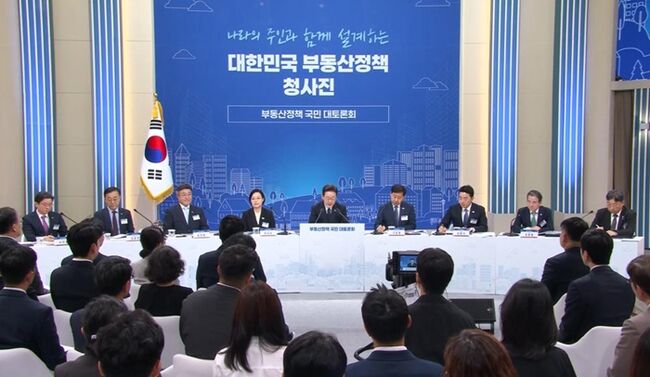 [Liberal Democratic Party Statement] Calling it a Grand Real Estate Debate… It Was Nothing More Than a Private Party Among Themselves
The 'National Grand Debate on Real Estate Policy' held on July 23rd and 27th. [Photo=Yonhap News]The 'National Grand Debate on Real Estate Policy,' hosted by the Lee Jae-myung administration under the
[Liberal Democratic Party Statement] Calling it a Grand Real Estate Debate… It Was Nothing More Than a Private Party Among Themselves
The 'National Grand Debate on Real Estate Policy' held on July 23rd and 27th. [Photo=Yonhap News]The 'National Grand Debate on Real Estate Policy,' hosted by the Lee Jae-myung administration under the
 [Photo] Evidence of Election Fraud Flooding U.S. Media… Trump Had 2.7 Million Votes Stolen
 [Video] U.S. Semiquincentennial Air Show... 'Art in the Sky' streaks across New York
 [Editorial Cartoon] A Draconian Law That Undermines Freedom of Expression

 List
List