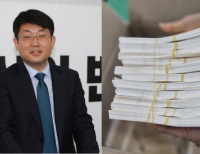
A woman in Hong Kong searches for books on a public library shelf on July 4, 2020. Following the implementation of the Hong Kong National Security Law, books by prominent pro-democracy figures, including Joshua Wong, have disappeared from public libraries and are no longer available for loan. [AFP=Yonhap News]
A Society Where Past Judgments and Future Standards Are Unsafe
The U.S. Department of State has publicly expressed concern over South Korea's amendment to the Act on Promotion of Information and Communications Network Utilization and Information Protection, often referred to as the 'Fake News Eradication Act'.
While the controversy often narrows down to freedom of expression or censorship, the essence of the issue is not simple.
The core dispute is not about who determines falsehood, but rather for how long that determination remains valid. In other words, the 'temporal structure' of records and accountability is changing.
This amendment, in form, does not introduce prior censorship. There are no provisions for administrative agencies to directly order content removal.
Instead, it defines the concepts of false and manipulated information through legislation and imposes punitive damages for intentional dissemination.
On the surface, this appears to be an enhancement of ex post facto civil liability. However, in practice, the locus of judgment shifts away from the judiciary.
When punitive damages are combined with the abstract concept of falsehood, media outlets and platforms find it difficult to wait for court judgments.
Rather than risking litigation, preemptively blocking and deleting content becomes the most rational choice. In this process, the standard for determining falsehood shifts from judicial rulings to platform-specific regulations and risk management logic.
The state may not censor directly, but judgment is rendered outside of judicial proceedings.
A more serious problem is the continuity of responsibility.
This law is not structured to make a single judgment on a post and then conclude. As long as the information remains, it can be interpreted as being 'in circulation,' thus subject to current illegality. Even if a record was created in the past, responsibility can be raised again if someone claims damages today.
While not a retroactive application of criminal penalties, it opens up a structure where past records can be scrutinized based on present standards.
This shakes the temporality of the legal order.
It's not simply a matter of unpredictability in future judgments. The decisive point is that even records that have already received social and legal judgment and have been finalized can be resurrected by current claims of damage.
This is not a procedural trial like an appeal or retrial, but a method that nullifies the very finality of judgment. Records can no longer remain in the past; they are subject to accountability based on present standards at any time.
If this structure becomes entrenched, the nature of records fundamentally changes.
Records become not subjects of verification and rebuttal, but burdens that can transform into legal risks at any moment. Media outlets will organize their archives, platforms will move to a constant blocking system, and researchers and citizens will hesitate to cite past records. It becomes a society where deletion, rather than judgment, is the solution.
This is why concerns about a 'modern-day book burning' arise. Today's book burning does not involve burning books, but rather begins with a structure where retaining records becomes dangerous.
Let's return to the simplest yet most crucial question.
“Why not just avoid writing fake news?”
The answer is clear: “That is not the case.”
The problem with this law lies not in whether one writes fake news, but in the structure that renders records unsafe in both the past and the future.
Even records that were written in the past, accepted as fact, and have undergone social and legal judgment can become subjects of responsibility again due to claims of damage today.
Concurrently, even if there are no issues in the present, if there is a possibility that a record could become problematic due to future changes in standards, then the record is unsafe even at this very moment.
In a society where past judgments are never finalized and future judgments are unpredictable, the most rational choice becomes clear.
It becomes safest to avoid leaving any record at all, rather than writing accurately or recording faithfully.
This is why the regulation of fake news is not merely an issue of freedom of expression, but a problem that threatens the persistence of records and the temporality of the legal order of a democratic society.
There may be no censorship, but in a society where the past is never over and the future is uncertain, records disappear on their own.
This is the real danger we face today.

 [Statement by the Seo-beo-kka Korea Military Academy Save-the-Nation Comrades Association] ㉛ Recount the Votes Publicly, as the Previous Recount Concealed Election Fraud
Tongyeong Mayoral Election Recount [Photo=Yonhap News]South Korea's liberal democracy is dying. The National Election Commission (NEC) and the judiciary, which have plummeted into criminal syndicates
[Statement by the Seo-beo-kka Korea Military Academy Save-the-Nation Comrades Association] ㉛ Recount the Votes Publicly, as the Previous Recount Concealed Election Fraud
Tongyeong Mayoral Election Recount [Photo=Yonhap News]South Korea's liberal democracy is dying. The National Election Commission (NEC) and the judiciary, which have plummeted into criminal syndicates
 What is the significance of the "Trump 2028" red hats that keep making a comeback?
It is noteworthy that President Donald Trump is "intentionally" fueling controversy over whether he can actually run in the 2028 presidential election, even though it is "highly likely he is seriously
What is the significance of the "Trump 2028" red hats that keep making a comeback?
It is noteworthy that President Donald Trump is "intentionally" fueling controversy over whether he can actually run in the 2028 presidential election, even though it is "highly likely he is seriously
 Jin Cummings: “North Korea says it will increase the number of spies, so what is the government doing?”
U.S. political columnist Gene Cummings has publicly questioned the South Korean government, asking, "North Korea is declaring that it will increase its number of spies, so what is the South Kore
Jin Cummings: “North Korea says it will increase the number of spies, so what is the government doing?”
U.S. political columnist Gene Cummings has publicly questioned the South Korean government, asking, "North Korea is declaring that it will increase its number of spies, so what is the South Kore
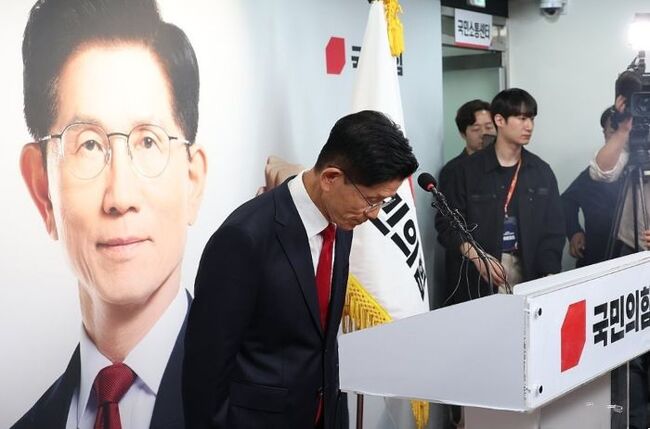 “Too little, too late?…” Kim Moon-soo, who previously conceded his presidential election defeat, now demands a special counsel investigation into ‘allegations of election fraud in the 2025 presidential election’
People Power Party presidential candidate Kim Moon-soo concedes defeat during a press conference at the party headquarters in Yeouido, Seoul, on June 4, 2025. [Joint Press Corps]As allegations emerge
“Too little, too late?…” Kim Moon-soo, who previously conceded his presidential election defeat, now demands a special counsel investigation into ‘allegations of election fraud in the 2025 presidential election’
People Power Party presidential candidate Kim Moon-soo concedes defeat during a press conference at the party headquarters in Yeouido, Seoul, on June 4, 2025. [Joint Press Corps]As allegations emerge
 Stock Market Crash 'Black Tuesday'… KOSPI down 10.8%, KOSDAQ down 7.7%
The KOSPI fell by more than 5% in early trading on the 28th, triggering a sell-side sidecar.On the 28th, the KOSPI plunged by more than 10%.Due to the sharp decline, a sell-side sidecar—a temporary
Stock Market Crash 'Black Tuesday'… KOSPI down 10.8%, KOSDAQ down 7.7%
The KOSPI fell by more than 5% in early trading on the 28th, triggering a sell-side sidecar.On the 28th, the KOSPI plunged by more than 10%.Due to the sharp decline, a sell-side sidecar—a temporary
 [World Heritage Committee] 25 New World Heritage Sites Inscribed in Busan… South Korea Successfully Expands 'Getbol' Listing
The Chairperson of the World Heritage Committee speaks at the plenary session of the 48th session of the World Heritage Committee, held at BEXCO in Busan on the 20th. [Photo: Yonhap News]A total of 25
[World Heritage Committee] 25 New World Heritage Sites Inscribed in Busan… South Korea Successfully Expands 'Getbol' Listing
The Chairperson of the World Heritage Committee speaks at the plenary session of the 48th session of the World Heritage Committee, held at BEXCO in Busan on the 20th. [Photo: Yonhap News]A total of 25
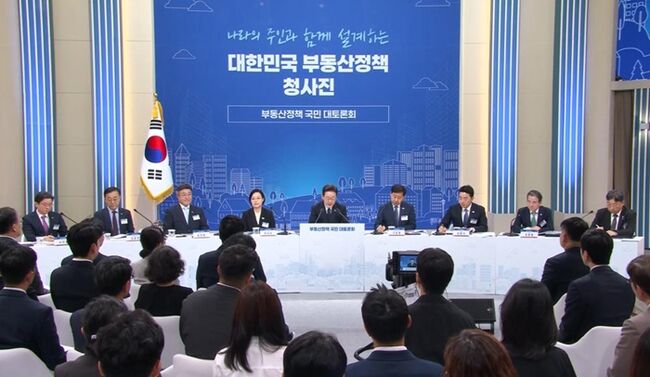 [Liberal Democratic Party Statement] Calling it a Grand Real Estate Debate… It Was Nothing More Than a Private Party Among Themselves
The 'National Grand Debate on Real Estate Policy' held on July 23rd and 27th. [Photo=Yonhap News]The 'National Grand Debate on Real Estate Policy,' hosted by the Lee Jae-myung administration under the
[Liberal Democratic Party Statement] Calling it a Grand Real Estate Debate… It Was Nothing More Than a Private Party Among Themselves
The 'National Grand Debate on Real Estate Policy' held on July 23rd and 27th. [Photo=Yonhap News]The 'National Grand Debate on Real Estate Policy,' hosted by the Lee Jae-myung administration under the
 [Photo] Evidence of Election Fraud Flooding U.S. Media… Trump Had 2.7 Million Votes Stolen
 [Video] U.S. Semiquincentennial Air Show... 'Art in the Sky' streaks across New York
 [Editorial Cartoon] A Draconian Law That Undermines Freedom of Expression

 List
List