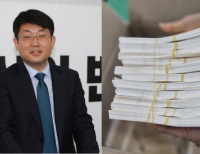
Lee Rae-jin, the elder brother of Mr. A, a public official from the Ministry of Oceans and Fisheries who was shot and killed by North Korean soldiers while drifting in the waters of Yeonpyeong Island in the West Sea, holds a press conference requesting information disclosure in front of the Blue House fountain on October 28, 2020, in Jongno-gu, Seoul. [Photo=Yonhap News]
The first-instance ruling in the West Sea public official murder case was not a verdict that concluded a single incident, but a judgment that clearly revealed what the judiciary should and should not judge.
The court did not ask whether the government's judgment at the time was correct or morally justifiable. Instead, it only considered whether the judgment crossed the threshold for criminal punishment and concluded that it "cannot be determined as a crime."
At this point, many felt bewildered.
Why Did the Court Not Hold Anyone Accountable?
People ask: Why did the court not hold anyone accountable, even though the state's judgment and actions clearly seemed inappropriate?
However, the essence of criminal trials lies elsewhere.
A criminal trial is not a procedure to judge whether state power operated incorrectly, but a procedure to determine whether a specific individual committed an act that constitutes the elements of a crime. The moment this boundary is confused, the judiciary degenerates from a tool of justice into an extension of politics.
The legal principle confirmed in the first instance of the West Sea case is cold.
Even if there are suspicions of distorted policy judgments, biased reporting, and political interference, these alone do not constitute criminal punishment.
Unless specific abuse of power, individual coercion, explicit directives, and resulting actual rights violations are proven, criminal law stops. The court does not punish structures. It does not convict explanations either.
Abuse of Power in the West Sea Case, If Applied to Rebellion Cases
Applying this legal principle directly to the ongoing rebellion and abuse of power trials brings an uncomfortable scene to mind.
Expressions like "structural rebellion," "the intention of power," and "implicit approval" are politically powerful but become vulnerable in court. This is because the logic that the court excluded in the West Sea case is being repeated in the rebellion case.
The language of criminal trials is proof, not interpretation, and requirements, not anger.
Abuse of power is the most dangerous charge at this point.
Although it is a provision created to punish the abuse of power, it is also a crime where power can most easily argue "what was within the scope of duty?"
If the scope of official duties is unclear or "unnecessary acts" are presented abstractly, the court will not easily recognize the establishment of a crime. This is why abuse of power collapses first as political anger grows.
The standard for judging abuse of power shown in the West Sea case will inevitably be applied to the rebellion case as well.
However, the questions should not end here.
The Issue in the West Sea Case is the Relief of the Victim
This is because the absence of criminal liability does not mean the disappearance of responsibility. The true challenge left by the West Sea public official case is not the success or failure of punishment, but the issue of victim relief.
A criminal acquittal is not a denial of state responsibility. Rather, from that moment on, the center of gravity of responsibility shifts from criminal to administrative and constitutional law.
If a criminal trial is a procedure to determine an individual's crime, then state compensation and administrative responsibility are procedures to ask whether the state system operated normally. State compensation liability, which can be established even with negligence, asks whether the judgment and response at the time exceeded the scope of reasonable discretion.
Questions remain as to whether the hasty "defection to North Korea" judgment was appropriate, whether the state fulfilled its duty of protection, and whether the post-incident response and records were handled responsibly.
This is why the correction of administrative judgments and the restoration of honor are important. As long as the records are not corrected, the damage will not end.
This article is not intended to prejudge the guilt or innocence in a specific trial.
However, it asks whether it is a responsible attitude to bring another tragedy to court in the same way, while ignoring the way the judiciary operated in the West Sea public official case.
The more we acknowledge the limits of the judiciary, the clearer state responsibility must become.
This is the real question left by the first-instance trial of the West Sea public official case, and the point we must not miss when looking at the rebellion and abuse of power trials.
By Reporter Kim Young

 [Statement by the Seo-beo-kka Korea Military Academy Save-the-Nation Comrades Association] ㉛ Recount the Votes Publicly, as the Previous Recount Concealed Election Fraud
Tongyeong Mayoral Election Recount [Photo=Yonhap News]South Korea's liberal democracy is dying. The National Election Commission (NEC) and the judiciary, which have plummeted into criminal syndicates
[Statement by the Seo-beo-kka Korea Military Academy Save-the-Nation Comrades Association] ㉛ Recount the Votes Publicly, as the Previous Recount Concealed Election Fraud
Tongyeong Mayoral Election Recount [Photo=Yonhap News]South Korea's liberal democracy is dying. The National Election Commission (NEC) and the judiciary, which have plummeted into criminal syndicates
 What is the significance of the "Trump 2028" red hats that keep making a comeback?
It is noteworthy that President Donald Trump is "intentionally" fueling controversy over whether he can actually run in the 2028 presidential election, even though it is "highly likely he is seriously
What is the significance of the "Trump 2028" red hats that keep making a comeback?
It is noteworthy that President Donald Trump is "intentionally" fueling controversy over whether he can actually run in the 2028 presidential election, even though it is "highly likely he is seriously
 Jin Cummings: “North Korea says it will increase the number of spies, so what is the government doing?”
U.S. political columnist Gene Cummings has publicly questioned the South Korean government, asking, "North Korea is declaring that it will increase its number of spies, so what is the South Kore
Jin Cummings: “North Korea says it will increase the number of spies, so what is the government doing?”
U.S. political columnist Gene Cummings has publicly questioned the South Korean government, asking, "North Korea is declaring that it will increase its number of spies, so what is the South Kore
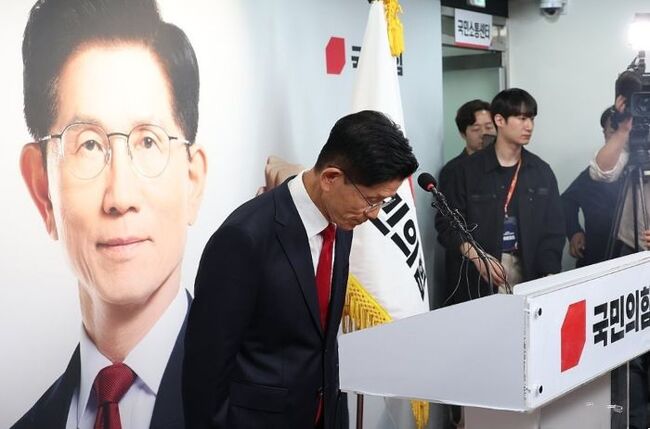 “Too little, too late?…” Kim Moon-soo, who previously conceded his presidential election defeat, now demands a special counsel investigation into ‘allegations of election fraud in the 2025 presidential election’
People Power Party presidential candidate Kim Moon-soo concedes defeat during a press conference at the party headquarters in Yeouido, Seoul, on June 4, 2025. [Joint Press Corps]As allegations emerge
“Too little, too late?…” Kim Moon-soo, who previously conceded his presidential election defeat, now demands a special counsel investigation into ‘allegations of election fraud in the 2025 presidential election’
People Power Party presidential candidate Kim Moon-soo concedes defeat during a press conference at the party headquarters in Yeouido, Seoul, on June 4, 2025. [Joint Press Corps]As allegations emerge
 Stock Market Crash 'Black Tuesday'… KOSPI down 10.8%, KOSDAQ down 7.7%
The KOSPI fell by more than 5% in early trading on the 28th, triggering a sell-side sidecar.On the 28th, the KOSPI plunged by more than 10%.Due to the sharp decline, a sell-side sidecar—a temporary
Stock Market Crash 'Black Tuesday'… KOSPI down 10.8%, KOSDAQ down 7.7%
The KOSPI fell by more than 5% in early trading on the 28th, triggering a sell-side sidecar.On the 28th, the KOSPI plunged by more than 10%.Due to the sharp decline, a sell-side sidecar—a temporary
 [World Heritage Committee] 25 New World Heritage Sites Inscribed in Busan… South Korea Successfully Expands 'Getbol' Listing
The Chairperson of the World Heritage Committee speaks at the plenary session of the 48th session of the World Heritage Committee, held at BEXCO in Busan on the 20th. [Photo: Yonhap News]A total of 25
[World Heritage Committee] 25 New World Heritage Sites Inscribed in Busan… South Korea Successfully Expands 'Getbol' Listing
The Chairperson of the World Heritage Committee speaks at the plenary session of the 48th session of the World Heritage Committee, held at BEXCO in Busan on the 20th. [Photo: Yonhap News]A total of 25
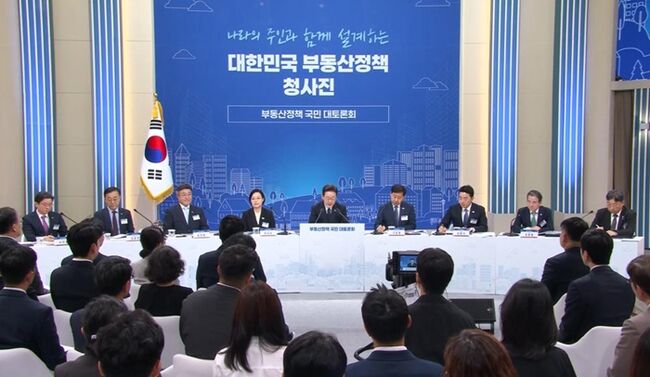 [Liberal Democratic Party Statement] Calling it a Grand Real Estate Debate… It Was Nothing More Than a Private Party Among Themselves
The 'National Grand Debate on Real Estate Policy' held on July 23rd and 27th. [Photo=Yonhap News]The 'National Grand Debate on Real Estate Policy,' hosted by the Lee Jae-myung administration under the
[Liberal Democratic Party Statement] Calling it a Grand Real Estate Debate… It Was Nothing More Than a Private Party Among Themselves
The 'National Grand Debate on Real Estate Policy' held on July 23rd and 27th. [Photo=Yonhap News]The 'National Grand Debate on Real Estate Policy,' hosted by the Lee Jae-myung administration under the
 [Photo] Evidence of Election Fraud Flooding U.S. Media… Trump Had 2.7 Million Votes Stolen
 [Video] U.S. Semiquincentennial Air Show... 'Art in the Sky' streaks across New York
 [Editorial Cartoon] A Draconian Law That Undermines Freedom of Expression

 List
List