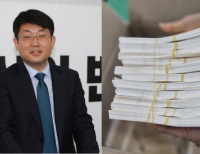
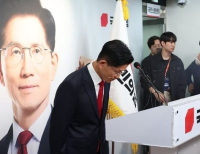
Kim Do-eup, the People Power Party's Policy Committee Chairman, speaks at a party leadership meeting at the National Assembly on the 19th. [Photo=Yonhap News]
Kim Do-eup, the chairman of the People Power Party's Policy Committee, resigned, sparking various interpretations. Some suggested a crack in the party leadership, while others analyzed it as a signal of ideological conflict.
However, viewing this resignation solely as a personal decision or a political message oversimplifies the issue.
Kim Do-eup's resignation highlights the limitations of the People Power Party's internal structure, rather than an individual's choice.
Kim Do-eup was a relatively suitable figure for the Policy Committee Chairman role. He had weak factional ties, avoided open confrontation, and treated policy as an object for coordination and explanation rather than a political weapon. He can be assessed as being closest to the role of a 'communicator' that an opposition party's policy chief should originally fulfill.
Nevertheless, the fact that he stepped down demonstrates that this position is not one that can be sustained by the capabilities of a specific individual.
In an opposition party, the Policy Committee Chairman is not a policy designer. This is because the opposition party's policies are a matter of deployment rather than execution.
More important than what to create is when to release it, within what frame to present it, and where to stop. The core function is strategic, translating policy into political language and deploying it according to the flow of political events.
However, the People Power Party's policy committee has long been solidified as a position that bears responsibility but lacks authority.
At the center of this structure is the Yeouido Institute. While the Yeouido Institute, the People Power Party's official think tank, has been diligent in policy research and data production, it is difficult to see it functioning as a strategic institution.
Reports accumulate, but the judgment of when to write and when to shelve policies is not organized. It explains the coherence of policies but lacks the function of calculating political effects. It is a state of having research but no strategy.
Looking at who the current head of the Yeouido Institute is reveals the current state of the People Power Party.
The fact that the head of the institute is someone strong in policy execution and administrative experience shows that this organization is still perceived as a 'policy coordination window' rather than a 'strategy production base'.
This is not a matter of individual capability, but rather a scene that fully reveals what role the People Power Party has expected from the Yeouido Institute.
At this point, the difference with the Democratic Research Institute of the Democratic Party becomes clear.
The Democratic Research Institute has gone beyond being a mere policy research institute to serve as a strategic brain for the party leader. It deploys policies according to election phases and changes in the political climate, and jointly designs the direction and timing of messages. The director of the Democratic Research Institute is closer to a strategic aide than a research institute director.
This difference stems not from individual capabilities, but from the difference in the roles assigned to the research institute by the political party.
The People Power Party has intentionally separated policy research and strategy. During election periods, the Yeouido Institute virtually fails to make its presence felt beyond its role in opinion polling. Strategists cannot grow in a structure where the research institute remains confined to policy research, and the policy committee bears the responsibility.
Attempts at strategic judgment were met with the assessment of "deviating from policy," and attempts at coordination were followed by criticism of "lacking fighting spirit." As a result, communicative figures are exhausted, and the position of Policy Committee Chairman has repeatedly experienced vacancies and changes.
Therefore, returning to discussions about appointing a new Policy Committee Chairman after Kim Do-eup's resignation bypasses the core issue.
The problem is not who sits in the position, but what the person who sits there can do. As long as the Yeouido Institute remains merely a repository of policy data, the Policy Committee Chairman will inevitably continue to serve as a shield.
The question posed by Kim Do-eup's resignation is simple.
Is the People Power Party prepared to produce strategy? Does it have the will to transform from an organization that explains policy answers to an organization that politically utilizes policy?
A political party does not revive by changing people. If the structure does not change, personnel changes are consumed.
Kim Do-eup's resignation is an event that once again reveals those structural limitations.
What needs to be asked now is not "Who will be the next Policy Committee Chairman?" but "Why is the People Power Party unable to create strategy?"
Reporter Kim Young

 [Statement by the Seo-beo-kka Korea Military Academy Save-the-Nation Comrades Association] ㉛ Recount the Votes Publicly, as the Previous Recount Concealed Election Fraud
Tongyeong Mayoral Election Recount [Photo=Yonhap News]South Korea's liberal democracy is dying. The National Election Commission (NEC) and the judiciary, which have plummeted into criminal syndicates
[Statement by the Seo-beo-kka Korea Military Academy Save-the-Nation Comrades Association] ㉛ Recount the Votes Publicly, as the Previous Recount Concealed Election Fraud
Tongyeong Mayoral Election Recount [Photo=Yonhap News]South Korea's liberal democracy is dying. The National Election Commission (NEC) and the judiciary, which have plummeted into criminal syndicates
 What is the significance of the "Trump 2028" red hats that keep making a comeback?
It is noteworthy that President Donald Trump is "intentionally" fueling controversy over whether he can actually run in the 2028 presidential election, even though it is "highly likely he is seriously
What is the significance of the "Trump 2028" red hats that keep making a comeback?
It is noteworthy that President Donald Trump is "intentionally" fueling controversy over whether he can actually run in the 2028 presidential election, even though it is "highly likely he is seriously
 Jin Cummings: "North Korea says it will increase the number of spies, so what is the government doing?"
U.S. political columnist Gene Cummings has publicly questioned the South Korean government, asking, "North Korea is announcing plans to increase its number of spies, yet what is the South Korean
Jin Cummings: "North Korea says it will increase the number of spies, so what is the government doing?"
U.S. political columnist Gene Cummings has publicly questioned the South Korean government, asking, "North Korea is announcing plans to increase its number of spies, yet what is the South Korean
 Attorney Do Tae-woo: “Discrepancies in Voter Count and Improper Sealing Confirmed in Tongyeong Mayoral Recount… Official Request for Additional Verification Submitted to Gyeongnam Election Commission”
A bundle of mail-in early voting ballots captured by lawyer Do Tae-woo at the Tongyeong mayoral election recount site. A clear solid line, raising suspicions of election fraud, is visible on the side
Attorney Do Tae-woo: “Discrepancies in Voter Count and Improper Sealing Confirmed in Tongyeong Mayoral Recount… Official Request for Additional Verification Submitted to Gyeongnam Election Commission”
A bundle of mail-in early voting ballots captured by lawyer Do Tae-woo at the Tongyeong mayoral election recount site. A clear solid line, raising suspicions of election fraud, is visible on the side
 Stock Market Crash 'Black Tuesday'… KOSPI down 10.8%, KOSDAQ down 7.7%
The KOSPI fell by more than 5% in early trading on the 28th, triggering a sell-side sidecar.On the 28th, the KOSPI plunged by more than 10%.Due to the sharp decline, a sell-side sidecar—a temporary
Stock Market Crash 'Black Tuesday'… KOSPI down 10.8%, KOSDAQ down 7.7%
The KOSPI fell by more than 5% in early trading on the 28th, triggering a sell-side sidecar.On the 28th, the KOSPI plunged by more than 10%.Due to the sharp decline, a sell-side sidecar—a temporary
 [World Heritage Committee] 25 New World Heritage Sites Inscribed in Busan… South Korea Successfully Expands 'Getbol' Listing
The Chairperson of the World Heritage Committee speaks at the plenary session of the 48th session of the World Heritage Committee, held at BEXCO in Busan on the 20th. [Photo: Yonhap News]A total of 25
[World Heritage Committee] 25 New World Heritage Sites Inscribed in Busan… South Korea Successfully Expands 'Getbol' Listing
The Chairperson of the World Heritage Committee speaks at the plenary session of the 48th session of the World Heritage Committee, held at BEXCO in Busan on the 20th. [Photo: Yonhap News]A total of 25
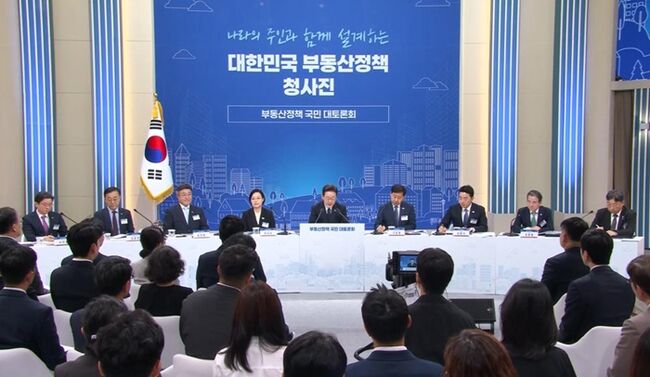 [Liberal Democratic Party Statement] Calling it a Grand Real Estate Debate… It Was Nothing More Than a Private Party Among Themselves
The 'National Grand Debate on Real Estate Policy' held on July 23rd and 27th. [Photo=Yonhap News]The 'National Grand Debate on Real Estate Policy,' hosted by the Lee Jae-myung administration under the
[Liberal Democratic Party Statement] Calling it a Grand Real Estate Debate… It Was Nothing More Than a Private Party Among Themselves
The 'National Grand Debate on Real Estate Policy' held on July 23rd and 27th. [Photo=Yonhap News]The 'National Grand Debate on Real Estate Policy,' hosted by the Lee Jae-myung administration under the
 [Photo] Evidence of Election Fraud Flooding U.S. Media… Trump Had 2.7 Million Votes Stolen
 [Video] U.S. Semiquincentennial Air Show... 'Art in the Sky' streaks across New York
 [Editorial Cartoon] A Draconian Law That Undermines Freedom of Expression

 List
List