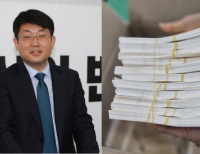
Seoul Metropolitan Police Commissioner Park Jeong-bo and Gyeonggi Nambu Provincial Police Commissioner Hwang Chang-sun [Photo=Yonhap News]
Controversy over a "flight for evasion" has arisen after Seoul City Council member Kim Gyeong, identified as a key figure in allegations of party nomination kickbacks, departed the country immediately after the recording was reported. However, investigative agencies opted only for a "notification upon arrival" measure instead of an exit ban or arrest warrant.
The core of this case lies not in Kim Gyeong's personal behavior, but in the criteria the police are using for their investigative judgments.
Does Kim Gyeong's Departure Constitute "Evasion"?
Seoul City Council member Kim Gyeong departed for the United States on December 30, 2025, the day after the recording related to the nomination kickback allegations was reported. At the time, no exit ban was in place, and the police, upon belatedly learning of his departure, requested "notification upon arrival" from the Ministry of Justice. Kim's side stated, "There was no intention to flee, and he will cooperate with the investigation upon his return."
Under current law, departing overseas without an exit ban in effect is not illegal.
It is not possible to definitively conclude "evasion" in a legal sense solely based on the act of leaving the country. However, considering the timing immediately after the recording's release and his status as a key suspect, it is arguable that investigative agencies should have considered more proactive measures to secure his presence.
Why Was an Exit Ban Not Implemented First?
An exit ban can be requested by investigative agencies under the Immigration Act if there is △ identification of the suspect, △ reasonable suspicion of the alleged crime, and △ concern of flight or destruction of evidence. It can be preemptively requested even in the early stages of an investigation.
The police explained, "The case was officially received on January 2nd, and there was a need for physical time, including weekends and consultations with the prosecution."
However, in this case, the recording, as tangible evidence, had already been released, and the individuals involved and the criminal structure were relatively clear. Given that it does not appear to be a situation where an exit ban request was legally impossible, the question remains whether the police underestimated the urgency of the case.
Why Was an Arrest Warrant Not Sought?
Under the Criminal Procedure Act, an arrest warrant is issued when △ reasonable suspicion of the alleged crime, △ concern of flight or destruction of evidence, and △ urgency are all met simultaneously.
In this case, the reasonable suspicion of the alleged crime is considered to have been substantially met due to the release of the recording, among other factors. Despite this, the police opted for a "notification upon arrival" measure instead of seeking an arrest warrant.
This is interpreted not as an inability to "request an arrest warrant," but rather because the police assessed the risk of flight and urgency as low. Legal circles have commented, "It wasn't that they couldn't, but that they chose not to."
Is Investigating by Summoning Peripheral Figures Normal?
The police are currently conducting questioning of peripheral figures, including former aides Kang Seon-woo and Kim Byeong-gi. This is also a standard investigative method to understand the structure of the case.
However, when the investigation proceeds from the outer layers while the key suspect is abroad, it is realistic for questions to arise regarding the will and pace of the investigation. This method, in particular, has been repeatedly controversial in political fund cases in the past.
Is Kim Gyeong a "Dangerous Suspect" in the Police's Eyes?
The measures taken by the police against Seoul City Council member Kim Gyeong are not an exit ban, an arrest warrant, or a wanted notice❌; they involve notification upon arrival and an investigation premised on voluntary return.
In practical investigative terms, this is a measure chosen when the risk of flight and urgency are deemed low, and the investigation can proceed with voluntary appearance.
This is often described as dealing with a "good suspect," but more accurately, it signifies that the police have classified Kim Gyeong as a "manageable suspect" and an "un-urgent suspect."
However, considering the circumstances of his departure immediately after the recording's release and the political ramifications of the case, the question remains whether this judgment is excessively lenient compared to other political fund cases.
The Inconsistent Standards of Investigative Agencies Are the Problem
The core of this case is not Kim Gyeong's departure itself.
The issue is why the investigation only began in earnest after the key suspect had already left the country, and why the mildest measure was chosen instead of the strongest ones.
This is not a matter of personal conduct, but a question of how seriously the investigative agencies view this case and whether their judgment standards are consistent.

 [Statement by the Seo-beo-kka Korea Military Academy Save-the-Nation Comrades Association] ㉛ Recount the Votes Publicly, as the Previous Recount Concealed Election Fraud
Tongyeong Mayoral Election Recount [Photo=Yonhap News]South Korea's liberal democracy is dying. The National Election Commission (NEC) and the judiciary, which have plummeted into criminal syndicates
[Statement by the Seo-beo-kka Korea Military Academy Save-the-Nation Comrades Association] ㉛ Recount the Votes Publicly, as the Previous Recount Concealed Election Fraud
Tongyeong Mayoral Election Recount [Photo=Yonhap News]South Korea's liberal democracy is dying. The National Election Commission (NEC) and the judiciary, which have plummeted into criminal syndicates
 What is the significance of the "Trump 2028" red hats that keep making a comeback?
It is noteworthy that President Donald Trump is "intentionally" fueling controversy over whether he can actually run in the 2028 presidential election, even though it is "highly likely he is seriously
What is the significance of the "Trump 2028" red hats that keep making a comeback?
It is noteworthy that President Donald Trump is "intentionally" fueling controversy over whether he can actually run in the 2028 presidential election, even though it is "highly likely he is seriously
 Jin Cummings: "North Korea says it will increase the number of spies, so what is the government doing?"
U.S. political columnist Gene Cummings has publicly questioned the South Korean government, asking, "North Korea is announcing plans to increase its number of spies, yet what is the South Korean
Jin Cummings: "North Korea says it will increase the number of spies, so what is the government doing?"
U.S. political columnist Gene Cummings has publicly questioned the South Korean government, asking, "North Korea is announcing plans to increase its number of spies, yet what is the South Korean
 Attorney Do Tae-woo: “Discrepancies in Voter Count and Improper Sealing Confirmed in Tongyeong Mayoral Recount… Official Request for Additional Verification Submitted to Gyeongnam Election Commission”
A bundle of mail-in early voting ballots captured by lawyer Do Tae-woo at the Tongyeong mayoral election recount site. A clear solid line, raising suspicions of election fraud, is visible on the side
Attorney Do Tae-woo: “Discrepancies in Voter Count and Improper Sealing Confirmed in Tongyeong Mayoral Recount… Official Request for Additional Verification Submitted to Gyeongnam Election Commission”
A bundle of mail-in early voting ballots captured by lawyer Do Tae-woo at the Tongyeong mayoral election recount site. A clear solid line, raising suspicions of election fraud, is visible on the side
 Stock Market Crash 'Black Tuesday'… KOSPI down 10.8%, KOSDAQ down 7.7%
The KOSPI fell by more than 5% in early trading on the 28th, triggering a sell-side sidecar.On the 28th, the KOSPI plunged by more than 10%.Due to the sharp decline, a sell-side sidecar—a temporary
Stock Market Crash 'Black Tuesday'… KOSPI down 10.8%, KOSDAQ down 7.7%
The KOSPI fell by more than 5% in early trading on the 28th, triggering a sell-side sidecar.On the 28th, the KOSPI plunged by more than 10%.Due to the sharp decline, a sell-side sidecar—a temporary
 [World Heritage Committee] 25 New World Heritage Sites Inscribed in Busan… South Korea Successfully Expands 'Getbol' Listing
The Chairperson of the World Heritage Committee speaks at the plenary session of the 48th session of the World Heritage Committee, held at BEXCO in Busan on the 20th. [Photo: Yonhap News]A total of 25
[World Heritage Committee] 25 New World Heritage Sites Inscribed in Busan… South Korea Successfully Expands 'Getbol' Listing
The Chairperson of the World Heritage Committee speaks at the plenary session of the 48th session of the World Heritage Committee, held at BEXCO in Busan on the 20th. [Photo: Yonhap News]A total of 25
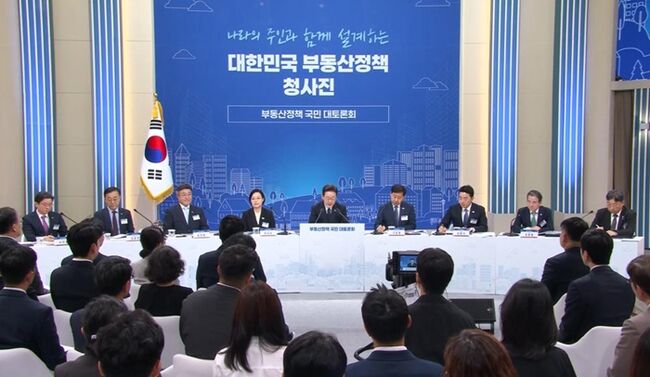 [Liberal Democratic Party Statement] Calling it a Grand Real Estate Debate… It Was Nothing More Than a Private Party Among Themselves
The 'National Grand Debate on Real Estate Policy' held on July 23rd and 27th. [Photo=Yonhap News]The 'National Grand Debate on Real Estate Policy,' hosted by the Lee Jae-myung administration under the
[Liberal Democratic Party Statement] Calling it a Grand Real Estate Debate… It Was Nothing More Than a Private Party Among Themselves
The 'National Grand Debate on Real Estate Policy' held on July 23rd and 27th. [Photo=Yonhap News]The 'National Grand Debate on Real Estate Policy,' hosted by the Lee Jae-myung administration under the
 [Photo] Evidence of Election Fraud Flooding U.S. Media… Trump Had 2.7 Million Votes Stolen
 [Video] U.S. Semiquincentennial Air Show... 'Art in the Sky' streaks across New York
 [Editorial Cartoon] A Draconian Law That Undermines Freedom of Expression

 List
List