Bank of Korea Governor Rhee Chang-yong delivers his New Year's address at the Bank of Korea's New Year's ceremony on the 2nd. [Photo=Yonhap News]
The market's reaction to the Bank of Korea's explanations is not unusual, as the won-dollar exchange rate has been fluctuating in the late 1440 won range recently.
The Bank of Korea repeatedly states its position, saying, "The current exchange rate level does not reflect economic fundamentals" and "Market functions are operating normally." However, the foreign exchange market and investors perceive it differently.
The issue is not the exchange rate level itself, but rather that market confidence in the Bank of Korea's judgment criteria has hit rock bottom.
The Bank of Korea has traditionally emphasized its principle of not setting specific exchange rate numbers as defense lines. Instead, it explains that it uses factors such as volatility, supply and demand structure, divergence from fundamentals, and the normalcy of market functions as comprehensive judgment criteria.
However, these criteria share a common weakness: quantitative standards are not disclosed.
It is impossible for outsiders to verify how much volatility is "excessive," which combination of indicators constitutes a "divergence from fundamentals," and when that judgment is resolved.
This way of explaining things results in weakened trust the more it is repeated during times of crisis.
Even in a high exchange rate environment, the Bank of Korea states that "fundamentals are sound," yet at the same time, intervention that is interpreted as smoothing operations is repeatedly detected in the foreign exchange market.
As the perception builds that the official message is stability but the actual actions are close to defense, the market has begun to interpret the situation based on the Bank of Korea's actions rather than its words.
In particular, distrust has grown with the recent explanation that exchange rate fluctuations are due to "pension fund overseas investments and genuine demand."
Increased overseas investment by pension funds or demand for import payments are not new variables but structural factors already inherent in the market. Nevertheless, if the exchange rate reacted sensitively at a specific point in time, the market interprets this as a problem of management capability.
The explanation "due to genuine demand" is perceived not as an identification of the cause, but as an admission of uncontrollability.
Another factor is the temporal structure of the explanations.
The Bank of Korea's messages are generally retrospective. The pattern of explaining "excessive movements" and "divergence from fundamentals" after the exchange rate has changed rapidly is repeated.
On the other hand, what the market desires is a preemptive guideline on how far things could potentially go in the worst-case scenario and under what conditions intervention will be strengthened.
As this gap does not narrow, the perception that "the Bank of Korea's explanations are always late" is becoming entrenched.
This distrust is not just an emotional issue but is leading to actual investment behavior.
Recently, movements such as avoidance of won-denominated assets, preference for dollar holdings, and caution regarding short-term exchange rate peaks are simultaneously appearing in the market.
This is less about conviction on the direction of the exchange rate and more about defensive choices made due to weakened confidence in policy signals.
Ultimately, the core issue is not whether the exchange rate is 1450 won or 1430 won.
It is the loss of predictability regarding the Bank of Korea's judgment criteria and the timing and method of its responses.
The market is reacting conservatively not because it exaggerates crises, but because it cannot ascertain the criteria.
The challenge facing the Bank of Korea is not to explain the exchange rate, but to restore a structure where explanations lead to trust.
Otherwise, the word "stable" is likely to lose its persuasiveness the more it is repeated.
By Reporter Kim Young

 [Statement by the Seo-beo-kka Korea Military Academy Save-the-Nation Comrades Association] ㉛ Recount the Votes Publicly, as the Previous Recount Concealed Election Fraud
Tongyeong Mayoral Election Recount [Photo=Yonhap News]South Korea's liberal democracy is dying. The National Election Commission (NEC) and the judiciary, which have plummeted into criminal syndicates
[Statement by the Seo-beo-kka Korea Military Academy Save-the-Nation Comrades Association] ㉛ Recount the Votes Publicly, as the Previous Recount Concealed Election Fraud
Tongyeong Mayoral Election Recount [Photo=Yonhap News]South Korea's liberal democracy is dying. The National Election Commission (NEC) and the judiciary, which have plummeted into criminal syndicates
 What is the significance of the "Trump 2028" red hats that keep making a comeback?
It is noteworthy that President Donald Trump is "intentionally" fueling controversy over whether he can actually run in the 2028 presidential election, even though it is "highly likely he is seriously
What is the significance of the "Trump 2028" red hats that keep making a comeback?
It is noteworthy that President Donald Trump is "intentionally" fueling controversy over whether he can actually run in the 2028 presidential election, even though it is "highly likely he is seriously
 Jin Cummings: "North Korea says it will increase the number of spies, so what is the government doing?"
U.S. political columnist Gene Cummings has publicly questioned the South Korean government, asking, "North Korea is announcing plans to increase its number of spies, yet what is the South Korean
Jin Cummings: "North Korea says it will increase the number of spies, so what is the government doing?"
U.S. political columnist Gene Cummings has publicly questioned the South Korean government, asking, "North Korea is announcing plans to increase its number of spies, yet what is the South Korean
 Attorney Do Tae-woo: “Discrepancies in Voter Count and Improper Sealing Confirmed in Tongyeong Mayoral Recount… Official Request for Additional Verification Submitted to Gyeongnam Election Commission”
A bundle of mail-in early voting ballots captured by lawyer Do Tae-woo at the Tongyeong mayoral election recount site. A clear solid line, raising suspicions of election fraud, is visible on the side
Attorney Do Tae-woo: “Discrepancies in Voter Count and Improper Sealing Confirmed in Tongyeong Mayoral Recount… Official Request for Additional Verification Submitted to Gyeongnam Election Commission”
A bundle of mail-in early voting ballots captured by lawyer Do Tae-woo at the Tongyeong mayoral election recount site. A clear solid line, raising suspicions of election fraud, is visible on the side
 Stock Market Crash 'Black Tuesday'… KOSPI down 10.8%, KOSDAQ down 7.7%
The KOSPI fell by more than 5% in early trading on the 28th, triggering a sell-side sidecar.On the 28th, the KOSPI plunged by more than 10%.Due to the sharp decline, a sell-side sidecar—a temporary
Stock Market Crash 'Black Tuesday'… KOSPI down 10.8%, KOSDAQ down 7.7%
The KOSPI fell by more than 5% in early trading on the 28th, triggering a sell-side sidecar.On the 28th, the KOSPI plunged by more than 10%.Due to the sharp decline, a sell-side sidecar—a temporary
 [World Heritage Committee] 25 New World Heritage Sites Inscribed in Busan… South Korea Successfully Expands 'Getbol' Listing
The Chairperson of the World Heritage Committee speaks at the plenary session of the 48th session of the World Heritage Committee, held at BEXCO in Busan on the 20th. [Photo: Yonhap News]A total of 25
[World Heritage Committee] 25 New World Heritage Sites Inscribed in Busan… South Korea Successfully Expands 'Getbol' Listing
The Chairperson of the World Heritage Committee speaks at the plenary session of the 48th session of the World Heritage Committee, held at BEXCO in Busan on the 20th. [Photo: Yonhap News]A total of 25
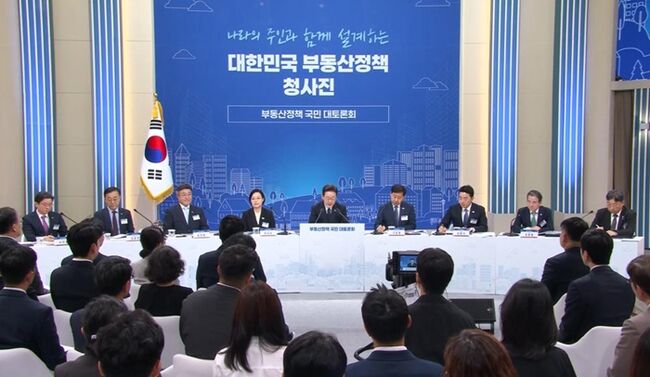 [Liberal Democratic Party Statement] Calling it a Grand Real Estate Debate… It Was Nothing More Than a Private Party Among Themselves
The 'National Grand Debate on Real Estate Policy' held on July 23rd and 27th. [Photo=Yonhap News]The 'National Grand Debate on Real Estate Policy,' hosted by the Lee Jae-myung administration under the
[Liberal Democratic Party Statement] Calling it a Grand Real Estate Debate… It Was Nothing More Than a Private Party Among Themselves
The 'National Grand Debate on Real Estate Policy' held on July 23rd and 27th. [Photo=Yonhap News]The 'National Grand Debate on Real Estate Policy,' hosted by the Lee Jae-myung administration under the
 [Photo] Evidence of Election Fraud Flooding U.S. Media… Trump Had 2.7 Million Votes Stolen
 [Video] U.S. Semiquincentennial Air Show... 'Art in the Sky' streaks across New York
 [Editorial Cartoon] A Draconian Law That Undermines Freedom of Expression

 List
List