정권 붕괴의 여부를 가르는 핵심은 시위의 규모나 희생자의 숫자가 아니다. 결정적인 변수는 권력이 유지되는 구조가 언제, 어떻게 끊어지는가에 있다. 체제가 무너지는 순간은 시민이 거리로 나오는 시점이 아니라, 군과 치안 조직이 더 이상 명령을 일관되게 수행하지 않을 때다. 1989년 루마니아의 독재자 니콜라에 차우셰스쿠(Nicolae Ceaușescu)의 공산주의 독재 체제가 붕괴한 이유는 군이 발포 명령을 거부하거나 중립으로 돌아섰기 때문이다.
 U.S. President Donald Trump announced that he had been informed that the Iranian government had stopped the killing and execution of protesters. This statement is being interpreted as a sign that the U.S. stance on forceful military intervention in Iran's protests could change. [Yonhap News]
On the evening of January 8 (local time), Iranian authorities once again shut down internet access nationwide, followed by the sequential blocking of mobile and landline communications, cutting off 92 million citizens from the outside world in an instant.
In the past, Iranian authorities have resorted to communication blackouts during critical junctures. This occurred during protests against fuel subsidy reductions in 2019 and during nationwide protests following the death of Mahsa Amini in 2022.
However, the current measure surpasses previous ones in scope and intensity. Most notably, it differs in its nature by also disrupting access to Starlink, SpaceX's low Earth orbit (LEO) satellite internet.
Iranian Citizens Used Starlink During 2019 Protests As Well
During the 2019 protests, citizens used Starlink to communicate, bypassing censorship. Through Starlink, they transmitted photos and videos from protest sites in real-time to the rest of the world. The mere existence of airspace beyond the reach of a totalitarian regime's power offered hope to the citizens.
However, in 2026, the Iranian authorities have opted for a more advanced response. They are not only blocking terrestrial communication networks but also suppressing or blocking satellite communications. Iranian authorities are monitoring rooftops in urban areas where large-scale protests are occurring using drones to arrest terminal owners and are also employing localized jamming (radio interference that disrupts communication or radar systems).
Starlink terminals are visually detectable based on characteristics such as radio frequency (RF) signals, network patterns, and installation environment. The flat, rectangular terminal is difficult to conceal as it must be installed at an angle facing the sky. Reports indicate that Starlink terminal owners have been arrested or killed on-site in approximately 600 locations. Consequently, there are reports of users abandoning access due to fears of punishment.
Iranian Authorities' Response: Making Actual Use Difficult Rather Than Complete Blocking
Starlink operates in the KU band (12-18 GHz) for communication between satellites and users (terminals installed at homes) and the KA band (26.5-40 GHz) for high-volume data transmission between satellites and ground stations (gateways). The downlink is known to be around 10.7-12.7 GHz, and the uplink is around 14-14.5 GHz.
Key design elements to prevent internet disconnections and increase speed include 'burst type' transmission, which sends large amounts of data rapidly, 'beam steering' technology that precisely adjusts radio waves without changing antenna direction, and 'fast handoff' technology that quickly switches between moving satellites.
Therefore, a complete nationwide shutdown is difficult. However, reports have emerged of significant disruptions in large-volume data transmission and data delivery due to radio interference (jamming) in protest areas. This approach creates a situation where connectivity is possible, but actual use is difficult.
While Starlink's phased-array antennas and narrow beams make it relatively resistant to radio interference, it is not impossible to neutralize. Jamming the uplink (transmission) rather than the downlink (reception) can effectively paralyze communication, even if reception is still possible.
In response, claims have been made that Iranian authorities received expertise in Starlink terminal detection or jamming from Russia's accumulated experience during the Russia-Ukraine war, or that they have acquired related equipment and technology from China.
Blocking Information Flow... Suppressed Anger Will Be Expressed More Forcefully
Even when terrestrial communication infrastructure collapses or is blocked due to disasters or government censorship, satellite internet has served as the last lifeline for information. However, dictators have also learned methods to suppress and block that lifeline. Technology is neutral, but the power and systems that operate it are never neutral.
The silence achieved through communication blackouts in Iran in January 2026 is essentially temporary. The moment information flow is obstructed, rumors spread throughout society, fear accumulates, and suppressed anger will ultimately manifest as greater political and social instability.
Currently, in Iran, the Basij militia, police, and special security forces are harshly suppressing protests. Although the Islamic Revolutionary Guard Corps (IRGC) has not yet been fully deployed, if they become extensively involved, the situation could escalate into large-scale bloody suppression, i.e., a massacre.
According to estimates from local and international human rights organizations, the death toll is believed to exceed 12,000 so far. Generally, even if only dozens of people die from gunfire, most crowds disperse in fear. However, Iranians are not halting their protests even as those around them fall, bleeding.
Iranian Citizens Continue Protests Despite Large-Scale Casualties
Why do protests continue in Iran despite such a large number of casualties?
First, they have already passed the threshold of fear.
Usually, crowds disperse when they calculate that "retreating means survival." However, in Iran, a significant number of citizens perceive that retreat does not guarantee safety. In Iran, where arrests, torture, and long-term detentions have been repeatedly carried out, the choice to retreat no longer ensures survival. At this stage, fear does not deter citizens; instead, it fuels and amplifies their anger.
Second, the persistence and consistency of violence.
The oppressive politics of the Iranian authorities are not temporary but have been structurally repeated over a long period. In such cases, people do not think, "I'll just endure this time." When the regime's violence runs rampant, citizens adapt to fear and believe there is no exit other than regime change. From the outside, people ask, "Why do they continue to fight despite such great sacrifices?" but Iranian citizens think, "We've gone too far, and if we stop here, nothing will remain."
Third, the sense of loss for future generations.
The youth constitute a significant portion of the protest attendees. They feel they cannot expect a future in terms of employment, asset formation, freedom of movement, or freedom of expression. Under these conditions, the choice to "retreat to survive" loses its persuasiveness. In a society where the future is not visible, taking risks might be a more rational choice than avoiding them.
Fourth, the collapse of religious authority.
The core of the Iranian regime was religious legitimacy. However, in Iran, where violence has persisted for so long, religious authority has already hit rock bottom. Citizens have begun to challenge the regime, viewing the Supreme Leader, especially Ali Khamenei's administration, not as a 'sacred system' but simply as a dictatorial political power.
Regime Collapse... Begins When Military and Security Forces Do Not Obey Orders
Then, which regimes collapse, and which ones endure?
The key determinant of regime collapse is not the scale of protests or the number of casualties. The decisive factor lies in when and how the structure maintaining power is broken. The moment a system collapses is not when citizens take to the streets, but when the military and security forces no longer consistently carry out orders. The communist dictatorship of Romanian dictator Nicolae Ceaușescu collapsed in 1989 because the military refused to open fire or returned to neutrality.
Furthermore, power is maintained not by the will of an individual but by an alliance of elites, including political leadership, military brass, intelligence agencies, the judiciary, state-owned enterprises, and religious leaders. When this alliance fractures, the regime is replaced.
The collapse of the former Soviet Union was due to the breakdown of elite alliances rather than popular uprisings. In contrast, China has maintained its regime through the solidarity of its elites since the Tiananmen Square incident in 1989.
Hankook Ilbo Editorial Department

 [Statement by the Seo-beo-kka Korea Military Academy Save-the-Nation Comrades Association] ㉛ Recount the Votes Publicly, as the Previous Recount Concealed Election Fraud
Tongyeong Mayoral Election Recount [Photo=Yonhap News]South Korea's liberal democracy is dying. The National Election Commission (NEC) and the judiciary, which have plummeted into criminal syndicates
[Statement by the Seo-beo-kka Korea Military Academy Save-the-Nation Comrades Association] ㉛ Recount the Votes Publicly, as the Previous Recount Concealed Election Fraud
Tongyeong Mayoral Election Recount [Photo=Yonhap News]South Korea's liberal democracy is dying. The National Election Commission (NEC) and the judiciary, which have plummeted into criminal syndicates
 What is the significance of the "Trump 2028" red hats that keep making a comeback?
It is noteworthy that President Donald Trump is "intentionally" fueling controversy over whether he can actually run in the 2028 presidential election, even though it is "highly likely he is seriously
What is the significance of the "Trump 2028" red hats that keep making a comeback?
It is noteworthy that President Donald Trump is "intentionally" fueling controversy over whether he can actually run in the 2028 presidential election, even though it is "highly likely he is seriously
 Jin Cummings: "North Korea says it will increase the number of spies, so what is the government doing?"
U.S. political columnist Gene Cummings has publicly questioned the South Korean government, asking, "North Korea is announcing plans to increase its number of spies, yet what is the South Korean
Jin Cummings: "North Korea says it will increase the number of spies, so what is the government doing?"
U.S. political columnist Gene Cummings has publicly questioned the South Korean government, asking, "North Korea is announcing plans to increase its number of spies, yet what is the South Korean
 Attorney Do Tae-woo: “Discrepancies in Voter Count and Improper Sealing Confirmed in Tongyeong Mayoral Recount… Official Request for Further Verification Filed with Gyeongnam Election Commission”
A bundle of out-of-district early voting ballots photographed by attorney Do Tae-woo at the Tongyeong mayoral election recount site. A clear, solid line visible on the side of the ballots raises suspi
Attorney Do Tae-woo: “Discrepancies in Voter Count and Improper Sealing Confirmed in Tongyeong Mayoral Recount… Official Request for Further Verification Filed with Gyeongnam Election Commission”
A bundle of out-of-district early voting ballots photographed by attorney Do Tae-woo at the Tongyeong mayoral election recount site. A clear, solid line visible on the side of the ballots raises suspi
 Stock Market Crash 'Black Tuesday'… KOSPI down 10.8%, KOSDAQ down 7.7%
The KOSPI fell by more than 5% in early trading on the 28th, triggering a sell-side sidecar.On the 28th, the KOSPI plunged by more than 10%.Due to the sharp decline, a sell-side sidecar—a temporary
Stock Market Crash 'Black Tuesday'… KOSPI down 10.8%, KOSDAQ down 7.7%
The KOSPI fell by more than 5% in early trading on the 28th, triggering a sell-side sidecar.On the 28th, the KOSPI plunged by more than 10%.Due to the sharp decline, a sell-side sidecar—a temporary
 [World Heritage Committee] 25 New World Heritage Sites Inscribed in Busan… South Korea Successfully Expands 'Getbol' Listing
The Chairperson of the World Heritage Committee speaks at the plenary session of the 48th session of the World Heritage Committee, held at BEXCO in Busan on the 20th. [Photo: Yonhap News]A total of 25
[World Heritage Committee] 25 New World Heritage Sites Inscribed in Busan… South Korea Successfully Expands 'Getbol' Listing
The Chairperson of the World Heritage Committee speaks at the plenary session of the 48th session of the World Heritage Committee, held at BEXCO in Busan on the 20th. [Photo: Yonhap News]A total of 25
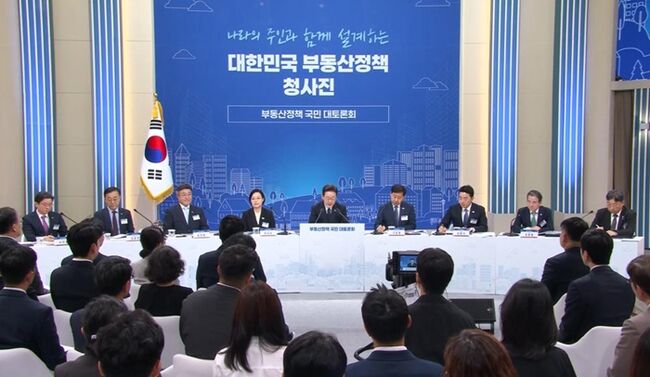 [Liberal Democratic Party Statement] Calling it a Grand Real Estate Debate… It Was Nothing More Than a Private Party Among Themselves
The 'National Grand Debate on Real Estate Policy' held on July 23rd and 27th. [Photo=Yonhap News]The 'National Grand Debate on Real Estate Policy,' hosted by the Lee Jae-myung administration under the
[Liberal Democratic Party Statement] Calling it a Grand Real Estate Debate… It Was Nothing More Than a Private Party Among Themselves
The 'National Grand Debate on Real Estate Policy' held on July 23rd and 27th. [Photo=Yonhap News]The 'National Grand Debate on Real Estate Policy,' hosted by the Lee Jae-myung administration under the
 [Photo] Evidence of Election Fraud Flooding U.S. Media… Trump Had 2.7 Million Votes Stolen
 [Video] U.S. Semiquincentennial Air Show... 'Art in the Sky' streaks across New York
 [Editorial Cartoon] A Draconian Law That Undermines Freedom of Expression

 List
List