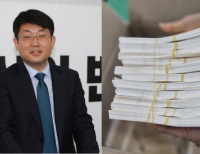
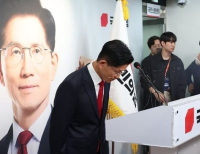
Former People Power Party leader Han Dong-hoon. [Photo=Yonhap News]
In politics, an apology is not a moral gesture but a clear strategic act.
Apologies, especially during a crisis, are evaluated not on whether the wrongdoing is admitted, but on how much they reduce political losses and leave room for recovery. In this regard, Han Dong-hoon's recent apology, regardless of its inherent rightness or wrongness, is closer to a case of failed political gain-loss calculation.
According to crisis management communication theory, an apology should be designed to aim for mid- to long-term trust recovery, even if it means enduring short-term criticism. In other words, the key performance indicator is to postpone the judgment of neutral and undecided audiences rather than immediate consolidation of the supporter base.
Long-Term Loss Consolidation Effect
However, this apology failed to generate political "gains" by these standards and instead resulted in a loss-consolidation effect.
The aspects that can be considered political gains are limited. Within the hardline supporter base, the mere formality of "offering an apology" acts as a psychological defense mechanism.
This can have the effect of partially preventing supporter defection in the short term. However, this effect is only valid within an already consolidated group and does not lead to new support expansion or persuasion of neutral audiences. The scope is too narrow to be called a political gain.
On the other hand, the political losses are structural and extensive. Firstly, the lack of clear attribution of responsibility, a core requirement of an apology, failed to provide neutral audiences with a reason to defer their judgment.
This can turn "let's wait and see" into "this person is not the one." In politics, a negative judgment from neutral audiences is the most difficult loss to recover from.
Secondly, the political arguments and disputes raised simultaneously within the apology undermined the message's consistency. In crisis management communication, an apology should serve to narrow the scope of the issue, but this apology instead expanded it.
As a result, the apology did not serve as a shield and risked being recycled as a quote for rebuttal in all subsequent reports and commentaries. This is a loss that accumulates political costs in the mid- to long-term.
Amplified Question of "Why Now?"
Thirdly, political benefits with the party in the National Assembly and legacy media were lost. The minimum condition they expect from an apology is manageability. That is, a signal that the situation can be resolved even if this individual is kept on board.
However, this apology did not provide that signal, and consequently weakened the motivation to defend. This manifests as a loss in the form of quiet distancing rather than public criticism. Politically, this loss is not easily visible but is the most fatal.
Fourthly, the very method of apology narrowed future options. In a crisis situation, an apology should leave room for subsequent actions, even if it fails. However, this message attempted both apology and struggle simultaneously, failing to secure persuasiveness in either.
As a result, even if further apologies or a shift in stance occur later, it is difficult to avoid the reaction of "Why now?" This is a loss that has narrowed the path to political recovery on its own.
In conclusion, the political gains and losses of this apology are clear. While there may have been a slight gain in the short term by aiding the psychological defense of hardline supporters, the mid- to long-term losses—failure to defer neutral audiences' judgment, loss of defense from the party and legacy media, and amplification of long-term message risks—are far greater.
From the perspective of crisis management communication, this can be evaluated not as a failed apology, but as a case of failing to manage political losses.
In politics, an apology is a matter of design, not courage. If it is not clear what will be sacrificed to gain what, an apology becomes a sentence that solidifies a crisis rather than a mechanism to overcome it. This case reconfirms that point once again.

◆ Professor Shim Gyu-jin
Assistant Professor of Digital Media, IE University, Spain. Previously served as a policy advisor to the Ministry of National Defense and head of the data lab at the Yeouido Institute. He also worked as a full-time professor at the University of Melbourne, Australia, and an assistant professor at Singapore Management University. His books include 'K-Drama Yoon Suk-yeol' and 'Hyper Gender'.

 [Statement by the Seo-beo-kka Korea Military Academy Save-the-Nation Comrades Association] ㉛ Recount the Votes Publicly, as the Previous Recount Concealed Election Fraud
Tongyeong Mayoral Election Recount [Photo=Yonhap News]South Korea's liberal democracy is dying. The National Election Commission (NEC) and the judiciary, which have plummeted into criminal syndicates
[Statement by the Seo-beo-kka Korea Military Academy Save-the-Nation Comrades Association] ㉛ Recount the Votes Publicly, as the Previous Recount Concealed Election Fraud
Tongyeong Mayoral Election Recount [Photo=Yonhap News]South Korea's liberal democracy is dying. The National Election Commission (NEC) and the judiciary, which have plummeted into criminal syndicates
 What is the significance of the "Trump 2028" red hats that keep making a comeback?
It is noteworthy that President Donald Trump is "intentionally" fueling controversy over whether he can actually run in the 2028 presidential election, even though it is "highly likely he is seriously
What is the significance of the "Trump 2028" red hats that keep making a comeback?
It is noteworthy that President Donald Trump is "intentionally" fueling controversy over whether he can actually run in the 2028 presidential election, even though it is "highly likely he is seriously
 Jin Cummings: "North Korea says it will increase the number of spies, so what is the government doing?"
U.S. political columnist Gene Cummings has publicly questioned the South Korean government, asking, "North Korea is announcing plans to increase its number of spies, yet what is the South Korean
Jin Cummings: "North Korea says it will increase the number of spies, so what is the government doing?"
U.S. political columnist Gene Cummings has publicly questioned the South Korean government, asking, "North Korea is announcing plans to increase its number of spies, yet what is the South Korean
 Attorney Do Tae-woo: “Discrepancies in Voter Count and Improper Sealing Confirmed in Tongyeong Mayoral Recount… Official Request for Further Verification Filed with Gyeongnam Election Commission”
A bundle of out-of-district early voting ballots photographed by attorney Do Tae-woo at the Tongyeong mayoral election recount site. A clear, solid line visible on the side of the ballots raises suspi
Attorney Do Tae-woo: “Discrepancies in Voter Count and Improper Sealing Confirmed in Tongyeong Mayoral Recount… Official Request for Further Verification Filed with Gyeongnam Election Commission”
A bundle of out-of-district early voting ballots photographed by attorney Do Tae-woo at the Tongyeong mayoral election recount site. A clear, solid line visible on the side of the ballots raises suspi
 Stock Market Crash 'Black Tuesday'… KOSPI down 10.8%, KOSDAQ down 7.7%
The KOSPI fell by more than 5% in early trading on the 28th, triggering a sell-side sidecar.On the 28th, the KOSPI plunged by more than 10%.Due to the sharp decline, a sell-side sidecar—a temporary
Stock Market Crash 'Black Tuesday'… KOSPI down 10.8%, KOSDAQ down 7.7%
The KOSPI fell by more than 5% in early trading on the 28th, triggering a sell-side sidecar.On the 28th, the KOSPI plunged by more than 10%.Due to the sharp decline, a sell-side sidecar—a temporary
 [World Heritage Committee] 25 New World Heritage Sites Inscribed in Busan… South Korea Successfully Expands 'Getbol' Listing
The Chairperson of the World Heritage Committee speaks at the plenary session of the 48th session of the World Heritage Committee, held at BEXCO in Busan on the 20th. [Photo: Yonhap News]A total of 25
[World Heritage Committee] 25 New World Heritage Sites Inscribed in Busan… South Korea Successfully Expands 'Getbol' Listing
The Chairperson of the World Heritage Committee speaks at the plenary session of the 48th session of the World Heritage Committee, held at BEXCO in Busan on the 20th. [Photo: Yonhap News]A total of 25
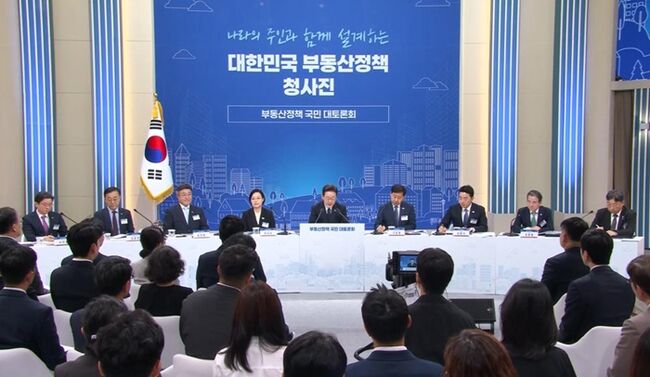 [Liberal Democratic Party Statement] Calling it a Grand Real Estate Debate… It Was Nothing More Than a Private Party Among Themselves
The 'National Grand Debate on Real Estate Policy' held on July 23rd and 27th. [Photo=Yonhap News]The 'National Grand Debate on Real Estate Policy,' hosted by the Lee Jae-myung administration under the
[Liberal Democratic Party Statement] Calling it a Grand Real Estate Debate… It Was Nothing More Than a Private Party Among Themselves
The 'National Grand Debate on Real Estate Policy' held on July 23rd and 27th. [Photo=Yonhap News]The 'National Grand Debate on Real Estate Policy,' hosted by the Lee Jae-myung administration under the
 [Photo] Evidence of Election Fraud Flooding U.S. Media… Trump Had 2.7 Million Votes Stolen
 [Video] U.S. Semiquincentennial Air Show... 'Art in the Sky' streaks across New York
 [Editorial Cartoon] A Draconian Law That Undermines Freedom of Expression

 List
List