 Residents who evacuated to the mid-mountain area during the Jeju April 3 Incident in May 1948.
Immediately after liberation, the Korean peninsula was close to a pre-political state. After Japan withdrew, a state did not immediately emerge. The administration was vacant, and public order was unstable. The military had not yet established a unified command structure, and the police organization was not yet complete.
Leftist and rightist groups competitively formed organizations, and some had already acquired weapons. Society at this time was not a space regulated by law, but a space where force moved first.
This chaos was nationwide. However, not all regions flowed in the same direction. In some places, conflict entered the institutional framework, while in others, guns appeared first. Jeju and Yeosu-Suncheon fall into the latter category.
Although these two events differ in nature, they share a common structure. Armed action, driven by political objectives, occurred first, and the state's response escalated into uncontrolled violence, leading to increased civilian casualties.
Jeju April 3: The Condition of Being an Island, Organized Armed Action
Immediately after liberation, Jeju was administratively vulnerable. Due to its geographical condition as an island, police personnel were insufficient, and orders from the central government were delayed. Leftist organizations exploited this vacuum.
Organizations aligned with the South Korean Workers' Party (Namro-dang) spread rapidly in Jeju. Organizations were established at the village level, and secret meetings and communication networks were formed. Even at this point, some organizations had already acquired weapons.
Around April 3, 1948, armed units of the Namro-dang simultaneously attacked several police substations. This was not a random clash. The targets were set, and the timing was coordinated.
The attacks occurred at night, and guns and Molotov cocktails were used. Police officers were killed, and weapons were confiscated. This was not a protest to convey political demands, but an act of rebellion using force.
Subsequently, the armed groups retreated to the mountains, forming what were called mountain brigades. The problem arose thereafter. The mountains and villages were not separated. The armed groups descended into the villages at night, demanding rice and food, and forcing them to provide lodging. Those who did not cooperate were classified as enemies.
Indeed, there were cases where residents who refused to cooperate were threatened or killed. Villages were divided into two. The police and administration exerted influence during the day, while the armed groups exerted influence at night.
At this point, daily life in Jeju collapsed. Residents could not fully belong to either side. Cooperating with the police meant danger at night, and cooperating with the armed groups meant danger during the day. This applied to children, the elderly, and women as well. This situation became prolonged, and fear became commonplace.
The government and security authorities decided to suppress the armed groups. The decision itself was not unusual, as police substations had been attacked and public officials had been killed.
The problem lay in the execution. There was insufficient intelligence and personnel to distinguish between armed groups and civilians. Communications were slow, and on-site judgments became harsh. Entire specific areas were designated as danger zones.
Mid-mountain villages began to burn. Residents were rounded up collectively. Even those not directly involved with the armed groups were not exempt. The elderly and children were also victims. The violence of the state was layered upon the violence of the armed groups. In this process, casualties snowballed.
There are two key points to understanding the Jeju April 3 Incident. First, there was an armed action where police substations were attacked and guns were used. Second, the response to that action became uncontrolled, leading to an explosion of civilian casualties.
These two aspects must be considered together. Emphasizing only one will not explain Jeju. However, explanations by pro-North Korean leftists distort this structure. The attacks and killings by the armed groups are either rarely mentioned or glorified as "resistance" or "struggle."
Instead, only the state's response is placed in the foreground. This causes the reasons why guns appeared and why villages became battlegrounds to disappear.
Yeosu-Suncheon: The Day the Military Intervened in Politics
The Yeosu-Suncheon incident differs in nature from Jeju. The military was at the center of this event. The military is a core tool of state power. At the same time, it is an organization that demands the strictest command structure. When this organization takes up arms for political reasons, the entire society is shaken. It is a rebellion.
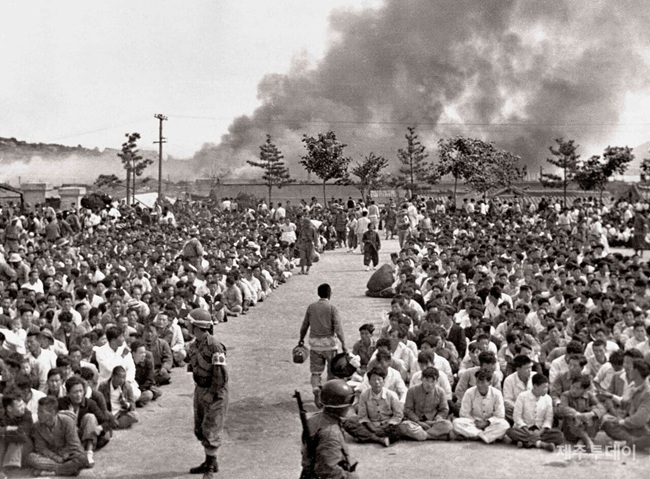 Related archival photo of the Yeosu-Suncheon Incident. [Photo=Yeosu City Hall Archive, taken by Lee Kyung-mo]
In October 1948, some military units stationed in Yeosu refused orders from their superiors concerning their deployment to suppress the Jeju uprising. Refusing orders itself was already a serious problem. However, the situation did not stop there. A rebellion began with the taking up of arms.
The rebel forces seized the armory. Police stations and government offices were attacked. Rightist figures were arrested or killed. In some areas, guns were even pointed at civilians.
For several days, Yeosu and Suncheon were in a state of uncontrollability. The moment soldiers used weapons for political reasons, law and order rapidly collapsed. That is what rebellion is.
Government forces intervened to suppress the rebellion. Here, the problem was repeated. There was insufficient time and intelligence to accurately distinguish between rebel soldiers and civilians. Widespread arrests were made, and residents unrelated to the rebellion also suffered casualties.
Like the Jeju April 3 rebellion, this incident also began with the rebel forces taking up arms first. Then, as the state's response became harsher, casualties expanded.
However, pro-North Korean leftists completely reject this structure. Yeosu-Suncheon is always referred to as a "struggle." This term is used to cover up the fact that it was a military rebellion. The act of taking up arms and refusing orders disappears, leaving only the casualties during the suppression. The starting point of the violence was the rebel forces.
The Distortion Created by the Word 'Struggle'
The common method of pro-North Korean leftists regarding Jeju and Yeosu-Suncheon is twofold: first, they erase the scene where guns first appeared; second, they change the name. In this way, armed attacks become 'resistance,' and military rebellions become 'struggles.'
When the name changes, violence is no longer considered violence. Questions are not asked about why guns were necessary, why people had to be killed, or if there were other options. Instead, judgments are taken over by grand terms like "on the side of history."
In both Jeju and Yeosu-Suncheon, those who first took up arms always gained a moral shield. Conversely, those who questioned that violence were branded as 'reactionaries' or 'hostile forces.' The position of responsibility also shifted with the change of words.
Pro-North Korean leftists always say, "Violence was born of oppression." However, violence does not arise spontaneously. Someone decided to take up arms, and someone defined people as enemies. And that act was covered up with the word "inevitable." As this word was repeated, the violence of the pro-North Korean leftists became progressively lighter.
What Remains When Guns Enter Politics
What is confirmed in Jeju and Yeosu-Suncheon is that when guns enter politics, casualties are unavoidable. Both the violence of the armed groups and the excessive response of the state escalated the tragedy. An attitude that shields only one side's violence leads to the repetition of the same events.
Violence is not a struggle. Violence is violence in itself. In both Jeju and Yeosu-Suncheon, the act of guns appearing first should be criticized. At the same time, the state's responsibility for failing to control it and protect civilians is also clear.
The biggest problem with the pro-North Korean leftists immediately after liberation was not simply that they supported North Korea. It was that they cloaked violence in the language of politics and solidified those methods as legitimate actions. What remained as a result was not liberation or progress. What remained were casualties, evasion of responsibility, and the dangerous mindset that "guns are faster than words."
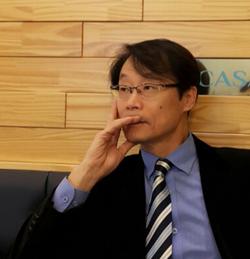
◆ Songsan
A poet and researcher of history and philosophy, he is a former director of the Rhee Syngman School and currently serves as a research advisor for the Korean Modern and Contemporary History Research Association and the representative of the Philosophy Forum Lyceum. He has published four poetry collections and co-translated 'Heroes of Hook Ridge.' Songsan is a pen name.

 Iranian Foreign Ministry: "Continuing Message Exchanges with the U.S. and Activities of Mediating Countries"
Esmaeil Baghaei, Spokesperson for the Iranian Ministry of Foreign Affairs [Xinhua, Yonhap News file photo]Esmaeil Baghaei, spokesperson for the Iranian Ministry of Foreign Affairs, stated on the 26th
Iranian Foreign Ministry: "Continuing Message Exchanges with the U.S. and Activities of Mediating Countries"
Esmaeil Baghaei, Spokesperson for the Iranian Ministry of Foreign Affairs [Xinhua, Yonhap News file photo]Esmaeil Baghaei, spokesperson for the Iranian Ministry of Foreign Affairs, stated on the 26th
 President Yoon: "Do You Think You Are Safe from the Special Counsel?"... Final Statement Video Released
President Yoon Suk Yeol rebuking the special prosecutor on the 24th. [Court video / @birds_justice X account subtitle GIF] A video of President Yoon Suk Yeol's closing statement at his trial rega
President Yoon: "Do You Think You Are Safe from the Special Counsel?"... Final Statement Video Released
President Yoon Suk Yeol rebuking the special prosecutor on the 24th. [Court video / @birds_justice X account subtitle GIF] A video of President Yoon Suk Yeol's closing statement at his trial rega
 President Yoon, regarding the first-instance ruling on the Public Official Election Act: “An excessive political verdict that distorts the facts… We will appeal immediately.”
The first-instance sentencing hearing for President Yoon Suk Yeol regarding violations of the Public Official Election Act is being broadcast live at Seoul Station on the 27th. [Photo=Yonhap News]Pres
President Yoon, regarding the first-instance ruling on the Public Official Election Act: “An excessive political verdict that distorts the facts… We will appeal immediately.”
The first-instance sentencing hearing for President Yoon Suk Yeol regarding violations of the Public Official Election Act is being broadcast live at Seoul Station on the 27th. [Photo=Yonhap News]Pres
 WSJ: "SK Hynix ADR Premium Is a Sign of AI Trading Overheat"
Advertisement for SK Hynix ADR listing in New York's Times Square [Reuters=Yonhap News file photo]The Wall Street Journal (WSJ) has pointed out that the price of SK Hynix’s American Depositary Recei
WSJ: "SK Hynix ADR Premium Is a Sign of AI Trading Overheat"
Advertisement for SK Hynix ADR listing in New York's Times Square [Reuters=Yonhap News file photo]The Wall Street Journal (WSJ) has pointed out that the price of SK Hynix’s American Depositary Recei
 'Godfather of Japanese Mystery Novels' Keigo Higashino Passes Away After Battle with Cancer at 68
Famous Japanese mystery novelist Keigo Higashino [AFP=Yonhap News]It has been belatedly reported that Keigo Higashino, the "godfather of Japanese mystery novels" and author of bestsellers such as "The
'Godfather of Japanese Mystery Novels' Keigo Higashino Passes Away After Battle with Cancer at 68
Famous Japanese mystery novelist Keigo Higashino [AFP=Yonhap News]It has been belatedly reported that Keigo Higashino, the "godfather of Japanese mystery novels" and author of bestsellers such as "The
 [Park Pil-kyu Security Column] To the Ignorant Trying to Clothe a Beast in Sheep's Clothing
Rep. Kim Byung-joo of the Democratic Party of Korea [Photo=Yonhap News]“The Air Force Academy doesn't teach you how to fly a plane!” “The Army, Navy, and Air Force academies are exactly the
[Park Pil-kyu Security Column] To the Ignorant Trying to Clothe a Beast in Sheep's Clothing
Rep. Kim Byung-joo of the Democratic Party of Korea [Photo=Yonhap News]“The Air Force Academy doesn't teach you how to fly a plane!” “The Army, Navy, and Air Force academies are exactly the
 [Issue Diagnosis] Two Effects of the Election Petition Review
 [Photo] Evidence of Election Fraud Flooding U.S. Media… Trump Had 2.7 Million Votes Stolen
 [Video] U.S. Semiquincentennial Air Show... 'Art in the Sky' streaks across New York
 [Editorial Cartoon] A Draconian Law That Undermines Freedom of Expression

 List
List










