 At the first Military Armistice Commission meeting held in Panmunjom on July 28, 1953, U.S. Army Major General Blackshear Bryan (left) and North Korean People's Army Major General Ri Sang-jo exchange credentials. The armistice agreement was signed in Panmunjom on July 27, 1953.
When the gunfire ceased, many thought, "The war is over." However, this armistice was merely a military pause, not a declaration of the end of the ideological war. For the pro-North leftists, in particular, the armistice was not an acknowledgment of defeat but a starting point for a change in tactics.
During the war, the organizations of the South Korean Workers' Party faction were virtually annihilated. Many of their leaders died, defected to the North, or were arrested, and their open organizational networks collapsed.
However, there is a crucial fact. There were no declarations of abandoning their ideology or documents of ideological conversion. Nowhere in the remaining investigation records or court judgments is there a sentence stating, "We were wrong." Instead, the phrase "Now is not the time" was repeated. This sentence summarizes the core strategy of the pro-North leftists in the 1950s.
1. 1953-1954: The End of Open Activities and the Beginning of Underground Operations
Immediately after the armistice, the South Korean government prioritized public security restoration. In August 1953, the Ministry of Home Affairs issued guidelines to provincial police bureaus for a comprehensive crackdown on remaining leftist elements. In 1954, the National Security Act was amended, strengthening the scope of punishment and investigative authority.
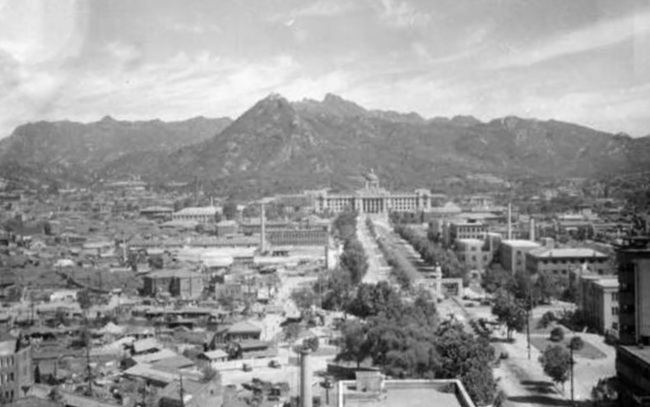 Gwanghwamun area in Seoul, 1954. [Photo: National Archives of Korea, Ministry of the Interior and Safety]
According to police statistics, the number of arrests for violations of the National Security Act between 1953 and 1955 averaged several thousand per year. While this number was lower than before the war, it was by no means small, considering that open activities had almost disappeared. This indicates that pro-North leftists still lingered in various parts of society.
A representative case from this period is the underground cell incident in Seoul and Incheon in 1954.
According to the prosecution's investigation records, the suspects in this case did not form any political organizations, store weapons, or print leaflets. Instead, individuals with past affiliations with the South Korean Workers' Party maintained personal connections and made intermittent contact.
Statements confirmed during the trial were common: "There is no organization. But our beliefs have not changed." This serves as evidence that the dissolution of organizations and the maintenance of ideology proceeded simultaneously.
2. 1954-1956: Concealment through Language, Ideology Remains Unchanged
The most significant change for the pro-North leftists in the mid-1950s was not in their actions but in their language. Investigation records and intelligence reports show that terms like 'revolution,' 'armed struggle,' and 'proletarian dictatorship' virtually disappeared. Instead, terms such as 'peace,' 'neutrality,' 'national self-determination,' 'anti-war,' and 'reconstruction' emerged.
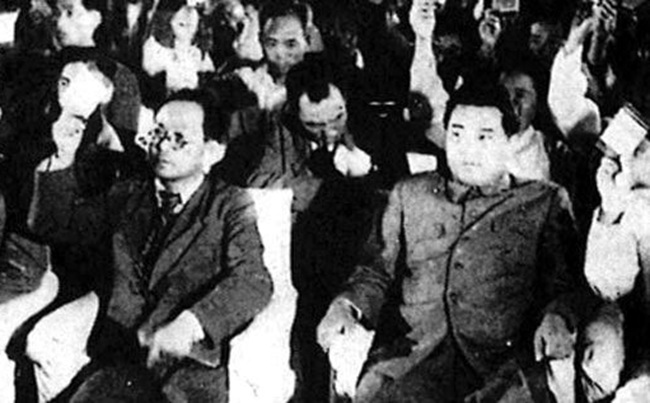 The 1st session of the Supreme People's Assembly of North Korea, which opened on September 2, 1948. Park Hun-young (center), leader of the South Korean Workers' Party, and Kim Il-sung, leader of the North Korean Workers' Party, participate in a vote. After Park Hun-young defected to the North, South Korea's pro-North leftists went underground.
This change was a deliberate choice to avoid public detection. For example, in 1955, there were a series of collective protests at the Busan port involving issues of unpaid wages and housing problems.
A police report stated: "No political slogans were found, but some of the individuals involved were confirmed to have had past leftist affiliations."
The crucial point here is this: they did not change their language because they abandoned their political goals. They changed their language to avoid being caught. While they highlighted livelihood issues, the interpretation of these issues remained consistently anti-government and anti-American.
3. Education and Academic Spaces: Propagation in Silence
In the late 1950s, when political parties and the media were heavily controlled, there were relatively more relaxed spaces. These were universities and academic circles.
Although overt political activities were prohibited at major universities such as Seoul National University, Yonhee University (now Yonsei University), Korea University, and Ewha Womans University, reading groups, translation circles, and academic discussions were relatively free.
A Ministry of Education internal report from 1956 stated: "Interpretations biased toward certain ideologies are repeated in some academic gatherings, but no explicit violations have been detected."
This sentence accurately reflects the situation at the time. There were no direct violations, but the direction of interpretation was fixed. Works by Marx and Lenin were not directly studied. Instead, commentaries by foreign leftist thinkers and critical translations circulated. This was a typical method of covert operation, maintaining the ideology while legalizing the surface activities.
4. Silence on International Events: The Hungarian Incident of 1956
When the Soviet Union forcibly intervened in Hungary in 1956, significant debates arose within the international communist bloc. However, no public reaction from the South Korean pro-North leftist faction has been confirmed. There was neither criticism nor support. It was silence.
This silence was not due to ignorance but calculation. Speaking in either direction was risky. Therefore, they remained silent. Internally, the perception solidified that "now is a long-term battle." From this period onwards, the concept of an organization that endures time rather than taking immediate action began to take root.
5. 1958-1960: The Stable Phase of Covert Operations and the Era of Connectors
As the 1950s drew to a close, the pro-North leftists' covert operations entered a stable phase. Skills to reduce the risk of arrest, methods for maintaining loose communication networks, and practices of refraining from public statements accumulated. The key figures during this time were not leaders, but connectors whose names were not often recorded.
These connectors did not form organizations. They connected people. They did not engage in lengthy political discussions. However, they maintained the direction of interpretation. This approach laid the foundation for their rapid reappearance around 1960.
Evaluation from the Liberal Right
From the perspective of the liberal right, the period from 1953 to 1960 was not a void. It was a period of going underground, maintaining their ideology without acknowledging defeat. Interpreting the cessation of open struggle as a change in ideology does not align with the records. Silence was a strategic choice, not a retreat.
The war stopped with the armistice. However, the ideology did not have a truce. Words filled the space where guns had been, and intentions were maintained in the space where words had been. The period from 1953 to 1960 was the time when those intentions were pursued most quietly, yet most tenaciously.
◆ Songsan
Poet and researcher of history and philosophy. Former director of the Rhee Syngman Institute. Currently serves as a research advisor for the Korean Modern and Contemporary History Research Society and as the representative of the philosophical forum Lyceum. He has published four collections of poetry, co-translated 'Heroes of Hookooji,' and published the historical psychology commentary 'Joseon as Myth' (2026). He is actively engaged in research and practice for the liberal cultural movement. Songsan is a pen name.

 Iranian Foreign Ministry: "Continuing Message Exchanges with the U.S. and Activities of Mediating Countries"
Esmaeil Baghaei, Spokesperson for the Iranian Ministry of Foreign Affairs [Xinhua, Yonhap News file photo]Esmaeil Baghaei, spokesperson for the Iranian Ministry of Foreign Affairs, stated on the 26th
Iranian Foreign Ministry: "Continuing Message Exchanges with the U.S. and Activities of Mediating Countries"
Esmaeil Baghaei, Spokesperson for the Iranian Ministry of Foreign Affairs [Xinhua, Yonhap News file photo]Esmaeil Baghaei, spokesperson for the Iranian Ministry of Foreign Affairs, stated on the 26th
 President Yoon: "Do You Think You Are Safe from the Special Counsel?"... Final Statement Video Released
President Yoon Suk Yeol rebuking the special prosecutor on the 24th. [Court video / @birds_justice X account subtitle GIF] A video of President Yoon Suk Yeol's closing statement at his trial rega
President Yoon: "Do You Think You Are Safe from the Special Counsel?"... Final Statement Video Released
President Yoon Suk Yeol rebuking the special prosecutor on the 24th. [Court video / @birds_justice X account subtitle GIF] A video of President Yoon Suk Yeol's closing statement at his trial rega
 President Yoon, regarding the first-instance ruling on the Public Official Election Act: “An excessive political verdict that distorts the facts… We will appeal immediately.”
The first-instance sentencing hearing for President Yoon Suk Yeol regarding violations of the Public Official Election Act is being broadcast live at Seoul Station on the 27th. [Photo=Yonhap News]Pres
President Yoon, regarding the first-instance ruling on the Public Official Election Act: “An excessive political verdict that distorts the facts… We will appeal immediately.”
The first-instance sentencing hearing for President Yoon Suk Yeol regarding violations of the Public Official Election Act is being broadcast live at Seoul Station on the 27th. [Photo=Yonhap News]Pres
 WSJ: "SK Hynix ADR Premium Is a Sign of AI Trading Overheat"
Advertisement for SK Hynix ADR listing in New York's Times Square [Reuters=Yonhap News file photo]The Wall Street Journal (WSJ) has pointed out that the price of SK Hynix’s American Depositary Recei
WSJ: "SK Hynix ADR Premium Is a Sign of AI Trading Overheat"
Advertisement for SK Hynix ADR listing in New York's Times Square [Reuters=Yonhap News file photo]The Wall Street Journal (WSJ) has pointed out that the price of SK Hynix’s American Depositary Recei
 'Godfather of Japanese Mystery Novels' Keigo Higashino Passes Away After Battle with Cancer at 68
Famous Japanese mystery novelist Keigo Higashino [AFP=Yonhap News]It has been belatedly reported that Keigo Higashino, the "godfather of Japanese mystery novels" and author of bestsellers such as "The
'Godfather of Japanese Mystery Novels' Keigo Higashino Passes Away After Battle with Cancer at 68
Famous Japanese mystery novelist Keigo Higashino [AFP=Yonhap News]It has been belatedly reported that Keigo Higashino, the "godfather of Japanese mystery novels" and author of bestsellers such as "The
 [Park Pil-kyu Security Column] To the Ignorant Trying to Clothe a Beast in Sheep's Clothing
Rep. Kim Byung-joo of the Democratic Party of Korea [Photo=Yonhap News]“The Air Force Academy doesn't teach you how to fly a plane!” “The Army, Navy, and Air Force academies are exactly the
[Park Pil-kyu Security Column] To the Ignorant Trying to Clothe a Beast in Sheep's Clothing
Rep. Kim Byung-joo of the Democratic Party of Korea [Photo=Yonhap News]“The Air Force Academy doesn't teach you how to fly a plane!” “The Army, Navy, and Air Force academies are exactly the
 [Issue Diagnosis] Two Effects of the Election Petition Review
 [Photo] Evidence of Election Fraud Flooding U.S. Media… Trump Had 2.7 Million Votes Stolen
 [Video] U.S. Semiquincentennial Air Show... 'Art in the Sky' streaks across New York
 [Editorial Cartoon] A Draconian Law That Undermines Freedom of Expression

 List
List









