 Kim Il-sung (left) and Park Heon-young converse in the garden of the South-North Joint Conference Hall in Pyongyang in April 1948.
On July 27, 1953, when the armistice agreement was signed in Panmunjom, the gunfire on the front lines subsided. However, the gunfire within North Korea became more pronounced from that moment on. In the place where the war stopped, the accounting of power began.
Kim Il-sung had to shift the responsibility for the defeat to "someone" and also needed to consolidate the factions within the party that he had forcibly suppressed during the war. The target of this purge was Park Heon-young.
Park Heon-young began as a key figure in rebuilding the Communist Party organization in South Korea immediately after liberation in 1945, and later moved north to join the leadership of the Workers' Party.
When the war ended, he, along with the entire "South Korean Workers' Party faction (those from the South Korean Workers' Party)," was placed at the center of the purges. Park Heon-young's downfall was not just the fall of an individual; it was an event where Kim Il-sung simultaneously addressed two tasks: 'responsibility for the war's failure' and 'eliminating party rivals.'
Yet, the pro-North Korean leftists in South Korea remain silent on this matter. The very forces that spoke of 'liberation,' 'unification,' and 'progress' have remained silent about the large-scale purges, public trials, executions, and enforced disappearances that occurred in North Korea.
Even the phrase "remained silent" is mild. They knew about these events but turned a blind eye, pretended not to know, and in some cases, justified them as 'necessary measures.'
August 1953: The Operation to Create a "Responsible Party for the War"
The purge of Park Heon-young accelerated rapidly immediately after the armistice. Various studies and compiled materials indicate that Park Heon-young was arrested on August 3, 1953.
The date holds significant meaning. It signifies that within just a few days after the armistice agreement (July 27, 1953), the "internal enemy" was identified, and procedures were initiated through the party and state apparatus to eliminate them.
North Korea actively utilized the facade of "justice" in this process. A plenary meeting of the Party Central Committee expelled Park Heon-young from the party, and through a military trial (often described as involving the Military Court under the Supreme Court), he was framed as part of an "American spy ring."
What's important here is not the truthfulness of the charges. In the North Korean system, charges are a tool. They are a mechanism to detach the political cost of defeat in the war from the leader and place it onto the target of the purge.
A key sentence in this mechanism was "American spy." By designating Park Heon-young as an "American spy," Kim Il-sung reframed the war's failure not as an 'error in strategy or command' but as the 'work of a traitor.'
Reports written and declassified by the CIA in the 1950s also repeatedly mention the North Korean leadership's systematic elimination of the South Korean Workers' Party and domestic factions around 1953.
There's no need to claim these documents are the absolute truth. However, the fact that "large-scale purges were actually underway within North Korea" is supported by the convergence of various sources.
December 1955: The Staged "Special Trial by the Supreme Court"
The case of Park Heon-young did not end with his arrest in 1953. In December 1955, Park Heon-young was tried in a "special trial (special session)" by the Supreme Court and sentenced to death. Notably, the death sentence was handed down on December 15, 1955.
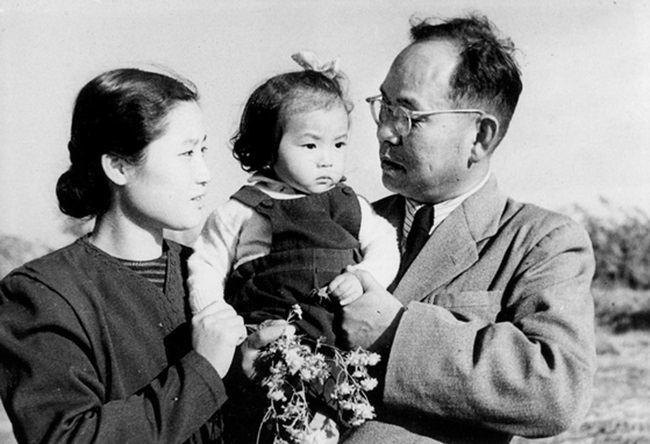 Park Heon-young, Deputy Premier and Foreign Minister of North Korea, with his family shortly before his purge.
Some records indicate that the execution took place a few days later. For instance, accounts place the execution on December 18, although the date of death remains "difficult to confirm" depending on the source.
This very "difficulty in confirmation" is how North Korean politics operates. It is a method of disseminating fear through public trials while erasing the traces of the final disposition. Subsequently, North Korea gradually reduced "public trials" and moved more towards quietly making people disappear.
There are also points to note from an administrative and judicial perspective. North Korea used systems like the 'Supreme Court' and 'special trials' to create the image that "the state had judged according to the law." However, the reality of the trials was that the court merely recorded the party's conclusions. The trial of Park Heon-young was not "judicial independence" but "mobilization of the judiciary."
At this point, the silence of the pro-North Korean leftists becomes more contemptible. Those who spoke of freedom of expression and procedural justice in South Korean society fall silent when faced with the scene of all of that being dismantled in North Korea. If they were to speak out, it would reveal the bankruptcy of their own logic.
Not Just Park Heon-young: The Purge of the "Entire" Remaining South Korean Workers' Party Faction
The elimination of Park Heon-young was not an issue of individual execution but a process of designating and eradicating the entire South Korean Workers' Party faction as the "responsible party for the war." Officials from the South Korean Workers' Party had played important roles even during the war, and consequently, they were potential rivals to Kim Il-sung.
The system Kim Il-sung sought to build was a hierarchical system centered around their experience as 'anti-Japanese partisans.' The independent organizational experience and networks of communists from the South were impurities to that system.
Names emerge at this time. The rapid deaths or suicides of individuals like Ho Ka-i (from the Soviet faction), the series of purges against the South Korean Workers' Party and domestic factions, and the factional purges that led to the 'August Factional Incident' in 1956 are all connected. In other words, the case of Park Heon-young was just a part of a larger purge.
Here, the pro-North Korean leftists often employ avoidance tactics. Phrases like "It was common during the Stalin era" or "It was unavoidable due to the post-war chaos." While these statements pretend to explain the facts, they are ultimately a technique for deflecting responsibility.
The pro-North Korean leftists in South Korea apply this logic leniently only to North Korea. They subject South Korean events to relentless moral judgment, while North Korean purges and executions are dismissed as "historical circumstances." This is the structure of their silence.
August 1956: The "Factional Incident" and the Reaffirmation of Silence
If the elimination of Park Heon-young was the signal for the purge of the South Korean Workers' Party faction, the incident in August 1956 was the extensive clearing out of opposing forces within the party, including the Soviet and Yenan factions.
The so-called 'August Factional Incident' occurred when attempts to criticize Kim Il-sung's personality cult and concentration of power at the 3rd Plenary Session of the 2nd Central Committee of the Workers' Party (1956) were thwarted, and those involved were subsequently eliminated.
Traces of "administrative documents" remain from this period as well. The reactions of the Soviet Union and China, internal reports from North Korea, and records related to meetings, as they were declassified or introduced over time, have made it clearer than mere 'internal rumors' that these were historical facts.
In particular, research on documents related to 1956 introduced by the Wilson Center (CWIHP) provides a document-based account of how policy lines, personality cults, and factional conflicts exploded in post-war North Korea.
By this point, the silence of the pro-North Korean leftists cannot be explained by ignorance. In the late 1950s, North Korea's power struggles were known to some extent even within the international communist bloc, and documents have accumulated over time.
Despite this, the pro-North Korean leftists in South Korea treated the purges of Park Heon-young and the South Korean Workers' Party faction as mere "noises" in history, in order to maintain their rhetoric of portraying North Korea as a "legitimate revolutionary state."
Regardless of what Park Heon-young did, in a system where neither procedure nor evidence was disclosed, there should have been at least a comparable level of anger expressed about a system that determined life and death based solely on the label of "spy." However, that balance is not achieved. What they protect is not human rights but the idol of North Korea.
Why Do Those Who Speak of "Anti-Imperialism" and "Unification" Fall Silent?
The reason the pro-North Korean leftists ignore the case of Park Heon-young is that confronting the purge of Park Heon-young directly would cause the collapse of several key premises they cling to.
First, the premise that "North Korea established a just order after liberation" is shattered. A regime that immediately initiated internal purges after the armistice, where the supreme leader shifts the blame for 'defeat' onto others, and stages trials to spread fear, is far from 'justice.'
Second, the premise that "North Korea is the representative of the nation (or unification)" is shaken. Park Heon-young was a key figure in the communist movement in the South. If North Korea truly claims to represent the entire North and South, its treatment of the South Korean Workers' Party faction, which constituted a part of that representative body, cannot be explained. This is because North Korea eliminated not 'enemies' but 'comrades.'
Third, the morality of the pro-North Korean leftists in South Korea collapses. When criticizing issues in South Korean society, they use terms like 'human rights,' 'procedures,' and 'state violence.' However, they do not use these terms in the face of North Korean purges. This reveals that their standard is not universal but factional.
A Concrete Example of "Silence": The Technique of Turning Issues into "Terminology"
The silence of the pro-North Korean leftists is not simply about not speaking. There is a more subtle method. It is the technique of reducing events to "terminology."
The purge of Park Heon-young is reduced to the term "power struggle." The elimination of the remaining South Korean Workers' Party faction is diluted with the term "ideological conflict."
The 1956 incident is categorized as a "factional problem," ultimately treated as a "minor internal conflict within the organization." However, in reality, it was a key link in the regime's operational methods, leading to arrests, enforced disappearances, executions, and family guilt by association (punishment of relatives).
Another technique is "covering up with South Korean stories." When discussing North Korean purges, the topic is immediately shifted to South Korea's past events. This does not mean that discussing South Korea's wrongdoings is forbidden.
The problem lies in the method of comparison. While South Korean events are thoroughly investigated and framed as the "original sin of the state," North Korean purges are passed over with a "it could happen" attitude. This asymmetry is the very identity of the pro-North Korean leftists.
Political Effects of Park Heon-young's Elimination: Ingredients for the Completion of the Kim Il-sung Regime
The elimination of Park Heon-young yielded three effects for Kim Il-sung.
First, it shifted the direction of responsibility for the war. It has already been widely reported through various channels that documents exist showing Kim Il-sung's consultations with the Soviet Union during the planning and execution of the war. However, by attributing the war's outcome to internal betrayal, the leader's misjudgment is framed as the 'victim of a conspiracy.'
Second, it strengthened the single hierarchy within the party by eliminating the organizational base of the South Korean Workers' Party faction. The independence of communists from the South was an uncomfortable competition for Kim Il-sung. After eliminating this competition, Kim Il-sung moved towards near-complete dominance by resolving conflicts with the Soviet and Yenan factions (in 1956).
Third, it institutionalized fear. The facade of "special trials by the Supreme Court" creates the illusion that this fear operates through "official state procedures." Once this structure solidifies, the powerful can erase people in the name of "law" at any time.
Why Can't South Korea's Pro-North Korean Leftists Talk About "Park Heon-young"?
Park Heon-young is an uncomfortable mirror for the pro-North Korean leftists. He was not an outsider to North Korean power but an insider, and a core figure of the communist bloc, not the anti-communist camp.
His execution as an "American spy" shows that North Korean politics does not solely revolve around "struggle against the enemy camp." North Korean politics operates by first consolidating internal comrades.
That is why they do not speak. Even if they speak, they skim over it. They end their sentences with phrases like "It was complicated," "There is insufficient data," or "Both sides had problems."
However, in the case of Park Heon-young, while data might be insufficient, the substance is sufficiently evident. The timing of the arrest (August 1953), the trial and sentencing (December 1955), and the subsequent flow into the factional purges of 1956 clearly reveal the reality of the purge of opposition figures.
Instead of a Conclusion, One Standard for Record Keeping
The issue of purges in North Korea from 1953 to 1956 serves as a litmus test for the standards by which South Korea's pro-North Korean leftists view the world. The elimination of Park Heon-young was an event that revealed the true nature of North Korean politics.
Immediately after the war, the leader passed the responsibility for defeat onto others, the party used law to disseminate fear, and the remaining South Korean Workers' Party faction was erased as an organization. And in the face of this, the pro-North Korean leftists in South Korea remained silent.
Silence is not neutrality. Silence is a form of complicity. By not speaking, they issued a moral absolution for the methods of the North Korean regime. If the mouths that speak of "justice" fall silent before North Korean purges, then that justice was never justice in the first place. They were merely phrases that packaged factional interests as morality.
◆ Songsan
A poet and researcher of history and philosophy. Former director of the Syngman Rhee Institute. Currently serves as a senior researcher at the Korean Modern and Contemporary History Research Association and as the representative of the philosophical forum Lyceum. He has published four poetry collections, co-translated "Heroes of Cape Goseong," and authored the historical psychology commentary "Joseon as a Myth" (2026). He is actively engaged in the research and practice of liberal cultural movements. Songsan is a pseudonym.

 Iranian Foreign Ministry: "Continuing Message Exchanges with the U.S. and Activities of Mediating Countries"
Esmaeil Baghaei, Spokesperson for the Iranian Ministry of Foreign Affairs [Xinhua, Yonhap News file photo]Esmaeil Baghaei, spokesperson for the Iranian Ministry of Foreign Affairs, stated on the 26th
Iranian Foreign Ministry: "Continuing Message Exchanges with the U.S. and Activities of Mediating Countries"
Esmaeil Baghaei, Spokesperson for the Iranian Ministry of Foreign Affairs [Xinhua, Yonhap News file photo]Esmaeil Baghaei, spokesperson for the Iranian Ministry of Foreign Affairs, stated on the 26th
 President Yoon: "Do You Think You Are Safe from the Special Counsel?"... Final Statement Video Released
President Yoon Suk Yeol rebuking the special prosecutor on the 24th. [Court video / @birds_justice X account subtitle GIF] A video of President Yoon Suk Yeol's closing statement at his trial rega
President Yoon: "Do You Think You Are Safe from the Special Counsel?"... Final Statement Video Released
President Yoon Suk Yeol rebuking the special prosecutor on the 24th. [Court video / @birds_justice X account subtitle GIF] A video of President Yoon Suk Yeol's closing statement at his trial rega
 President Yoon, regarding the first-instance ruling on the Public Official Election Act: “An excessive political verdict that distorts the facts… We will appeal immediately.”
The first-instance sentencing hearing for President Yoon Suk Yeol regarding violations of the Public Official Election Act is being broadcast live at Seoul Station on the 27th. [Photo=Yonhap News]Pres
President Yoon, regarding the first-instance ruling on the Public Official Election Act: “An excessive political verdict that distorts the facts… We will appeal immediately.”
The first-instance sentencing hearing for President Yoon Suk Yeol regarding violations of the Public Official Election Act is being broadcast live at Seoul Station on the 27th. [Photo=Yonhap News]Pres
 WSJ: "SK Hynix ADR Premium Is a Sign of AI Trading Overheat"
Advertisement for SK Hynix ADR listing in New York's Times Square [Reuters=Yonhap News file photo]The Wall Street Journal (WSJ) has pointed out that the price of SK Hynix’s American Depositary Recei
WSJ: "SK Hynix ADR Premium Is a Sign of AI Trading Overheat"
Advertisement for SK Hynix ADR listing in New York's Times Square [Reuters=Yonhap News file photo]The Wall Street Journal (WSJ) has pointed out that the price of SK Hynix’s American Depositary Recei
 'Godfather of Japanese Mystery Novels' Keigo Higashino Passes Away After Battle with Cancer at 68
Famous Japanese mystery novelist Keigo Higashino [AFP=Yonhap News]It has been belatedly reported that Keigo Higashino, the "godfather of Japanese mystery novels" and author of bestsellers such as "The
'Godfather of Japanese Mystery Novels' Keigo Higashino Passes Away After Battle with Cancer at 68
Famous Japanese mystery novelist Keigo Higashino [AFP=Yonhap News]It has been belatedly reported that Keigo Higashino, the "godfather of Japanese mystery novels" and author of bestsellers such as "The
 [Park Pil-kyu Security Column] To the Ignorant Trying to Clothe a Beast in Sheep's Clothing
Rep. Kim Byung-joo of the Democratic Party of Korea [Photo=Yonhap News]“The Air Force Academy doesn't teach you how to fly a plane!” “The Army, Navy, and Air Force academies are exactly the
[Park Pil-kyu Security Column] To the Ignorant Trying to Clothe a Beast in Sheep's Clothing
Rep. Kim Byung-joo of the Democratic Party of Korea [Photo=Yonhap News]“The Air Force Academy doesn't teach you how to fly a plane!” “The Army, Navy, and Air Force academies are exactly the
 [Issue Diagnosis] Two Effects of the Election Petition Review
 [Photo] Evidence of Election Fraud Flooding U.S. Media… Trump Had 2.7 Million Votes Stolen
 [Video] U.S. Semiquincentennial Air Show... 'Art in the Sky' streaks across New York
 [Editorial Cartoon] A Draconian Law That Undermines Freedom of Expression

 List
List










