 North Korean People's Army infantry units advancing into Seoul with tanks during the Korean War. [Photo=Woodrow Wilson Center]
Around 4 a.m. on June 25, 1950, North Korean forces launched a multi-pronged invasion south of the 38th parallel. The axes of 'Kaesong-Munsan,' 'Cheorwon-Uijeongbu,' and 'Chuncheon-Hongcheon' were simultaneously opened.
The main thrust was towards Kaesong-Munsan. Approximately 130,000 North Korean soldiers from the 1st, 2nd, 3rd, and 4th Army Corps were deployed. Around 150 Soviet-made T-34 tanks were positioned at the front, supported by hundreds of 122mm and 152mm artillery pieces and howitzers.
The Korean War: A Result of Kim Il-sung and Stalin's Conspiracy
The attack commenced simultaneously in the early morning hours, with pre-established command and communication systems at the corps level. This was not an extension of reconnaissance or localized skirmishes, but a typical pattern of a full-scale invasion.
The Korean War was not an impulsive decision. In April 1950, Kim Il-sung visited Moscow and met with Joseph Stalin. The gist of this meeting remains in Soviet diplomatic and military documents. The plan for the southern invasion was reviewed in advance, and support for tank and air power, as well as the dispatch of military advisors, was approved.
Notably, these documents include discussions on how to make the start of the war appear "ambiguous as to who initiated it." This indicates that deliberate measures to obscure responsibility for the invasion were considered from the operational planning stage.
In May of the same year, Kim Il-sung met with Mao Zedong in Beijing. While China did not immediately promise intervention, it adopted a stance that left open the possibility of subsequent involvement.
These contacts were part of the process of solidifying the diplomatic rear for the war. The timing of the southern invasion was calculated based on meteorological conditions prior to the rainy season, gaps in South Korean military strength, and the international political climate. The date was a military choice, not a symbolic one.
The international community's judgment immediately after the outbreak of the war was clear. On June 25, 1950, the United Nations Security Council, meeting in New York, adopted Resolution 82, which characterized the North Korean attack as an act of aggression.
The resolution was premised on North Korean forces crossing the 38th parallel to launch an armed attack, demanding an immediate cessation of hostilities and withdrawal to the 38th parallel. This document did not view the war as a 'civil war' or 'mutual conflict.' It specified the aggressor and the act of aggression.
Subsequently, Security Council Resolution 83, adopted on June 27, recommended that member states assist the Republic of Korea. The starting point for the international legal judgment was clear.
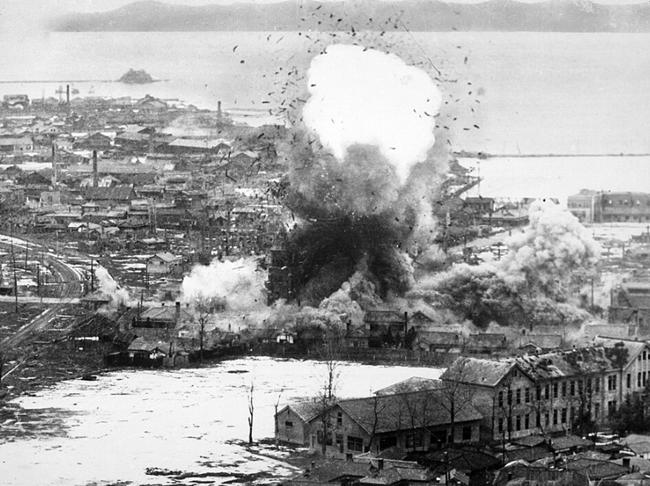 A 5th Air Force B-26 Invader light bomber drops bombs on a supply depot and port facilities at Wonsan, North Korea.
Official records of the U.S. government also show the same timeline. White House and State Department records report the full-scale North Korean attack on the morning of June 25.
In a statement on June 27, President Harry S. Truman announced his order for the U.S. Air Force and Navy to support the South Korean forces. This was a decision regarding air and naval support.
The deployment of ground troops was approved in subsequent stages. In other words, the invasion came first, followed by international intervention. This timeline is fixed by presidential statements and official U.S. government documents.
"Kin-slaying" Blurs the Distinction Between Victim and Perpetrator
Nevertheless, as the war progressed, expressions aimed at obscuring responsibility began to circulate.
The term "kin-slaying" (동족상잔) is a prime example. While this phrase emphasizes the tragedy, it ambiguously blurs who the perpetrator is and who the victim is.
By foregrounding the fact that they are the same people, the question of who attacked first is pushed aside. The starting point becomes obscured, leaving only the tragedy of the outcome. From this point on, the war is transformed from a matter of fact to a matter of emotion.
In the late 1950s, some media and academic circles began to attribute the cause of the war to "tensions on the 38th parallel."
This explanation was based on localized engagements from 1948 to early 1950. However, these engagements were reconnaissance and small-scale clashes, fundamentally different from a full-scale war.
The scale of forces, level of equipment, duration of operations, and command structure were entirely different. By erasing this distinction and summarizing it as "they shot at each other," the preparation and responsibility for the invasion began to be concealed.
North Korean archival materials fully demonstrate the preparations for the invasion. North Korean army organization documents and training records include plans for the operational use of tank units and concentrated artillery fire. These are preparations that cannot be made in a short period.
Reports from the Soviet military advisory group mention tank operation training, supply system checks, and operational familiarization processes. These records show that the war was not an accidental clash but a pre-prepared operation.
From the 1960s onward, the avoidance of responsibility solidified into political interpretation. Explanations emerged that attributed the war's responsibility to the South Korean government's "hardline statements" or "advocacy for advancing north." However, statements do not move tanks.
Actual troop movements and the commencement of artillery fire were carried out by the North Korean army. The decision was made by Kim Il-sung. The locations were Kaesong, Munsan, Uijeongbu, and Chuncheon. The time was dawn on June 25, 1950. Explanations that bypass these basic facts depart from historical records.
The claim that the remarks of then-South Korean President Syngman Rhee triggered the war is not tenable based on the timeline.
The decision for U.S. air and naval support was announced on June 27, after the invasion. The deployment of ground troops was approved in stages thereafter. The claim that foreign forces initiated the war before the invasion is not supported by historical records.
Changing the timeline naturally changes responsibility. Therefore, the evasion of responsibility always begins by obscuring the timeline.
U.S. Military Intervention Began After the Southern Invasion
The erasure of location has a similar effect. Tank columns crossing from Kaesong to Munsan, mechanized units advancing towards Uijeongbu, and artillery positions in the Chuncheon area are confirmed by official records and battle reports.
However, these specific facts are often omitted from narratives. Instead, phrases like "chaos across the Korean Peninsula" take their place. When specific facts disappear, responsibility also disappears.
In the 1970s and 1980s, the discourse defining the Korean War as an "American proxy war" spread within university campuses and some intellectual circles. However, this definition intentionally confuses the initiators of the war and the interveners.
For the term "proxy war" to be valid, the decision to start the war and the initial operational control must have been with the United States. However, historical records show the opposite.
The war began with the full-scale invasion by North Korean forces on the morning of June 25, 1950, and up to that point, the U.S. had neither the decision-making authority nor operational control over the commencement of the war.
U.S. military intervention occurred after the invasion. The U.S. President's order for air and naval support was announced on June 27, and the deployment of ground troops was approved in stages thereafter.
This was a response to the invasion that had already begun, rather than an act that initiated the war. In a proxy war, the intervention of the proxy should be the cause of the war. However, in the Korean War, U.S. intervention was the result. The cause was the North Korean invasion.
Furthermore, the North Korean invasion plan in the early stages of the war was formulated under Kim Il-sung's decision, with the approval and coordination of the Soviet Union and China, and the operational commencement was carried out independently by the North Korean army.
The United States was not present on the battlefield at the time of the war's commencement, nor did it exercise control. Defining the entire war as an "American proxy war" while ignoring this basic fact is an error that fails to distinguish between intervention and initiation.
Therefore, the definition of 'proxy war' is not an explanation but a reversal of cause and effect. It is a method of turning post-hoc intervention into pre-emptive planning to obscure the responsibility of those who initiated the war.
When this discourse operates, the power that decided to invade disappears, and all responsibility is shifted externally. This is the structural problem of the 'proxy war' discourse that circulated in university campuses in the 1970s-80s.
China's intervention is also distinguished by historical records. The participation of the Chinese People's Volunteer Army was after October 1950. This was an escalation of the war, not its commencement. Confusing the start and escalation blurs the focus of responsibility. Historical records demand a distinction.
The same method has been repeated in post-war narratives. Defining the cause of the war as an "unavoidable tragedy" eliminates the question of assigning responsibility. It no longer matters who decided on the war and with what judgment the invasion was carried out.
The war is treated as if it were an accident, not the result of a choice, and the power that ordered the invasion and the ideology that justified it are removed from the seat of responsibility. Criticism shifts from the perpetrator to the era's circumstances or international dynamics.
Calling June 25, 1950, a "mutual conflict" transforms factual records into sentences for emotional processing. War can be a tragedy. However, the word 'tragedy' does not absolve responsibility for the invasion.
The attitude of not being able to call a southern invasion a southern invasion is where the pro-North Korea leftist historical narrative of the 80s began. The time spent obscuring the meaning of the gunfire has had a longer-lasting impact than the day the gunfire erupted.

◆ Songsan
Poet and researcher of history and philosophy. He served as a director of the Syngman Rhee Academy and currently works as a research advisor for the Korean Modern and Contemporary History Research Association and as the representative of the Philosophy Forum Lyceum. He has published four poetry collections and co-translated 'Heroes of Hook Ridge.' Songsan is a pen name.

 Iranian Foreign Ministry: "Continuing Message Exchanges with the U.S. and Activities of Mediating Countries"
Esmaeil Baghaei, Spokesperson for the Iranian Ministry of Foreign Affairs [Xinhua, Yonhap News file photo]Esmaeil Baghaei, spokesperson for the Iranian Ministry of Foreign Affairs, stated on the 26th
Iranian Foreign Ministry: "Continuing Message Exchanges with the U.S. and Activities of Mediating Countries"
Esmaeil Baghaei, Spokesperson for the Iranian Ministry of Foreign Affairs [Xinhua, Yonhap News file photo]Esmaeil Baghaei, spokesperson for the Iranian Ministry of Foreign Affairs, stated on the 26th
 President Yoon: "Do You Think You Are Safe from the Special Counsel?"... Final Statement Video Released
President Yoon Suk Yeol rebuking the special prosecutor on the 24th. [Court video / @birds_justice X account subtitle GIF] A video of President Yoon Suk Yeol's closing statement at his trial rega
President Yoon: "Do You Think You Are Safe from the Special Counsel?"... Final Statement Video Released
President Yoon Suk Yeol rebuking the special prosecutor on the 24th. [Court video / @birds_justice X account subtitle GIF] A video of President Yoon Suk Yeol's closing statement at his trial rega
 President Yoon, regarding the first-instance ruling on the Public Official Election Act: “An excessive political verdict that distorts the facts… We will appeal immediately.”
The first-instance sentencing hearing for President Yoon Suk Yeol regarding violations of the Public Official Election Act is being broadcast live at Seoul Station on the 27th. [Photo=Yonhap News]Pres
President Yoon, regarding the first-instance ruling on the Public Official Election Act: “An excessive political verdict that distorts the facts… We will appeal immediately.”
The first-instance sentencing hearing for President Yoon Suk Yeol regarding violations of the Public Official Election Act is being broadcast live at Seoul Station on the 27th. [Photo=Yonhap News]Pres
 WSJ: "SK Hynix ADR Premium Is a Sign of AI Trading Overheat"
Advertisement for SK Hynix ADR listing in New York's Times Square [Reuters=Yonhap News file photo]The Wall Street Journal (WSJ) has pointed out that the price of SK Hynix’s American Depositary Recei
WSJ: "SK Hynix ADR Premium Is a Sign of AI Trading Overheat"
Advertisement for SK Hynix ADR listing in New York's Times Square [Reuters=Yonhap News file photo]The Wall Street Journal (WSJ) has pointed out that the price of SK Hynix’s American Depositary Recei
 'Godfather of Japanese Mystery Novels' Keigo Higashino Passes Away After Battle with Cancer at 68
Famous Japanese mystery novelist Keigo Higashino [AFP=Yonhap News]It has been belatedly reported that Keigo Higashino, the "godfather of Japanese mystery novels" and author of bestsellers such as "The
'Godfather of Japanese Mystery Novels' Keigo Higashino Passes Away After Battle with Cancer at 68
Famous Japanese mystery novelist Keigo Higashino [AFP=Yonhap News]It has been belatedly reported that Keigo Higashino, the "godfather of Japanese mystery novels" and author of bestsellers such as "The
 [Park Pil-kyu Security Column] To the Ignorant Trying to Clothe a Beast in Sheep's Clothing
Rep. Kim Byung-joo of the Democratic Party of Korea [Photo=Yonhap News]“The Air Force Academy doesn't teach you how to fly a plane!” “The Army, Navy, and Air Force academies are exactly the
[Park Pil-kyu Security Column] To the Ignorant Trying to Clothe a Beast in Sheep's Clothing
Rep. Kim Byung-joo of the Democratic Party of Korea [Photo=Yonhap News]“The Air Force Academy doesn't teach you how to fly a plane!” “The Army, Navy, and Air Force academies are exactly the
 [Issue Diagnosis] Two Effects of the Election Petition Review
 [Photo] Evidence of Election Fraud Flooding U.S. Media… Trump Had 2.7 Million Votes Stolen
 [Video] U.S. Semiquincentennial Air Show... 'Art in the Sky' streaks across New York
 [Editorial Cartoon] A Draconian Law That Undermines Freedom of Expression

 List
List









