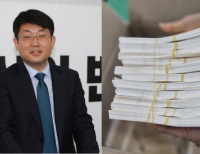
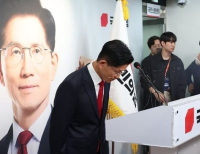
On January 11, at the launching ceremony of the National Growth Fund held at the Korea Development Bank in Yeouido, Seoul, Financial Services Commission Chairman Lee Bok-hyun, Mirae Asset Chairman Park Hyun-joo, Celltrion Chairman Seo Jung-jin, and Korea Development Bank Chairman Park Sang-jin are participating in a commemorative ceremony. [Photo=Yonhap News]
The "Tax Package to Vitalize the Domestic Capital Market and Stabilize the Foreign Exchange Market," announced by the government on the 20th, sounds unconventional at first glance.
It includes expanded income deductions for the people's participation-based National Growth Fund, reduced capital gains tax for those selling overseas stocks and returning to Korea, and tax benefits for foreign exchange hedging investments, all presented at once.
The government explains that the aim is to stabilize the foreign exchange market by bringing back funds that have flowed overseas back into the country.
However, upon closer inspection, the measures are less like policy and more akin to "conditional bait."
This is because it attempts to solve macroeconomic issues like foreign exchange instability through individual investor control, tax design that demands the abandonment of autonomy rather than fairness, and a short-term, event-driven approach lacking fundamental remedies.
The framework of the system introduced by the government consists of three pillars.
First, the National Growth Fund, which allows public participation, offers an income deduction of up to 40% for investments held for more than three years.
It provides separate taxation at a 9% rate on dividend income up to KRW 200 million, with income deductions applied at 40% for investments up to KRW 30 million, 20% for KRW 30 million to KRW 50 million, and 10% for KRW 50 million to KRW 70 million.
The second pillar is the Return to Korea Account (RIA). This system provides a reduction in capital gains tax on overseas stocks for funds sold and transferred to this account, which are then invested in domestic stocks or equity funds for at least one year.
The deduction limit per person is KRW 50 million, and the deduction rate varies depending on the timing of the return. A 100% deduction is applied for sales in the first quarter, 80% in the second quarter, and 50% in the second half of the year.
The third is the special provision for foreign exchange hedging investments.
Investing in foreign exchange hedging products allows for a deduction of 5% of the investment amount (up to KRW 5 million) from overseas stock capital gains tax. This is explained as an incentive to stabilize the foreign exchange market.
Apparent Lavish Benefits, Actually Conditional Taxation
While superficially appearing as benefits for investors, the design structure is not simple.
Funds entering the RIA account must only be invested in domestic assets, and if overseas stocks are net purchased in a general account, the tax benefits are reduced accordingly.
In summary, the condition is: "If you want to receive benefits, reduce overseas investments and tie up funds domestically." Taxation has become a tool to restrict investment freedom.
This structure is almost identical to the "bait product" method commonly seen in daily life.
It is no different from how credit card companies advertise "ultra-low-interest loans" but the benefits disappear if certain conditions are not met, or how mobile carriers promote "free phones" while requiring expensive plans and long-term contracts. It's a structure where strong restrictions are attached behind sweet benefits.
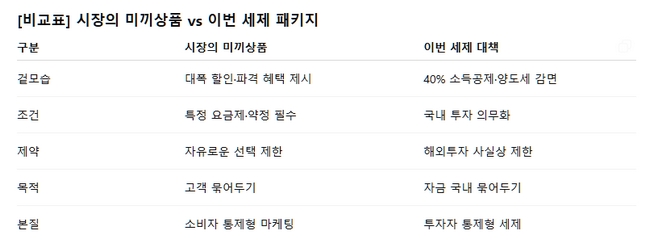
As the table shows, while this measure borrows the form of benefits, its actual structure restricts actions.
Investors must give up some of their right to freely construct their portfolios to receive benefits. Taxation has transformed from a tool to support the market into a mechanism to manage the market.
Taxation is Not the Cause of Foreign Exchange Instability
The starting point for these measures is the weakening of the Korean won and foreign exchange market instability. The government calculated that by directing individual investment funds back to Korea, foreign exchange supply and demand would stabilize, as increased overseas stock investment led to greater dollar demand.
However, this is a remedy that misses the essence of the problem.
The fundamental cause of foreign exchange instability lies not in individual investor choices, but in the structural weakening of the Korean economy.
The biggest weaknesses in the Korean market today are not taxes, but a lack of growth engines.
△ There are no new industries visible to lead beyond semiconductors.
△ Corporate governance reform is slow.
△ Regulatory predictability is low.
△ Shareholder return culture remains weak.
Unless these structural issues change, domestic capital will move overseas in search of higher returns, and foreign capital will not easily choose Korea as a long-term investment destination. As a result, the foreign exchange market will inevitably become structurally unstable.
A Remedy Choosing Control Over Market Attractiveness
In this situation, the solution offered by the government is far from a fundamental remedy.
The basic principles of tax policy are universality and fairness.
However, this system is conditional, requiring investors to give up some investment freedom to receive benefits. If overseas stocks are repurchased, benefits are reduced, and investment behavior in other accounts is effectively monitored.
Taxation has transformed into a means of controlling market autonomy.
To truly alleviate foreign exchange instability, the order should be reversed.
Macroeconomic and structural policies such as fostering new industries, reforming corporate governance, improving the regulatory environment, and reorganizing capital market systems should be presented first.
Tax benefits should only be a supplementary tool. Currently, the supplementary tool has become the main actor, and structural reforms have not even made it to the stage.
Taxation cannot replace trust.
The characteristic of bait products is that after attracting customers once, they narrow down future choices. This tax package is no different.
While it might tie up funds in the short term, it erodes investor trust in the long run.
Foreign exchange market stability comes from market attractiveness, not conditional benefits.
It is a time when genuine policies are needed to attract long-term capital on their own.

 [Statement by the Seo-beo-kka Korea Military Academy Save-the-Nation Comrades Association] ㉛ Recount the Votes Publicly, as the Previous Recount Concealed Election Fraud
Tongyeong Mayoral Election Recount [Photo=Yonhap News]South Korea's liberal democracy is dying. The National Election Commission (NEC) and the judiciary, which have plummeted into criminal syndicates
[Statement by the Seo-beo-kka Korea Military Academy Save-the-Nation Comrades Association] ㉛ Recount the Votes Publicly, as the Previous Recount Concealed Election Fraud
Tongyeong Mayoral Election Recount [Photo=Yonhap News]South Korea's liberal democracy is dying. The National Election Commission (NEC) and the judiciary, which have plummeted into criminal syndicates
 What is the significance of the "Trump 2028" red hats that keep making a comeback?
It is noteworthy that President Donald Trump is "intentionally" fueling controversy over whether he can actually run in the 2028 presidential election, even though it is "highly likely he is seriously
What is the significance of the "Trump 2028" red hats that keep making a comeback?
It is noteworthy that President Donald Trump is "intentionally" fueling controversy over whether he can actually run in the 2028 presidential election, even though it is "highly likely he is seriously
 Jin Cummings: "North Korea says it will increase the number of spies, so what is the government doing?"
U.S. political columnist Gene Cummings has publicly questioned the South Korean government, asking, "North Korea is announcing plans to increase its number of spies, yet what is the South Korean
Jin Cummings: "North Korea says it will increase the number of spies, so what is the government doing?"
U.S. political columnist Gene Cummings has publicly questioned the South Korean government, asking, "North Korea is announcing plans to increase its number of spies, yet what is the South Korean
 Attorney Do Tae-woo: “Discrepancies in Voter Count and Improper Sealing Confirmed in Tongyeong Mayoral Recount… Official Request for Additional Verification Submitted to Gyeongnam Election Commission”
A bundle of mail-in early voting ballots captured by lawyer Do Tae-woo at the Tongyeong mayoral election recount site. A clear solid line, raising suspicions of election fraud, is visible on the side
Attorney Do Tae-woo: “Discrepancies in Voter Count and Improper Sealing Confirmed in Tongyeong Mayoral Recount… Official Request for Additional Verification Submitted to Gyeongnam Election Commission”
A bundle of mail-in early voting ballots captured by lawyer Do Tae-woo at the Tongyeong mayoral election recount site. A clear solid line, raising suspicions of election fraud, is visible on the side
 Stock Market Crash 'Black Tuesday'… KOSPI down 10.8%, KOSDAQ down 7.7%
The KOSPI fell by more than 5% in early trading on the 28th, triggering a sell-side sidecar.On the 28th, the KOSPI plunged by more than 10%.Due to the sharp decline, a sell-side sidecar—a temporary
Stock Market Crash 'Black Tuesday'… KOSPI down 10.8%, KOSDAQ down 7.7%
The KOSPI fell by more than 5% in early trading on the 28th, triggering a sell-side sidecar.On the 28th, the KOSPI plunged by more than 10%.Due to the sharp decline, a sell-side sidecar—a temporary
 [World Heritage Committee] 25 New World Heritage Sites Inscribed in Busan… South Korea Successfully Expands 'Getbol' Listing
The Chairperson of the World Heritage Committee speaks at the plenary session of the 48th session of the World Heritage Committee, held at BEXCO in Busan on the 20th. [Photo: Yonhap News]A total of 25
[World Heritage Committee] 25 New World Heritage Sites Inscribed in Busan… South Korea Successfully Expands 'Getbol' Listing
The Chairperson of the World Heritage Committee speaks at the plenary session of the 48th session of the World Heritage Committee, held at BEXCO in Busan on the 20th. [Photo: Yonhap News]A total of 25
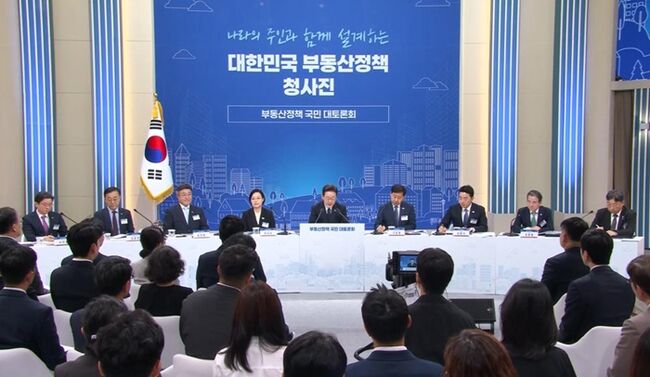 [Liberal Democratic Party Statement] Calling it a Grand Real Estate Debate… It Was Nothing More Than a Private Party Among Themselves
The 'National Grand Debate on Real Estate Policy' held on July 23rd and 27th. [Photo=Yonhap News]The 'National Grand Debate on Real Estate Policy,' hosted by the Lee Jae-myung administration under the
[Liberal Democratic Party Statement] Calling it a Grand Real Estate Debate… It Was Nothing More Than a Private Party Among Themselves
The 'National Grand Debate on Real Estate Policy' held on July 23rd and 27th. [Photo=Yonhap News]The 'National Grand Debate on Real Estate Policy,' hosted by the Lee Jae-myung administration under the
 [Photo] Evidence of Election Fraud Flooding U.S. Media… Trump Had 2.7 Million Votes Stolen
 [Video] U.S. Semiquincentennial Air Show... 'Art in the Sky' streaks across New York
 [Editorial Cartoon] A Draconian Law That Undermines Freedom of Expression

 List
List