1997년 12월3일, 대한민국 정부가 국제통화기금(IMF)에 구제금융을 공식 요청하던 날, 이 나라의 산업 현장은 조용히 두 갈래 길로 갈라졌다. 신문 1면에 ‘국가부도’라는 단어가 처음 등장한 이후 한국 사회를 지탱하던 수많은 기업과 일터는 생존이라는 냉혹한 시험대 위에 올려졌다. 그리고 같은 시대, 같은 조건 속에서 전혀 다른 결말을 맞이한 두 기업의 운명은 오늘날까지도 한국 노동조합의 본질을 묻는 상징적 사례로 남아 있다. 안양의 삼덕공원으로 변한 삼덕제지 공장과 라면 공장에서 세계 식탁으로 뻗어나간 삼양식품이 바로 그 주인공이다.
 Samdeok Park, built on the site of the former Samdeok Paper factory in Anyang. This park was created in August 2003 when the late Chairman Jeon Jae-jun of Samdeok Paper (now Samjeong Pulp) donated the factory site, valued at over 50 billion won at the time, to Anyang City.
On December 3, 1997, the day the South Korean government officially requested a bailout from the International Monetary Fund (IMF), the nation's industrial landscape quietly split into two paths. After the word 'national bankruptcy' appeared on the front page of newspapers for the first time, numerous companies and workplaces that had supported Korean society were placed on the harsh testing ground of survival.
And the fates of two companies that met entirely different ends under the same era and same conditions remain a symbolic case for questioning the essence of South Korean labor unions to this day. These protagonists are Samdeok Paper, which transformed into Samdeok Park in Anyang, and Samyang Foods, which expanded from a ramen factory to global dining tables.
Samyang Foods Union Overcame the IMF Crisis… A Choice Based on Cold Calculation
The winter of South Korea immediately after the IMF foreign exchange crisis was brutal. The streets were flooded with heads of households who had lost their jobs overnight, and the number of unemployed exceeded 1.7 million according to official statistics alone. According to a compilation of media and government data at the time, estimates suggested the actual felt unemployment reached nearly 3 million people. Companies' debt ratios soared, and financial institutions began recalling loans. The concept of a lifelong job vanished overnight, and labor unions and management entered an extreme game of chicken, battling to see 'who would last longer'.
Samyang Foods was no exception. The company, considered the originator of the ramen industry, saw its debt ratio exceed 300% immediately after the IMF crisis, and coupled with the internal shock of the founder's passing, it stood at a crossroads of survival. Banks pressured for fund recovery, and suppliers demanded payment for outstanding debts. In a typical scenario, labor and management would have likely clashed head-on at this stage. Indeed, at numerous industrial sites at the time, factory occupations, prolonged strikes, and intense struggles were repeated.
However, the Samyang Foods union's choice was different. Before management could even speak, the union and employee representatives resolved to forgo all bonuses and accept a 20% wage cut. Some employees even postponed their mid-term severance pay settlements to support the company's cash flow. This was not a heartwarming tale of emotional sacrifice, but the result of cold calculation. It was a choice born from the precise recognition that if the company disappeared, salaries, severance pay, and labor rights would all vanish with it. Instead of striking, they increased productivity, reduced defect rates, and did not shy away from weekend overtime. As a result, Samyang Foods weathered the IMF crisis.
The Outcome of Samdeok Paper Union's Choice of 'Struggle'… The Owner's 'Factory Closure'
In contrast, the union at Samdeok Paper, a local enterprise in Anyang, Gyeonggi Province, walked a completely different path. This paper factory, which had supported the regional economy for nearly 40 years since its founding in the 1960s, had a previous experience of overcoming a crisis through dramatic cooperation between labor and management during the IMF period. They had once saved the company by returning bonuses and adjusting wages. However, in the early 2000s, after joining a higher union, labor-management relations became sharply rigid, and conflicts over wage increases and welfare expansion escalated into struggle rather than dialogue.
In the summer of 2003, the Samdeok Paper factory went on a prolonged strike. Factory operations halted for 46 days, and clients gradually turned away. Given the nature of the paper industry, delivery reliability was a lifeline, but that reliability was shattered by a single strike. Although the company was profitable, a factory experiencing repeated production disruptions was merely an 'unstable asset' from a capitalist's perspective.
Ultimately, the founder, Chairman Jeon Jae-jun, who was 80 years old at the time, made a shocking decision. He declared he would close the factory and donate the site, valued at over 30 billion won, to Anyang City. This decision to relinquish tens of billions of won in assets became an irreversible turning point for both labor and management.
In November 2003, the Samdeok Paper Anyang factory closed its doors. Over time, the factory site became Samdeok Park, and over 60 workers lost their jobs. All that remained for the union members after the long strike were a few severance payments and the reality of losing their lifelong jobs. The company disappeared, and the entity to which they could assert their labor rights also vanished.
Samyang Foods Union's Decision… Not Submission, but Investment for the Future
During the same period, Samyang Foods quietly restructured itself. It streamlined its cost structure and focused on product competitiveness. Then, in the 2010s, it launched the hit product 'Buldak Bokkeum Myeon' (Fire Chicken Stir-fried Noodles). This product, which prominently featured the Korean characteristic of spiciness, spread to the global market via YouTube and social media (SNS).
As of 2024, Samyang Foods records an annual net profit of 344.2 billion won, significantly outperforming its competitor Nongshim. Its stock price, once hovering around 20,000 won, has surpassed 1.2 million won, and employees are enjoying tangible benefits such as performance bonuses and long-term employment stability.
The contrast between these two companies serves as empirical evidence of the choices labor and corporations must make for survival in a capitalist system. The Samyang Foods union's decision was not submission, but an investment in their future. It was a strategic choice that opted for long-term survival by accepting short-term losses. Conversely, Samdeok Paper's strike, while having its justifications, ultimately led to the demise of the workplace itself.
Today, in Korean society, the paradigm of 'struggle equals justice' is still repeated. However, in a global era where capital moves freely, capital can leave at any time. And capital that leaves does not return. Statistics showing that thousands of companies have left Korea over the years, with only a handful returning, starkly illustrate this reality.
Labor Rights Can Only Be Realized in a Sustainable Workplace
The lesson from the Samyang Foods case is clear. Workers' rights do not stem from slogans and continuous strikes. Labor rights only gain substance in the workplace of a sustainable company. Faced with the choice of 'growing the pie to share' or 'overturning the tray and starving everyone,' the Samyang Foods union chose the former, and the Samdeok Paper union chose the latter. The results are proven by numbers and on-site evidence some 20 years later.
Let us recall the moment in the winter of 1998 when Samyang Foods employees signed the bonus return agreement. They were wise workers who calculated their families' livelihoods and their own futures. And their calculations were correct. In contrast, the labor songs sung during the strike in the courtyard of the Samdeok Paper factory in the summer of 2003 are now buried in the silence of the park.
The lesson these two scenes offer our society is clear. There are workers because there is a company, and there are labor rights because there is a workplace. Justice without survival is empty. At this moment, when 'Peak Korea' is being cautiously discussed among economists, the success of Samyang Foods and the downfall of Samdeok Paper demand a clear choice for survival from all Korean workers.
Editorial Department, Hanmi Ilbo

 [Statement by the Seo-beo-kka Korea Military Academy Save-the-Nation Comrades Association] ㉛ Recount the Votes Publicly, as the Previous Recount Concealed Election Fraud
Tongyeong Mayoral Election Recount [Photo=Yonhap News]South Korea's liberal democracy is dying. The National Election Commission (NEC) and the judiciary, which have plummeted into criminal syndicates
[Statement by the Seo-beo-kka Korea Military Academy Save-the-Nation Comrades Association] ㉛ Recount the Votes Publicly, as the Previous Recount Concealed Election Fraud
Tongyeong Mayoral Election Recount [Photo=Yonhap News]South Korea's liberal democracy is dying. The National Election Commission (NEC) and the judiciary, which have plummeted into criminal syndicates
 What is the significance of the "Trump 2028" red hats that keep making a comeback?
It is noteworthy that President Donald Trump is "intentionally" fueling controversy over whether he can actually run in the 2028 presidential election, even though it is "highly likely he is seriously
What is the significance of the "Trump 2028" red hats that keep making a comeback?
It is noteworthy that President Donald Trump is "intentionally" fueling controversy over whether he can actually run in the 2028 presidential election, even though it is "highly likely he is seriously
 Jin Cummings: "North Korea says it will increase the number of spies, so what is the government doing?"
U.S. political columnist Gene Cummings has publicly questioned the South Korean government, asking, "North Korea is announcing plans to increase its number of spies, yet what is the South Korean
Jin Cummings: "North Korea says it will increase the number of spies, so what is the government doing?"
U.S. political columnist Gene Cummings has publicly questioned the South Korean government, asking, "North Korea is announcing plans to increase its number of spies, yet what is the South Korean
 Attorney Do Tae-woo: “Discrepancies in Voter Count and Improper Sealing Confirmed in Tongyeong Mayoral Recount… Official Request for Additional Verification Submitted to Gyeongnam Election Commission”
A bundle of mail-in early voting ballots captured by lawyer Do Tae-woo at the Tongyeong mayoral election recount site. A clear solid line, raising suspicions of election fraud, is visible on the side
Attorney Do Tae-woo: “Discrepancies in Voter Count and Improper Sealing Confirmed in Tongyeong Mayoral Recount… Official Request for Additional Verification Submitted to Gyeongnam Election Commission”
A bundle of mail-in early voting ballots captured by lawyer Do Tae-woo at the Tongyeong mayoral election recount site. A clear solid line, raising suspicions of election fraud, is visible on the side
 Stock Market Crash 'Black Tuesday'… KOSPI down 10.8%, KOSDAQ down 7.7%
The KOSPI fell by more than 5% in early trading on the 28th, triggering a sell-side sidecar.On the 28th, the KOSPI plunged by more than 10%.Due to the sharp decline, a sell-side sidecar—a temporary
Stock Market Crash 'Black Tuesday'… KOSPI down 10.8%, KOSDAQ down 7.7%
The KOSPI fell by more than 5% in early trading on the 28th, triggering a sell-side sidecar.On the 28th, the KOSPI plunged by more than 10%.Due to the sharp decline, a sell-side sidecar—a temporary
 [World Heritage Committee] 25 New World Heritage Sites Inscribed in Busan… South Korea Successfully Expands 'Getbol' Listing
The Chairperson of the World Heritage Committee speaks at the plenary session of the 48th session of the World Heritage Committee, held at BEXCO in Busan on the 20th. [Photo: Yonhap News]A total of 25
[World Heritage Committee] 25 New World Heritage Sites Inscribed in Busan… South Korea Successfully Expands 'Getbol' Listing
The Chairperson of the World Heritage Committee speaks at the plenary session of the 48th session of the World Heritage Committee, held at BEXCO in Busan on the 20th. [Photo: Yonhap News]A total of 25
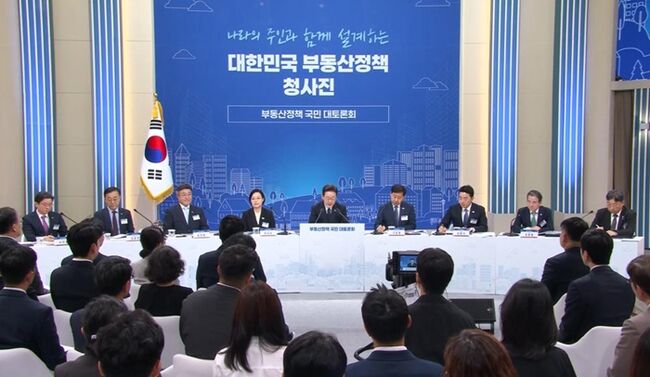 [Liberal Democratic Party Statement] Calling it a Grand Real Estate Debate… It Was Nothing More Than a Private Party Among Themselves
The 'National Grand Debate on Real Estate Policy' held on July 23rd and 27th. [Photo=Yonhap News]The 'National Grand Debate on Real Estate Policy,' hosted by the Lee Jae-myung administration under the
[Liberal Democratic Party Statement] Calling it a Grand Real Estate Debate… It Was Nothing More Than a Private Party Among Themselves
The 'National Grand Debate on Real Estate Policy' held on July 23rd and 27th. [Photo=Yonhap News]The 'National Grand Debate on Real Estate Policy,' hosted by the Lee Jae-myung administration under the
 [Photo] Evidence of Election Fraud Flooding U.S. Media… Trump Had 2.7 Million Votes Stolen
 [Video] U.S. Semiquincentennial Air Show... 'Art in the Sky' streaks across New York
 [Editorial Cartoon] A Draconian Law That Undermines Freedom of Expression

 List
List