U.S. President Trump. [Photo=Yonhap News]
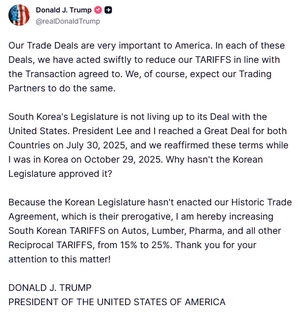
U.S. President Donald Trump announced on the 26th (local time) that he would again raise tariffs on Korean automobiles and other products from 15% to 25%.
Domestic interpretations are divided regarding the background of this statement.
President Trump explained the reason for the tariff increase via Truth Social, directly mentioning, "The Korean National Assembly has not ratified the historic trade agreement."
However, major domestic reports interpreted the core of this statement as a "delay in the passage of the Special Act on Investment in the U.S.," shifting the focus to the National Assembly's legislative schedule.
Key Issue | What Did Trump Take Issue With?
President Trump's original statement is relatively clear. He asked the following:
"So why has the Korean National Assembly not ratified it?"
(So why has the Korean National Assembly not ratified it?)
The target of concern here is not the "Special Act on Investment in the U.S." but the trade agreement signed between South Korea and the U.S., and the action requested is ratification, not legislation or enactment.
Ratification is a process by which the National Assembly approves treaties or international agreements under the Constitution.
This is different in nature from "legislation" to create new domestic laws or "enactment of implementation laws" to execute agreed-upon content.
President Trump's question was aimed not at the speed of agreement implementation, but at the legal status with which the agreement is being treated.
Verification | Is the Special Act Subject to Ratification?
The Special Act on Investment in the U.S. is implementation legislation to execute the investment content agreed upon by South Korea and the U.S. domestically. The Special Act is subject to enactment and deliberation by the National Assembly, not ratification of international agreements.
Therefore, the expression "delay in the ratification of the Special Act" used by Yonhap News is difficult to establish in terms of constitutional and legislative systems.
The agreement between South Korea and the U.S. only specifies the "submission of the bill" and the subsequent reduction of tariffs, but does not include a deadline for "bill passage" or penalty clauses for delay.
In fact, when the South Korean government submitted the bill, the U.S. retroactively reduced tariffs on Korean automobiles and other products to 15%. Based on these facts alone, South Korea can be said to have implemented the initial measures explicitly stipulated in the agreement.
However, the fact sheet also explicitly states that the U.S. has discretion to readjust tariffs if it deems the implementation of the agreement insufficient.
Considering this point, it is reasonable to interpret President Trump's renewed mention of "ratification" as a criticism not of the "speed of discussion on the Special Act," but of the "structure where the agreement itself was not put through the ratification process."
Correction of Interpretation | Where Does the Responsibility Lie?
Some domestic reports pointed to the "delay in the passage of the Special Act on Investment in the U.S." as the background for President Trump's tariff increase statement. This interpretation naturally directs the responsibility towards the National Assembly.
However, while the National Assembly has the authority to ratify, it does not have the authority to initiate the ratification process. The government is the entity that can submit a ratification bill to the National Assembly.
Therefore, President Trump's question, "Why has the National Assembly not ratified it?" structurally leads to the question, "Why has the South Korean government not put this agreement through the ratification process?"
The moment the issue of "ratification" is changed to "delay in the passage of the Special Act," the executive branch's choice regarding how to define the legal nature of the agreement is obscured, and only the National Assembly's responsibility is highlighted.
The political sphere also has divided opinions on the legal nature of this agreement. The Democratic Party of Korea views the South Korea-U.S. agreement as a policy agreement or a promise between executive branches, not a treaty, and has maintained the position that the enactment of the Special Act on Investment in the U.S., an implementation legislation, is sufficient without separate National Assembly ratification.
On the other hand, the People Power Party argues that as it entails significant financial burdens and trade and security obligations, it is an agreement that requires National Assembly ratification consent under the Constitution, and that proceeding without ratification procedures has constitutional issues.
Despite the existing differences in views between the ruling and opposition parties regarding the nature and procedures of the agreement, the government has only pursued implementation legislation without providing a clear judgment on whether the agreement is subject to ratification.
In this situation, when President Trump's question, "Why has the National Assembly not ratified it?" was raised, the focus naturally shifted to the issue of legislative delay by the National Assembly, and the executive branch's choice and responsibility for handling the agreement within a legal framework were once again obscured.
Conclusion | The Reason the Government Delayed Ratification is Key
The essence of this tariff controversy is not the tariff rate itself.
It is the absence of an explanation as to whether this agreement is subject to ratification, and if so, why the government did not put it through the ratification process.
An interpretation that presents only "delay of the Special Act" as the cause, without an answer to this question, does not accurately convey the intent of President Trump's statement.
Trump did not ask about the speed of legislation. He asked about ratification. The moment this difference is blurred, the direction of responsibility is also distorted.
Whether some Korean media outlets, including Yonhap News, misread the issue, or uncritically accepted explanations that shifted the government's responsibility to the National Assembly, is secondary.
The result is that the core issue of "ratification" has disappeared, and the responsibility for the tariff increase has been distorted.
This is not just a difference in interpretation, but will be a significant blemish in the historical record of Korean journalism.
Related Article: [Analysis of Korea-U.S. Fact Sheet] "Japan is an Exception, Korea is a Managed Country"... Not an 'Agreement', but 'Subjugation'
https://www.hanmiilbo.kr/news/view.php?idx=3847&mcode=m98oh30

 [Statement by the Seo-beo-kka Korea Military Academy Save-the-Nation Comrades Association] ㉛ Recount the Votes Publicly, as the Previous Recount Concealed Election Fraud
Tongyeong Mayoral Election Recount [Photo=Yonhap News]South Korea's liberal democracy is dying. The National Election Commission (NEC) and the judiciary, which have plummeted into criminal syndicates
[Statement by the Seo-beo-kka Korea Military Academy Save-the-Nation Comrades Association] ㉛ Recount the Votes Publicly, as the Previous Recount Concealed Election Fraud
Tongyeong Mayoral Election Recount [Photo=Yonhap News]South Korea's liberal democracy is dying. The National Election Commission (NEC) and the judiciary, which have plummeted into criminal syndicates
 What is the significance of the "Trump 2028" red hats that keep making a comeback?
It is noteworthy that President Donald Trump is "intentionally" fueling controversy over whether he can actually run in the 2028 presidential election, even though it is "highly likely he is seriously
What is the significance of the "Trump 2028" red hats that keep making a comeback?
It is noteworthy that President Donald Trump is "intentionally" fueling controversy over whether he can actually run in the 2028 presidential election, even though it is "highly likely he is seriously
 Jin Cummings: "North Korea says it will increase the number of spies, so what is the government doing?"
U.S. political columnist Gene Cummings has publicly questioned the South Korean government, asking, "North Korea is announcing plans to increase its number of spies, yet what is the South Korean
Jin Cummings: "North Korea says it will increase the number of spies, so what is the government doing?"
U.S. political columnist Gene Cummings has publicly questioned the South Korean government, asking, "North Korea is announcing plans to increase its number of spies, yet what is the South Korean
 Attorney Do Tae-woo: “Discrepancies in Voter Count and Improper Sealing Confirmed in Tongyeong Mayoral Recount… Official Request for Further Verification Filed with Gyeongnam Election Commission”
A bundle of out-of-district early voting ballots photographed by attorney Do Tae-woo at the Tongyeong mayoral election recount site. A clear, solid line visible on the side of the ballots raises suspi
Attorney Do Tae-woo: “Discrepancies in Voter Count and Improper Sealing Confirmed in Tongyeong Mayoral Recount… Official Request for Further Verification Filed with Gyeongnam Election Commission”
A bundle of out-of-district early voting ballots photographed by attorney Do Tae-woo at the Tongyeong mayoral election recount site. A clear, solid line visible on the side of the ballots raises suspi
 Stock Market Crash 'Black Tuesday'… KOSPI down 10.8%, KOSDAQ down 7.7%
The KOSPI fell by more than 5% in early trading on the 28th, triggering a sell-side sidecar.On the 28th, the KOSPI plunged by more than 10%.Due to the sharp decline, a sell-side sidecar—a temporary
Stock Market Crash 'Black Tuesday'… KOSPI down 10.8%, KOSDAQ down 7.7%
The KOSPI fell by more than 5% in early trading on the 28th, triggering a sell-side sidecar.On the 28th, the KOSPI plunged by more than 10%.Due to the sharp decline, a sell-side sidecar—a temporary
 [World Heritage Committee] 25 New World Heritage Sites Inscribed in Busan… South Korea Successfully Expands 'Getbol' Listing
The Chairperson of the World Heritage Committee speaks at the plenary session of the 48th session of the World Heritage Committee, held at BEXCO in Busan on the 20th. [Photo: Yonhap News]A total of 25
[World Heritage Committee] 25 New World Heritage Sites Inscribed in Busan… South Korea Successfully Expands 'Getbol' Listing
The Chairperson of the World Heritage Committee speaks at the plenary session of the 48th session of the World Heritage Committee, held at BEXCO in Busan on the 20th. [Photo: Yonhap News]A total of 25
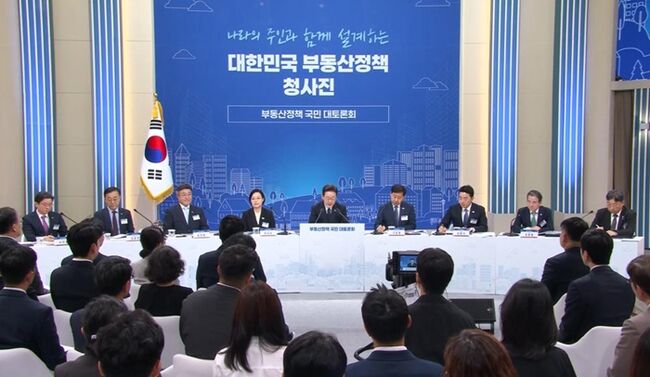 [Liberal Democratic Party Statement] Calling it a Grand Real Estate Debate… It Was Nothing More Than a Private Party Among Themselves
The 'National Grand Debate on Real Estate Policy' held on July 23rd and 27th. [Photo=Yonhap News]The 'National Grand Debate on Real Estate Policy,' hosted by the Lee Jae-myung administration under the
[Liberal Democratic Party Statement] Calling it a Grand Real Estate Debate… It Was Nothing More Than a Private Party Among Themselves
The 'National Grand Debate on Real Estate Policy' held on July 23rd and 27th. [Photo=Yonhap News]The 'National Grand Debate on Real Estate Policy,' hosted by the Lee Jae-myung administration under the
 [Photo] Evidence of Election Fraud Flooding U.S. Media… Trump Had 2.7 Million Votes Stolen
 [Video] U.S. Semiquincentennial Air Show... 'Art in the Sky' streaks across New York
 [Editorial Cartoon] A Draconian Law That Undermines Freedom of Expression

 List
List