In July 1998, then Minister of Education Lee Hae-chan (left) reports on the progress of national tasks to then-President Kim Dae-jung. [Photo=Yonhap News]
The reason left-leaning administrations appoint highly influential figures as Minister of Education is because they recognize the position as a key locus for managing society's long-term frameworks of thought.
Education is not an area that yields immediate, visible results. Nor does it align with election cycles. However, habits of thought, linguistic sense, historical perception, and attitudes toward the nation are slowly shaped through education.
Left-leaning political forces have long understood this point accurately. Thus, the Ministry of Education is treated not as a ministry concerned with budget size or administrative convenience, but as a department that lays the foundation for future society.
For the Left, the Minister of Education is a Position Responsible for the Future
Within the left-leaning camp, the Minister of Education is not merely an administrative head. Individuals with verified ideological trustworthiness, strong organizational control, and extensive connections with academia, teacher organizations, and civic groups are primarily appointed.
The ability to discern what to change and what to preserve in students' thinking, and to judge where to push ideological agendas and where to detour, stems from the Minister of Education's capabilities.
Left-leaning administrations do not approach educational policy as a one-off reform. They perceive it as a chain reaction involving the curriculum, textbooks, teacher evaluations, student rights, university structures, and research fund allocation. The Minister of Education is tasked with coordinating this entire chain to move in a single direction.
Left-leaning citizens also regard the appointment of the Minister of Education as a significant political event. They meticulously review the candidate's past remarks, research history, civic group activities, and petition signatures.
This is because there is a shared understanding that education is the front line in the cultural war. Consequently, debates surrounding the appointment of the Minister of Education are often heated within the left-leaning camp.
Conversely, conservative administrations have repeatedly tended to treat the position of Minister of Education as relatively less significant.
This phenomenon is not simply a cumulative result of personnel failures. It stems from a difference in political sensitivity toward education.
The conservative camp primarily views education as an area of management. They tend to focus on handling current issues such as the examination system, fairness in college admissions, mediating parental complaints, and managing conflicts with teacher unions.
While they do not deny that education forms the bedrock of societal perception, they are very passive in elevating it to a core pillar of their political strategy.
As a result, conservative administrations repeatedly appoint individuals with less political weight to the position of Minister of Education. The criteria of being a former bureaucrat, a stable academic figure, or someone unlikely to escalate conflict take precedence.
There is also a tendency to guard against the minister's prominence. This is because the Ministry of Education becoming the center of political debate is perceived as a burden.
"Education is Already Politicized"
This perception does not end with the appointing authority's attitude. Conservative citizens often do not pay much attention to the appointment of the Minister of Education. Compared to areas like foreign affairs, national security, economy, and real estate, education is relegated to a lower priority.
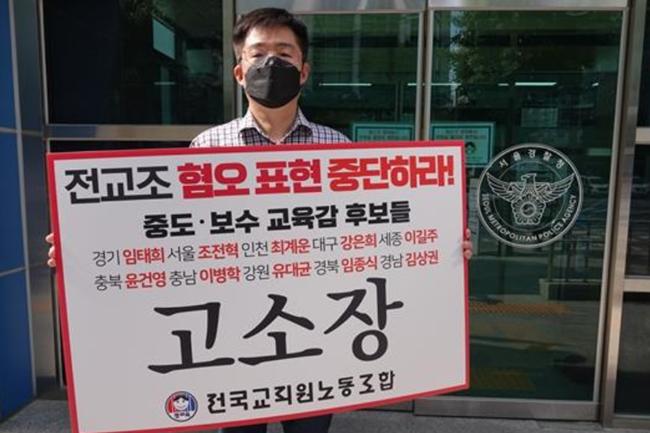 In May 2022, the Korean Teachers and Education Workers' Union (KTUW), having seemingly forgotten its active participation in past rallies such as 'Lee Myung-bak OUT,' 'Park Geun-hye OUT,' and 'Cho-Joong-Dong OUT,' sued ten then-superintendent candidates, including Jo Jun-hyuk, for labeling 'KTUW OUT' as hate speech. [Photo=KTUW]
The left aims to design the fundamental sensibilities of society in 10 or 20 years through education. They prioritize long-term effects, even if it means enduring current disadvantages.
In contrast, the right focuses more energy on managing current dissatisfactions and ensuring immediate institutional stability.
A caution against the idea of changing societal perceptions through education, as it could be misunderstood as ideological intervention, also plays a role. While this caution may appear as prudence politically, it ultimately leads to defeat on the long-term front.
The stature of the Minister of Education reveals what that administration fears and what it prioritizes.
Left-leaning administrations believe that if they cannot control education, all other policies can be rendered powerless. Even if laws and systems are changed or budgets increased, if the language that interprets and reproduces their meaning is formed in the classroom, society will move in a different direction.
In this regard, education is the domain that supplies the framework for interpreting policy outcomes. The left intuitively understands the importance of managing this framework.
Conservative administrations have considered their cautious approach to the politicization of education as a virtue. The rationale of protecting children from politics is often invoked. This rationale itself deserves respect.
However, the problem lies in reality. Education is already political. A single sentence in a textbook, the arrangement of a timeline, the tone of an assessment of a historical figure, and the way social issues are addressed all entail value judgments.
The stance of not engaging in political intervention may seem like a declaration of neutrality, but in practice, it means allowing the existing momentum to continue. In such a state, the significance of the Minister of Education is bound to diminish.
This difference is also repeated in civil society. Left-leaning civic groups are persistent on educational issues. They track textbook revisions, curriculum changes, and even teacher training content. They produce papers and reports, and exert pressure through media contributions. This is because there is a shared understanding that education is a core pillar of cultural struggle.
Conversely, conservative civil society is weak in its organized response to educational issues. Interest erupts temporarily and quickly subsides. They react only to specific events or controversies and fail to establish long-term response structures, scattering afterwards. These results accumulate.
Through education, the left disseminates its language and problem awareness throughout society. Generations that grow up learning that language naturally become accustomed to specific value judgments.
Political Perception is Formed Through Education
This is not a matter that can be explained by the simple term "brainwashing." It is because everyday linguistic sense, criteria for judging right and wrong, and a sense of distance toward the nation are formed through education.
The right has consistently underestimated this process. There was a strong belief that simply fixing systems and policies would suffice. However, systems operate based on interpretation. The left has not missed the fact that education is where interpretation is supplied.
The difference in the status of the Minister of Education ultimately stems from politics' self-understanding. The left perceives politics as a task of reshaping the entire society. Laws, budgets, education, culture, and language are placed on a single continuum.
Therefore, the Minister of Education is a key link managing that continuum. The right tends to view politics as a problem-solving technique. They focus on tangible indicators such as economic growth, public safety, and diplomatic achievements. Education is relegated to a supporting role that underpins those indicators.
Consequently, every time a conservative administration changes, educational policies are hastily revised, and ministers undergo frequent changes. Long-term strategies do not accumulate.
Meanwhile, the educational field maintains accumulated practices and language that are already oriented in a different direction. Even with a change in administration, the atmosphere in classrooms does not easily shift. The left understands this well. Therefore, they do not spare political assets for the single position of Minister of Education.
This issue is not a simple dichotomy of the left being right and the right being wrong.
Rather, it is a difference in how political forces perceive their long-term battleground. There is a significant gap between the view that sees education as a space for setting societal foundations and the view that sees it as one area to be managed.
This gap is not just a matter of one appointment or one minister. It is the result of the political sensibility and civic awareness of the entire camp.
As long as the right treats the position of Minister of Education lightly, the direction of societal perception formed through education will continue to be entrusted to the hands of the left-leaning camp. This is not defeatism but a diagnosis of reality.
Education operates quietly. It is not revealed by votes like legislation, nor by numbers like budgets. However, it is what endures the longest. This is why the left does not overlook this point.
Unless this fact is confronted, the fundamental sensibilities of society will perpetually accumulate in the same direction, regardless of changes in administration.
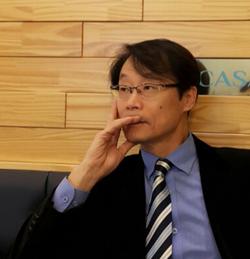
◆ Matsuyama
Poet and researcher of history and philosophy. Former director of the Syngman Rhee Institute. Currently serves as an honorary advisor for research at the Korean Modern and Contemporary History Research Association and as the representative of the philosophy forum Lyceum. He has published four poetry collections, co-translated "Heroes of Chosin," and authored the historical psychology commentary "Joseon Became a Myth" (2026). He is actively engaged in research and practice of liberal cultural movements. Matsuyama is a pen name.

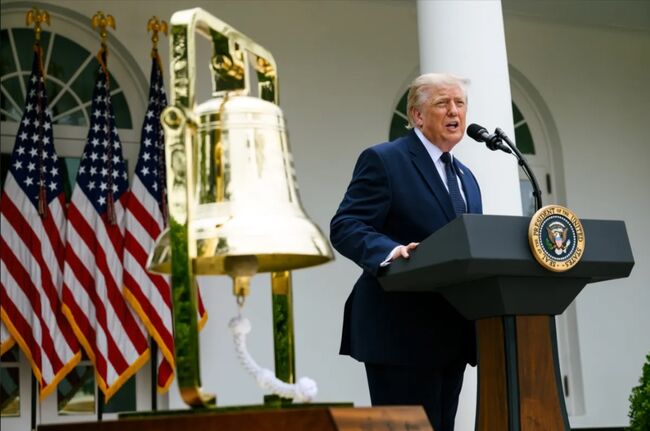 Trump pressures for rate cut again ahead of FOMC... "Should be the lowest in the world"
U.S. President Donald Trump. [Photo = The White House] U.S. President Donald Trump once again pressured the Federal Reserve, the U.S. central bank, to lower interest rates on the 27th (local time
Trump pressures for rate cut again ahead of FOMC... "Should be the lowest in the world"
U.S. President Donald Trump. [Photo = The White House] U.S. President Donald Trump once again pressured the Federal Reserve, the U.S. central bank, to lower interest rates on the 27th (local time
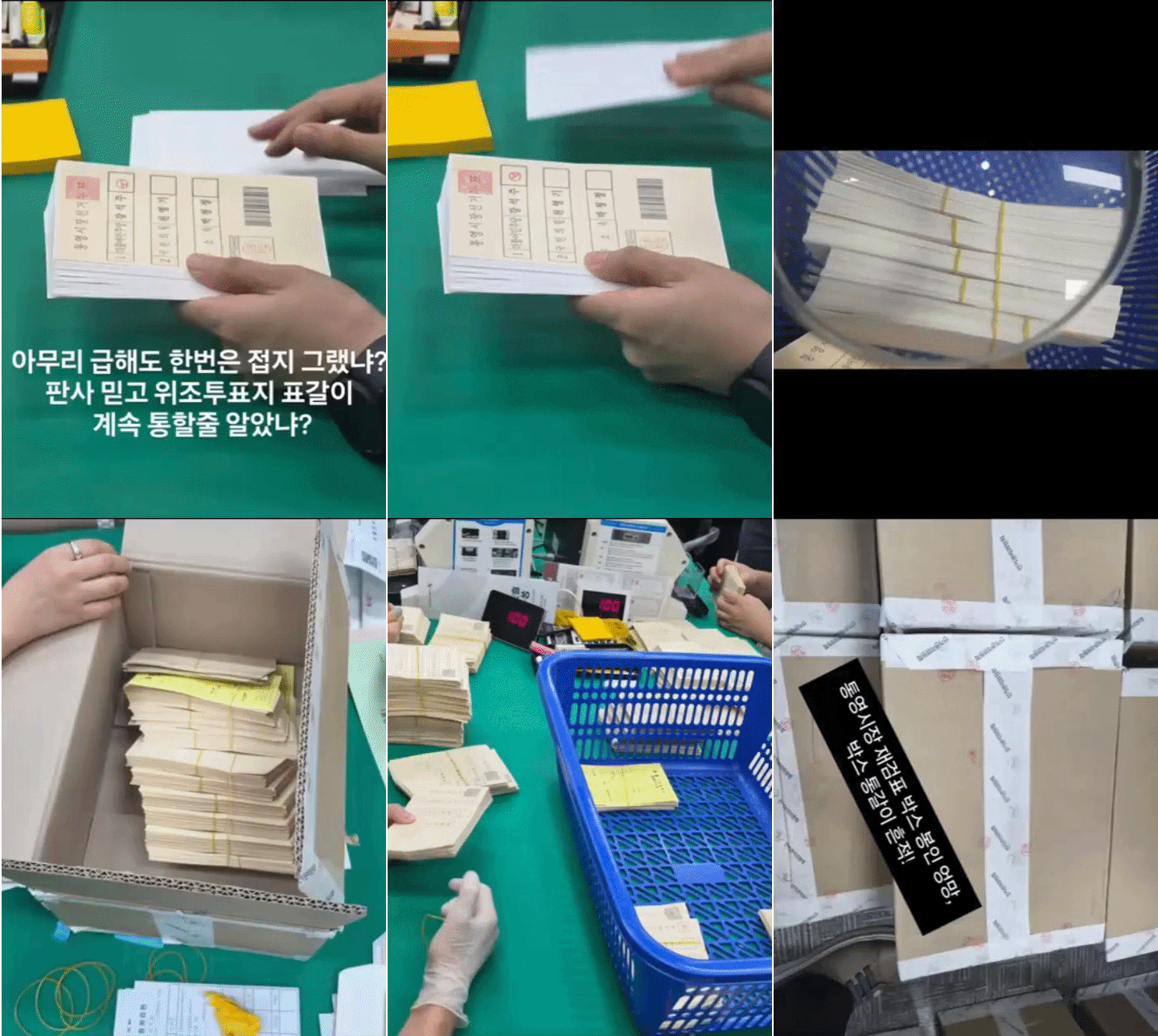 “Ignoring crisp ballots and damaged seals”… Tongyeong mayoral recount concludes with ‘no change in outcome,’ leaving suspicions and public outrage behind
Suspected counterfeit ballots discovered in Tongyeong [GIF from social media of Representative Hwang Kyo-ahn / Attorney Park Joo-hyun]During a recount of the Tongyeong mayoral election in South Gyeong
“Ignoring crisp ballots and damaged seals”… Tongyeong mayoral recount concludes with ‘no change in outcome,’ leaving suspicions and public outrage behind
Suspected counterfeit ballots discovered in Tongyeong [GIF from social media of Representative Hwang Kyo-ahn / Attorney Park Joo-hyun]During a recount of the Tongyeong mayoral election in South Gyeong
 President Yoon, regarding the first-instance ruling on the Public Official Election Act: “An excessive political verdict that distorts the facts… We will appeal immediately.”
The first-instance sentencing hearing for President Yoon Suk Yeol regarding violations of the Public Official Election Act is being broadcast live at Seoul Station on the 27th. [Photo=Yonhap News]Pres
President Yoon, regarding the first-instance ruling on the Public Official Election Act: “An excessive political verdict that distorts the facts… We will appeal immediately.”
The first-instance sentencing hearing for President Yoon Suk Yeol regarding violations of the Public Official Election Act is being broadcast live at Seoul Station on the 27th. [Photo=Yonhap News]Pres
 WSJ: "SK Hynix ADR Premium Is a Sign of AI Trading Overheat"
Advertisement for SK Hynix ADR listing in New York's Times Square [Reuters=Yonhap News file photo]The Wall Street Journal (WSJ) has pointed out that the price of SK Hynix’s American Depositary Recei
WSJ: "SK Hynix ADR Premium Is a Sign of AI Trading Overheat"
Advertisement for SK Hynix ADR listing in New York's Times Square [Reuters=Yonhap News file photo]The Wall Street Journal (WSJ) has pointed out that the price of SK Hynix’s American Depositary Recei
 'Godfather of Japanese Mystery Novels' Keigo Higashino Passes Away After Battle with Cancer at 68
Famous Japanese mystery novelist Keigo Higashino [AFP=Yonhap News]It has been belatedly reported that Keigo Higashino, the "godfather of Japanese mystery novels" and author of bestsellers such as "The
'Godfather of Japanese Mystery Novels' Keigo Higashino Passes Away After Battle with Cancer at 68
Famous Japanese mystery novelist Keigo Higashino [AFP=Yonhap News]It has been belatedly reported that Keigo Higashino, the "godfather of Japanese mystery novels" and author of bestsellers such as "The
 [Park Pil-kyu Security Column] To the Ignorant Trying to Clothe a Beast in Sheep's Clothing
Rep. Kim Byung-joo of the Democratic Party of Korea [Photo=Yonhap News]“The Air Force Academy doesn't teach you how to fly a plane!” “The Army, Navy, and Air Force academies are exactly the
[Park Pil-kyu Security Column] To the Ignorant Trying to Clothe a Beast in Sheep's Clothing
Rep. Kim Byung-joo of the Democratic Party of Korea [Photo=Yonhap News]“The Air Force Academy doesn't teach you how to fly a plane!” “The Army, Navy, and Air Force academies are exactly the
 [Issue Diagnosis] Two Effects of the Election Petition Review
 [Photo] Evidence of Election Fraud Flooding U.S. Media… Trump Had 2.7 Million Votes Stolen
 [Video] U.S. Semiquincentennial Air Show... 'Art in the Sky' streaks across New York
 [Editorial Cartoon] A Draconian Law That Undermines Freedom of Expression

 List
List