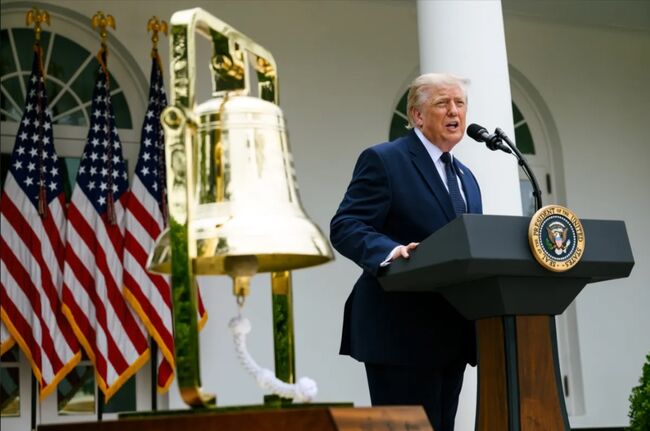
Statements that elevated the reliability of election management systems from ‘institutional debate’ to ‘security agenda’ followed around the Davos Forum from the US conservative camp. [Photo=White House]The recent controversy surrounding the Association of World Election Bodies (A-WEB) has been relatively quietly covered by the domestic media.
However, looking at the trends in overseas political/policy communities and international security discourse, the fairness and transparency of election systems, and the possibility of foreign technological/information intervention, are no longer peripheral issues.
Elections are now moving beyond procedural issues of democracy into the realm of national security and technological sovereignty.
This change is becoming even clearer on the recent international political stage. Around the Davos Forum, statements emerged from the US conservative camp elevating the issue of trust in election management systems from an ‘institutional debate’ to a ‘security agenda.’
The Nature of ‘Suspicions’ Raised Abroad
It is clear that a shared concern exists that the vulnerability of election systems can directly impact national sovereignty, even without specifically naming a particular country.
Policy professionals from Silicon Valley are also publicly discussing the tensions between digital identity verification, platform control, and national data management, and the core values of liberal democracy. There have also been instances where South Korea's digital administration system has been mentioned in these discussions.
This needs to be understood not as a definitive questioning of the legitimacy of Korean elections, but as part of a broader international concern regarding the relationship between digital control and democratic trust.
Recently, some US political and security communities have used extreme language referring to South Korea's election management system and the National Election Commission.
While these claims cannot be treated on the same level as official intelligence or judicial judgments, what is noteworthy here is that these claims did not suddenly emerge in a vacuum.
Electronic voting/counting systems, international election cooperation bodies, and the export and standardization of election technology have long been subjects of debate within Western democracies.
The reason why the German Federal Constitutional Court ruled electronic voting unconstitutional and the Netherlands abolished electronic voting/counting after numerous verifications was not necessarily due to the 'possibility of manipulation' of election results, but rather the judgment that systems that citizens cannot understand and verify could undermine democratic trust.
In this international context, the mention of A-WEB and South Korea's election management system, regardless of its factual basis, should be read as a warning signal in terms of trust management.
The ‘Securitization’ of Elections Amidst China’s Intervention Debate
Another noteworthy change is that election issues are being discussed in conjunction with foreign influence operations. As seen in the case of Venezuela, the collapse of election trust can lead to international non-recognition and political instability.
Canada officially investigated allegations of Chinese interference in elections through a public inquiry committee, and Australia is taking a strong stance against influence operations targeting expatriate communities and political circles by applying its foreign interference laws.
These countries commonly manage elections not as ‘subjects of political contention,’ but as part of their ‘national security systems.’ They have already experienced the significant costs incurred when institutional bodies neglect these issues, regardless of where the concerns originated.
In this international environment, Assemblywoman Kim Min-jeon’s raising of the controversy surrounding A-WEB and electronic voting/counting systems is not an attempt to amplify and reproduce specific claims.
It is closer to raising the issue that South Korea's election management system also needs to be examined from a trust perspective, based on the institutional judgments of Western democracies and international debates.
What is important is not to reduce this discussion to a matter of ‘believing or not believing.’ Election systems are not subjects that demand trust from citizens; they are public systems that must be designed and managed to prevent suspicion from arising. The role of institutional politics is not to suppress suspicions, but to explain why such doubts are repeatedly raised internationally and to resolve them institutionally.
The Responsibility to Respond to Debates Surrounding Elections
The international debate surrounding elections has already moved beyond the word 'fraud.' The current focus of discussion is on integrity, transparency, technological sovereignty, and institutional defense capabilities against foreign interference. South Korea cannot be an exception to this trend.
The A-WEB controversy should not be treated as a matter of judging someone's claims as right or wrong, but as an opportunity to examine the standards by which South Korean democracy manages trust in the global arena.
Silence or defense cannot protect trust. Only public explanation, institutional review, and responsible political response are the solutions.
Elections are not justified by their outcomes alone.
When the process is understandable and the system is beyond suspicion, democracy can finally defend itself.

◆ Professor Shim Gyu-jin
Professor of Digital Media, IE University, Spain. Formerly served as a policy advisor to the Ministry of National Defense and director of the Yeouido Research Institute's Data Lab, and previously worked as a full-time professor at the University of Melbourne, Australia, and an assistant professor at Singapore Management University. His books include 'K-Drama Yoon Suk-yeol' and 'Hyper Gender.'

 Trump pressures for rate cut again ahead of FOMC... "Should be the lowest in the world"
U.S. President Donald Trump. [Photo = The White House] U.S. President Donald Trump once again pressured the Federal Reserve, the U.S. central bank, to lower interest rates on the 27th (local time
Trump pressures for rate cut again ahead of FOMC... "Should be the lowest in the world"
U.S. President Donald Trump. [Photo = The White House] U.S. President Donald Trump once again pressured the Federal Reserve, the U.S. central bank, to lower interest rates on the 27th (local time
 “Ignoring crisp ballots and damaged seals”… Tongyeong mayoral recount concludes with ‘no change in outcome,’ leaving suspicions and public outrage behind
Suspected counterfeit ballots discovered in Tongyeong [GIF from social media of Representative Hwang Kyo-ahn / Attorney Park Joo-hyun]During a recount of the Tongyeong mayoral election in South Gyeong
“Ignoring crisp ballots and damaged seals”… Tongyeong mayoral recount concludes with ‘no change in outcome,’ leaving suspicions and public outrage behind
Suspected counterfeit ballots discovered in Tongyeong [GIF from social media of Representative Hwang Kyo-ahn / Attorney Park Joo-hyun]During a recount of the Tongyeong mayoral election in South Gyeong
 President Yoon, regarding the first-instance ruling on the Public Official Election Act: “An excessive political verdict that distorts the facts… We will appeal immediately.”
The first-instance sentencing hearing for President Yoon Suk Yeol regarding violations of the Public Official Election Act is being broadcast live at Seoul Station on the 27th. [Photo=Yonhap News]Pres
President Yoon, regarding the first-instance ruling on the Public Official Election Act: “An excessive political verdict that distorts the facts… We will appeal immediately.”
The first-instance sentencing hearing for President Yoon Suk Yeol regarding violations of the Public Official Election Act is being broadcast live at Seoul Station on the 27th. [Photo=Yonhap News]Pres
 WSJ: "SK Hynix ADR Premium Is a Sign of AI Trading Overheat"
Advertisement for SK Hynix ADR listing in New York's Times Square [Reuters=Yonhap News file photo]The Wall Street Journal (WSJ) has pointed out that the price of SK Hynix’s American Depositary Recei
WSJ: "SK Hynix ADR Premium Is a Sign of AI Trading Overheat"
Advertisement for SK Hynix ADR listing in New York's Times Square [Reuters=Yonhap News file photo]The Wall Street Journal (WSJ) has pointed out that the price of SK Hynix’s American Depositary Recei
 'Godfather of Japanese Mystery Novels' Keigo Higashino Passes Away After Battle with Cancer at 68
Famous Japanese mystery novelist Keigo Higashino [AFP=Yonhap News]It has been belatedly reported that Keigo Higashino, the "godfather of Japanese mystery novels" and author of bestsellers such as "The
'Godfather of Japanese Mystery Novels' Keigo Higashino Passes Away After Battle with Cancer at 68
Famous Japanese mystery novelist Keigo Higashino [AFP=Yonhap News]It has been belatedly reported that Keigo Higashino, the "godfather of Japanese mystery novels" and author of bestsellers such as "The
 [Park Pil-kyu Security Column] To the Ignorant Trying to Clothe a Beast in Sheep's Clothing
Rep. Kim Byung-joo of the Democratic Party of Korea [Photo=Yonhap News]“The Air Force Academy doesn't teach you how to fly a plane!” “The Army, Navy, and Air Force academies are exactly the
[Park Pil-kyu Security Column] To the Ignorant Trying to Clothe a Beast in Sheep's Clothing
Rep. Kim Byung-joo of the Democratic Party of Korea [Photo=Yonhap News]“The Air Force Academy doesn't teach you how to fly a plane!” “The Army, Navy, and Air Force academies are exactly the
 [Issue Diagnosis] Two Effects of the Election Petition Review
 [Photo] Evidence of Election Fraud Flooding U.S. Media… Trump Had 2.7 Million Votes Stolen
 [Video] U.S. Semiquincentennial Air Show... 'Art in the Sky' streaks across New York
 [Editorial Cartoon] A Draconian Law That Undermines Freedom of Expression

 List
List