FBI agents entering the Fulton County, Georgia, election center to execute a search warrant. [Photo=SBS video capture]
Korea Handled the 'Conclusion,' While the U.S. Opened Up the 'Process'
Recent FBI searches of the Fulton County, Georgia, election center have sparked controversy, with both Korean and U.S. media interpreting the event as an investigation into election fraud or political pressure.
Korean media's attention has focused more on the potential impact on the political sphere rather than the incident itself. Their perspective, unlike that of the U.S., conveys a negative view of the investigation.
However, to accurately interpret this incident, it is essential to first understand the reasons for the federal court's issuance of the warrant and the warrant application process.
First, the federal court's issuance of the warrant signifies its judgment that the entire election management process in Fulton County in 2020 was at a "stage requiring verification." This means that while taking the form of criminal legal procedures, it actually recognized the necessity of administrative verification.
This is where the term "Chain of Custody" comes into play.
Furthermore, it is important to consider the meaning of the "Affidavit" that the prosecution submits to the court when applying for a warrant.
The Meaning of Searches and Seizures and the Affidavit
The U.S. federal court's decision on the prosecution's application for a search warrant does not mean "there was fraud," but rather that it recognized "probable cause."
As indicated by the list of items to be seized, the federal court authorized the right to actually examine records related to election management.
Therefore, interpreting this matter as a simple political dispute or a frame of election denial at this point is inaccurate.
To understand this case, it is necessary to examine the criteria the federal court used when issuing the warrant.
The starting point for this is the affidavit.
An affidavit is a document submitted by investigative agencies to the prosecution when applying for a warrant, stating specific facts and assuming legal responsibility for perjury if the contents are false. This is a system not present in Korea.
After the prosecution's initial judgment, a federal judge uses the affidavit to determine whether the raised allegations are mere assertions or if they have reached a stage requiring verification through actual records and data.
In other words, issuing a warrant is not an act of reaching a conclusion, but a judgment on whether the threshold for commencing verification has been met.
'Chain of Custody,' for Which the Federal Court Allowed Verification
If the federal court acknowledged the need for verification, what is the subject of that verification?
The key concept here is the Chain of Custody.
There's no need to overcomplicate the concept of Chain of Custody. It's easy to understand if you think of a "quality management history log" used in manufacturing plants.
This log records when, at which stage, and who was responsible for processing a product at each step of its manufacturing. If a problem occurs, the record is followed to identify at which point the anomaly happened.
The reason a history log is used as a quality management method in manufacturing plants is not to determine 'if there was a defect,' but 'to trace the path, analyze the cause, and implement measures for recurrence prevention to reduce the defect rate when a problem arises.'
The Chain of Custody in U.S. elections is similar.
It is not a concept that traces where ballots or records were located.
More importantly, it is about whether the process from the moment of voting to storage, transportation, and counting can be continuously explained, indicating who was responsible at each stage. Therefore, the concept is defined as follows:
Custody is not about 'storage' but about 'responsibility,' and the Chain of Custody is a continuous record of how that responsibility transferred from one person to another.
This record is not intended to prove any particular conclusion beforehand. It is a minimal institutional safeguard left behind to allow for verification when a question is raised.
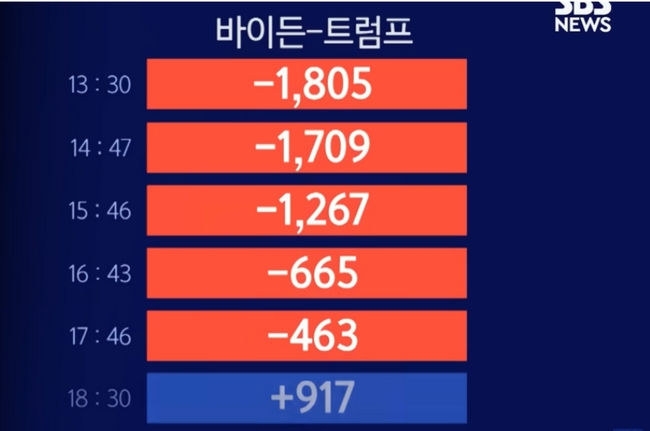 The vote difference between Biden and Trump by time of day during the 2020 election. Biden made a comeback in the final stretch, and allegations of election fraud have been consistently raised since then.
Korea Deals with the Outcome, the U.S. with the Process
The recurring debate in the U.S. surrounding mail-in voting is not solely due to political polarization.
Mail-in voting involves a more distributed pre-voting stage, extending the periods of ballot movement, storage, and management, thus complicating the chain of responsibility.
This is where the choices of Korea and the U.S. diverge.
The U.S. chose to leave records, knowing it would lead to noise.
Ballots, envelopes, scanned images, server logs, and transportation records are preserved for extended periods, and the system is designed to allow court access and verification if necessary.
This is why the U.S. is always subject to debate. However, this noise is not a result of the system collapsing, but a consequence of not sealing off questions.
Judicial decisions on elections have also existed in Korea.
The Supreme Court, through election litigation, has ruled on the validity of outcomes and the legality of individual violations, and these judgments have served to conclude disputes. This aspect should be respected.
However, there are structural differences. The Supreme Court primarily dealt with whether "fraud had a significant enough impact to change the election outcome." It is difficult to find cases where the verification of "whether the entire management process leading to that outcome can be re-explained" was undertaken.
In Korea, despite the extended storage and transportation periods between voting and counting due to early voting, relevant records are disposed of relatively quickly, making it difficult to reconstruct the chain of custody after the fact. This is by design.
As a result, Korea has a system where judgments on the outcome are possible, but post-hoc verification of the process is structurally difficult.
This difference is not a matter of the magnitude of suspicion or political will, but a difference in system design.
Korea dealt with the 'conclusion' of elections, while the U.S. opened up the 'process' of elections.
These words summarize the fundamental difference in the election systems of the two countries.
Quality Management is the Responsibility of the Election Commission
More important than whether defective products exist is whether the responsibility for those defects can be traced through records. Without a traceable path of responsibility, quality management is bound to be superficial.
Elections are no different.
This leads to the question of whether Korea's system implicitly assumes that a certain level of issues does not need to be explained.
The reason factories set a goal of 'zero defects' is not because they truly believe defects will never occur.
It is because they know that the system can only be maintained if the path of responsibility can be traced to the end when a problem arises.
Elections should conclude with an outcome, but without the process being explained through records, there is no trust. If the National Election Commission, which uses trillions of won in budget, neglects election quality management, transferring its responsibilities to the Ministry of the Interior and Safety, which manages the resident registration server, might be a wise choice.

 [Statement by the Seo-beo-kka Korea Military Academy Save-the-Nation Comrades Association] ㉛ Recount the Votes Publicly, as the Previous Recount Concealed Election Fraud
Tongyeong Mayoral Election Recount [Photo=Yonhap News]South Korea's liberal democracy is dying. The National Election Commission (NEC) and the judiciary, which have plummeted into criminal syndicates
[Statement by the Seo-beo-kka Korea Military Academy Save-the-Nation Comrades Association] ㉛ Recount the Votes Publicly, as the Previous Recount Concealed Election Fraud
Tongyeong Mayoral Election Recount [Photo=Yonhap News]South Korea's liberal democracy is dying. The National Election Commission (NEC) and the judiciary, which have plummeted into criminal syndicates
 What is the significance of the "Trump 2028" red hats that keep making a comeback?
It is noteworthy that President Donald Trump is "intentionally" fueling controversy over whether he can actually run in the 2028 presidential election, even though it is "highly likely he is seriously
What is the significance of the "Trump 2028" red hats that keep making a comeback?
It is noteworthy that President Donald Trump is "intentionally" fueling controversy over whether he can actually run in the 2028 presidential election, even though it is "highly likely he is seriously
 Jin Cummings: "North Korea says it will increase the number of spies, so what is the government doing?"
U.S. political columnist Gene Cummings has publicly questioned the South Korean government, asking, "North Korea is announcing plans to increase its number of spies, yet what is the South Korean
Jin Cummings: "North Korea says it will increase the number of spies, so what is the government doing?"
U.S. political columnist Gene Cummings has publicly questioned the South Korean government, asking, "North Korea is announcing plans to increase its number of spies, yet what is the South Korean
 Attorney Do Tae-woo: “Discrepancies in Voter Count and Improper Sealing Confirmed in Tongyeong Mayoral Recount… Official Request for Further Verification Filed with Gyeongnam Election Commission”
A bundle of out-of-district early voting ballots photographed by attorney Do Tae-woo at the Tongyeong mayoral election recount site. A clear, solid line visible on the side of the ballots raises suspi
Attorney Do Tae-woo: “Discrepancies in Voter Count and Improper Sealing Confirmed in Tongyeong Mayoral Recount… Official Request for Further Verification Filed with Gyeongnam Election Commission”
A bundle of out-of-district early voting ballots photographed by attorney Do Tae-woo at the Tongyeong mayoral election recount site. A clear, solid line visible on the side of the ballots raises suspi
 Stock Market Crash 'Black Tuesday'… KOSPI down 10.8%, KOSDAQ down 7.7%
The KOSPI fell by more than 5% in early trading on the 28th, triggering a sell-side sidecar.On the 28th, the KOSPI plunged by more than 10%.Due to the sharp decline, a sell-side sidecar—a temporary
Stock Market Crash 'Black Tuesday'… KOSPI down 10.8%, KOSDAQ down 7.7%
The KOSPI fell by more than 5% in early trading on the 28th, triggering a sell-side sidecar.On the 28th, the KOSPI plunged by more than 10%.Due to the sharp decline, a sell-side sidecar—a temporary
 [World Heritage Committee] 25 New World Heritage Sites Inscribed in Busan… South Korea Successfully Expands 'Getbol' Listing
The Chairperson of the World Heritage Committee speaks at the plenary session of the 48th session of the World Heritage Committee, held at BEXCO in Busan on the 20th. [Photo: Yonhap News]A total of 25
[World Heritage Committee] 25 New World Heritage Sites Inscribed in Busan… South Korea Successfully Expands 'Getbol' Listing
The Chairperson of the World Heritage Committee speaks at the plenary session of the 48th session of the World Heritage Committee, held at BEXCO in Busan on the 20th. [Photo: Yonhap News]A total of 25
 [Liberal Democratic Party Statement] Calling it a Grand Real Estate Debate… It Was Nothing More Than a Private Party Among Themselves
The 'National Grand Debate on Real Estate Policy' held on July 23rd and 27th. [Photo=Yonhap News]The 'National Grand Debate on Real Estate Policy,' hosted by the Lee Jae-myung administration under the
[Liberal Democratic Party Statement] Calling it a Grand Real Estate Debate… It Was Nothing More Than a Private Party Among Themselves
The 'National Grand Debate on Real Estate Policy' held on July 23rd and 27th. [Photo=Yonhap News]The 'National Grand Debate on Real Estate Policy,' hosted by the Lee Jae-myung administration under the
 [Photo] Evidence of Election Fraud Flooding U.S. Media… Trump Had 2.7 Million Votes Stolen
 [Video] U.S. Semiquincentennial Air Show... 'Art in the Sky' streaks across New York
 [Editorial Cartoon] A Draconian Law That Undermines Freedom of Expression

 List
List