U.S. President Donald Trump (left) and Chinese President Xi Jinping at the G20 Summit in Osaka, Japan, June 2019 [Photo=AP·Yonhap News]
U.S. President Donald Trump has warned that he may impose “much higher” tariffs on countries worldwide than current levels.
President Trump has publicly stated that “the United States has been too generous” and that he will not show leniency going forward. He also reaffirmed his "America First" policy, stating, "Many countries have deceived the United States for years. We will secure hundreds of billions of dollars in revenue through tariffs and strengthen national security."
'Unjust External Forces' and 'China-Centricity'
In South Korea, which is currently facing the risk of tariffs being raised from 15% to 25%, views on President Trump's actions are somewhat complex.
The opposition party has questioned the government's responsibility for the tariff increase, while the presidential office criticized the opposition, stating that "we must fight together against unjust external attacks."
In reality, the entity the government would want to object to is the "unjust attack" from the external force (the United States). However, Prime Minister Kim Min-seok made bold claims without basis after returning from the U.S., and since the government is not in a position to speak out to the U.S., they have taken their frustration out on the vulnerable opposition party. Regardless of the venting, the current government must take responsibility for the tariff issue.
Just as there are differing perspectives domestically, various voices are emerging within the U.S. regarding tariffs.
Currently, a lawsuit challenging the constitutionality of reciprocal tariffs is underway in the U.S. Supreme Court. President Trump has vehemently accused "the U.S. small and medium-sized businesses and the 12 Democratic-leaning states leading this lawsuit as being China-centric."
Interestingly, while Trump criticized the U.S. Democratic Party as "China-centric," Lee Jae-myung's statement about "unjust external forces (the United States)" could not be more China-centric.
As is well known, South Korea runs a deficit in trade with China and a surplus in trade with the United States. By branding the U.S., our largest customer, as an "unjust external force," how can the U.S. consider South Korea as its ally?
Trump and Xi Jinping Are Similar?
Over the past decades, U.S. policy towards China has shifted from "Engagement" to "Strategic Competition." Particularly since the mid-2010s, as China has emerged as the strongest power in Asia, the U.S. has viewed China as its "greatest threat."
Recently, the Center for American Progress (CAP) criticized, "Instead of trying to change China's trajectory, President Trump is increasingly imitating Beijing's strategy."
They further argued, "President Trump uses state power to achieve political goals," and claimed that "Trump's 'America First' policy, a mix of transactional nationalism, personal loyalty, and state control, is creating a 'China-like America.'"
They also lamented, "As a result of following China's pattern of using its influence to suppress multilateral regulations it dislikes, the U.S. is undermining the trust and credibility that was once the basis of its global leadership."
However, there is something CAP has overlooked.
While it is true that President Xi Jinping and President Trump exert influence on their own countries and others based on their formidable power, there is a significant gap between them.
Xi Jinping uses the method of seizing control of the party organization within the vast bureaucratic apparatus of the Communist Party and self-appropriating the system through strict discipline. In other words, organizational control is the core of Xi Jinping's power.
However, Trump emerged like a comet from outside the established political establishment and is pursuing his own politics powered by public support.
The basis of Trump's power is not a party organization. For Trump, the nation is a large corporation. He focuses on transactional outcomes of U.S. economic interests rather than ideological justification.
He pursues "America First" politics under the guise of "national glory" and, through this, is subject to institutional judgment in elections every four years. This is his weapon.
How can Trump, who is like this, be equated with Xi Jinping, who has voluntarily entered a period of permanent rule (by deleting the term limit for the state president through constitutional amendment in 2018) under the pretext of the ideological justification of "permanent rule of the Communist Party"?
By comparing Trump, who wants his own people to prosper, with Xi Jinping, a devotee of ideology, CAP has inadvertently exposed China's true nature even more.
Reporter Im Yo-hee

 [Statement by the Seo-beo-kka Korea Military Academy Save-the-Nation Comrades Association] ㉛ Recount the Votes Publicly, as the Previous Recount Concealed Election Fraud
Tongyeong Mayoral Election Recount [Photo=Yonhap News]South Korea's liberal democracy is dying. The National Election Commission (NEC) and the judiciary, which have plummeted into criminal syndicates
[Statement by the Seo-beo-kka Korea Military Academy Save-the-Nation Comrades Association] ㉛ Recount the Votes Publicly, as the Previous Recount Concealed Election Fraud
Tongyeong Mayoral Election Recount [Photo=Yonhap News]South Korea's liberal democracy is dying. The National Election Commission (NEC) and the judiciary, which have plummeted into criminal syndicates
 What is the significance of the "Trump 2028" red hats that keep making a comeback?
It is noteworthy that President Donald Trump is "intentionally" fueling controversy over whether he can actually run in the 2028 presidential election, even though it is "highly likely he is seriously
What is the significance of the "Trump 2028" red hats that keep making a comeback?
It is noteworthy that President Donald Trump is "intentionally" fueling controversy over whether he can actually run in the 2028 presidential election, even though it is "highly likely he is seriously
 Jin Cummings: "North Korea says it will increase the number of spies, so what is the government doing?"
U.S. political columnist Gene Cummings has publicly questioned the South Korean government, asking, "North Korea is announcing plans to increase its number of spies, yet what is the South Korean
Jin Cummings: "North Korea says it will increase the number of spies, so what is the government doing?"
U.S. political columnist Gene Cummings has publicly questioned the South Korean government, asking, "North Korea is announcing plans to increase its number of spies, yet what is the South Korean
 Attorney Do Tae-woo: “Discrepancies in Voter Count and Improper Sealing Confirmed in Tongyeong Mayoral Recount… Official Request for Further Verification Filed with Gyeongnam Election Commission”
A bundle of out-of-district early voting ballots photographed by attorney Do Tae-woo at the Tongyeong mayoral election recount site. A clear, solid line visible on the side of the ballots raises suspi
Attorney Do Tae-woo: “Discrepancies in Voter Count and Improper Sealing Confirmed in Tongyeong Mayoral Recount… Official Request for Further Verification Filed with Gyeongnam Election Commission”
A bundle of out-of-district early voting ballots photographed by attorney Do Tae-woo at the Tongyeong mayoral election recount site. A clear, solid line visible on the side of the ballots raises suspi
 Stock Market Crash 'Black Tuesday'… KOSPI down 10.8%, KOSDAQ down 7.7%
The KOSPI fell by more than 5% in early trading on the 28th, triggering a sell-side sidecar.On the 28th, the KOSPI plunged by more than 10%.Due to the sharp decline, a sell-side sidecar—a temporary
Stock Market Crash 'Black Tuesday'… KOSPI down 10.8%, KOSDAQ down 7.7%
The KOSPI fell by more than 5% in early trading on the 28th, triggering a sell-side sidecar.On the 28th, the KOSPI plunged by more than 10%.Due to the sharp decline, a sell-side sidecar—a temporary
 [World Heritage Committee] 25 New World Heritage Sites Inscribed in Busan… South Korea Successfully Expands 'Getbol' Listing
The Chairperson of the World Heritage Committee speaks at the plenary session of the 48th session of the World Heritage Committee, held at BEXCO in Busan on the 20th. [Photo: Yonhap News]A total of 25
[World Heritage Committee] 25 New World Heritage Sites Inscribed in Busan… South Korea Successfully Expands 'Getbol' Listing
The Chairperson of the World Heritage Committee speaks at the plenary session of the 48th session of the World Heritage Committee, held at BEXCO in Busan on the 20th. [Photo: Yonhap News]A total of 25
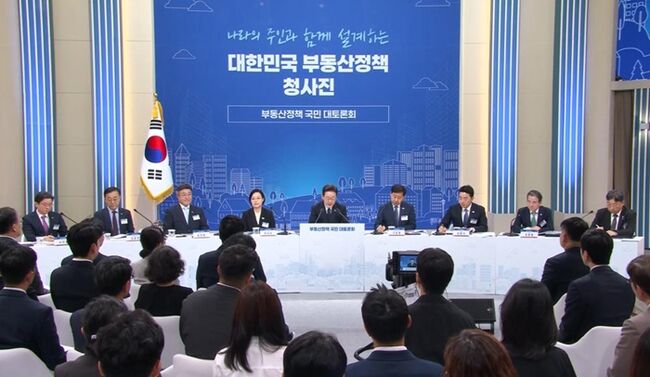 [Liberal Democratic Party Statement] Calling it a Grand Real Estate Debate… It Was Nothing More Than a Private Party Among Themselves
The 'National Grand Debate on Real Estate Policy' held on July 23rd and 27th. [Photo=Yonhap News]The 'National Grand Debate on Real Estate Policy,' hosted by the Lee Jae-myung administration under the
[Liberal Democratic Party Statement] Calling it a Grand Real Estate Debate… It Was Nothing More Than a Private Party Among Themselves
The 'National Grand Debate on Real Estate Policy' held on July 23rd and 27th. [Photo=Yonhap News]The 'National Grand Debate on Real Estate Policy,' hosted by the Lee Jae-myung administration under the
 [Photo] Evidence of Election Fraud Flooding U.S. Media… Trump Had 2.7 Million Votes Stolen
 [Video] U.S. Semiquincentennial Air Show... 'Art in the Sky' streaks across New York
 [Editorial Cartoon] A Draconian Law That Undermines Freedom of Expression

 List
List