The UK daily Telegraph reported on the 29th (local time) that the US Air Force WC-135R 'Constant Phoenix,' dubbed the 'nuclear detector,' had landed at RAF Mildenhall, a US Air Force base in Suffolk, UK. [Photo = Yonhap News]
As of the end of January 2026, the likelihood of the United States directly striking Iran militarily is assessed to be less than 10%.
This is not due to a lack of US military capability. The issue lies not in initiating a war, but in the ability to control the aftermath.
Considering the political burden ahead of the midterm elections, the potential for proxy wars to spread across the Middle East, and the ripple effects on energy and financial markets, Washington's options lean towards management and deterrence rather than military action.
The statements made by US Secretary of State Marco Rubio during a Senate Foreign Relations Committee hearing on the 28th (local time) also support this argument.
When asked about the military buildup in the Middle East, he stated, "I think it is a wise and prudent measure to deploy forces that can respond to this region, and if necessary, to preemptively block attacks on thousands of US troops and other facilities." This is interpreted as emphasizing a defensive posture rather than an offensive one.
President Donald Trump clearly addressed the nuclear negotiation issue on Truth Social on the same day, stating, "As I have told Iran before, negotiate! They did not negotiate, and a massive Iranian destruction operation called 'Midnight Hammer' took place. The next attack will be much more serious! Make sure that never happens again."
'Controlling Escalation' is More Difficult Than Starting a War
However, the reality is not straightforward.
The biggest constraint facing the United States is Iran's proxy network.
Iran is a country that excels in indirect power, extending through Lebanese Hezbollah, pro-Iranian militias in Syria and Iraq, and Houthi rebels in Yemen, rather than focusing on homeland defense.
The moment the United States strikes Iran's mainland, the conflict is highly likely to spread across the entire Middle East, not confined to a single theater.
While the start of a war can be controlled, the speed and direction of escalation, and the timing of its end, can exceed US calculations.
Why Israel is Also Cautious
This structure is also evident in Israel's stance.
Within Israeli security circles, there is a shared sentiment of "if you're going to strike, do it decisively; otherwise, just manage it."
Limited or symbolic strikes may not neutralize Iran's nuclear capabilities or regime while only provoking retaliation, a significant portion of which Israel would have to bear.
Israel's caution regarding a US strike on Iran is less about opposition and more about a realistic calculation that the cost of escalation could fall disproportionately on them.
The 'No-War Zone' Created by the Midterm Elections
The domestic political environment in the United States also acts as a constraint on military decisions.
For a president facing midterm elections, a Middle East war is unlikely to help gain votes.
An Iran conflict, in particular, would be difficult to end quickly and could inflict immediate shocks on prices and financial markets through disruptions to sea routes and rising oil prices.
Preventive strikes or displays of deterrence lack political persuasiveness, and the justifications for military action permissible during an election period are extremely limited.
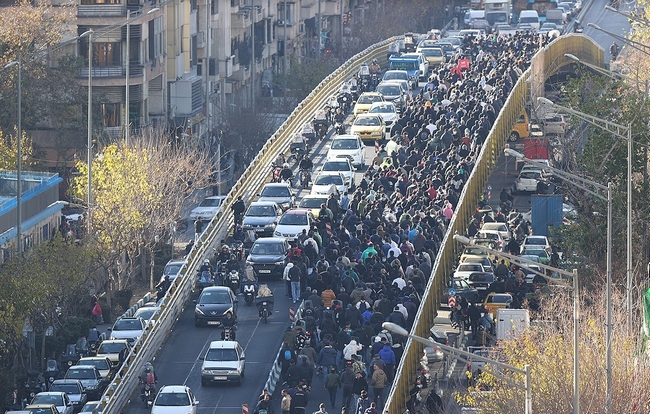 On January 8 (local time), protesters gathered across the country, including in the capital Tehran, and with the participation of university students and labor unions, the protests reached their largest scale since breaking out on the 28th of last month.
Why 'Less Than 10%' — Conditions Determining the Probability
The assessment of the probability of a direct US strike on Iran being less than 10% is not simply an intuitive judgment but a structural evaluation based on whether the determining conditions are met.
Based on past instances of the United States choosing military action, at least three conditions must be met simultaneously for a direct strike to occur.
First, the occurrence of direct damage to US military personnel or the US mainland.
Second, political consensus that all diplomatic, sanction, and deterrence means have been exhausted.
Third, the possibility of managing escalation to a level that allies can handle.
Currently, none of these three conditions have been met. There have been no US casualties, alternative measures such as diplomacy, sanctions, and internal political pressure are still in effect, and allies, including Israel, are showing a cautious stance towards limited strikes.
Unless these conditions are met simultaneously, a direct US strike on Iran may be under consideration but is unlikely to move to the decision-making stage. The realistic probability derived from this structure is assessed to be less than 10%.
Why 'Internal Pressure' Was Chosen Over Airstrikes
Under these conditions, recent US actions appear to be a strategy that combines military pressure with Iran's internal affairs.
The increasing frequency with which the US publicly mentions Iran's human rights issues, deteriorating living conditions, and internal political situation should be interpreted not as a precursor to war, but as a means of pressure to substitute for war.
This approach aims to amplify existing internal discontent and divisions within Iran into international issues, allowing the regime to consume its own energy.
The US message, "We are not fighting the Iranian people," contains a political calculation to separate the regime from its people.
The intention is to attribute any internal turmoil that arises not to the result of external invasion but to Iran's internal problems.
The Only Exception: US Casualties
Of course, there is a variable that could instantly reverse this low probability.
The occurrence of US casualties.
If US service members are killed in an attack by Iran or Iran-backed forces, the United States would have to admit a failure of deterrence, and due to domestic public opinion and alliance trust issues, the options for retaliation would rapidly expand.
In this scenario, the probability of a direct US strike on Iran could shift to an entirely different phase in a short period.
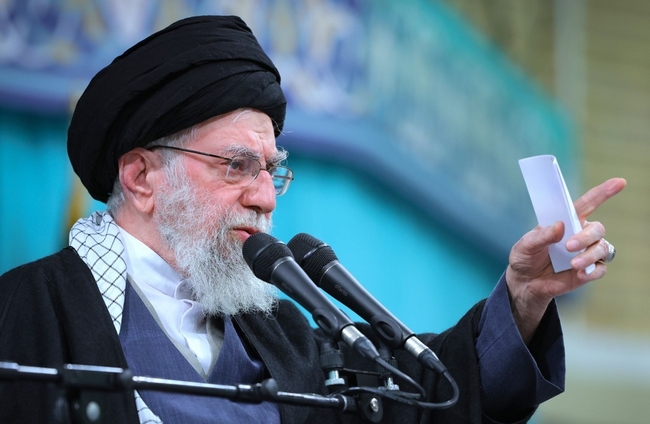 Ayatollah Khamenei, Iran's Supreme Leader, speaking at an event in Tehran on the 17th. Amid Iran's turmoil due to anti-government protests, reformist figures have unofficially demanded the resignation of Ayatollah Seyed Ali Khamenei, the pinnacle of the clerical regime, as reported by the European specialized media Euractiv on the 29th (local time). [Photo = Yonhap News]
What the US Wants is 'The State After Replacement'
At this point, the practical benefit the US anticipates from regime change in Iran becomes clear.
The US goal is not to overthrow Iran, but to 'manage' its nuclear program without war, 'control' proxy conflicts, and create a state where the Middle East is no longer the primary theater.
Therefore, Washington's objective is not airstrikes but replacement, and not victory but securing 'conditions under which war is unnecessary.'
Medium Crude Oil, Another Strategic Calculation
This benefit is not limited to security.
Iran's position in the energy market is also a key variable that the US is closely watching.
While Iranian crude oil does not constitute an absolute majority of global supply, it is an important source of medium crude, which is highly versatile in its refining structure.
Medium crude is optimized for the production of gasoline, diesel, and jet fuel, and many refinery facilities worldwide are designed based on this oil grade.
Consequently, when the supply of medium crude becomes unstable, the market impact is amplified not just by a simple reduction in volume, but by increased refining costs and greater price volatility.
Currently, Iranian crude oil is in an unstable gray zone, neither fully blocked nor fully restored to normal supply.
If the Iranian leadership is replaced, the US can manage the risk of soaring oil prices by restoring this crude oil as a normal supplier of medium crude without war.
From 'Target for Demolition' to 'Adjustable Variable'
Ultimately, the effect of regime change in Iran on the US converges into one outcome.
It is to bring three risk variables—nuclear, security, and energy—into a 'manageable domain' simultaneously, without the use of military force.
Iran is no longer a target for demolition, but is redefined as an adjustable variable.
Therefore, Washington's strategy is replacement, not airstrikes,
and the goal is 'a state of not having to go to war,' not victory.

 [Statement by the Seo-beo-kka Korea Military Academy Save-the-Nation Comrades Association] ㉛ Recount the Votes Publicly, as the Previous Recount Concealed Election Fraud
Tongyeong Mayoral Election Recount [Photo=Yonhap News]South Korea's liberal democracy is dying. The National Election Commission (NEC) and the judiciary, which have plummeted into criminal syndicates
[Statement by the Seo-beo-kka Korea Military Academy Save-the-Nation Comrades Association] ㉛ Recount the Votes Publicly, as the Previous Recount Concealed Election Fraud
Tongyeong Mayoral Election Recount [Photo=Yonhap News]South Korea's liberal democracy is dying. The National Election Commission (NEC) and the judiciary, which have plummeted into criminal syndicates
 What is the significance of the "Trump 2028" red hats that keep making a comeback?
It is noteworthy that President Donald Trump is "intentionally" fueling controversy over whether he can actually run in the 2028 presidential election, even though it is "highly likely he is seriously
What is the significance of the "Trump 2028" red hats that keep making a comeback?
It is noteworthy that President Donald Trump is "intentionally" fueling controversy over whether he can actually run in the 2028 presidential election, even though it is "highly likely he is seriously
 Jin Cummings: "North Korea says it will increase the number of spies, so what is the government doing?"
U.S. political columnist Gene Cummings has publicly questioned the South Korean government, asking, "North Korea is announcing plans to increase its number of spies, yet what is the South Korean
Jin Cummings: "North Korea says it will increase the number of spies, so what is the government doing?"
U.S. political columnist Gene Cummings has publicly questioned the South Korean government, asking, "North Korea is announcing plans to increase its number of spies, yet what is the South Korean
 Attorney Do Tae-woo: “Discrepancies in Voter Count and Improper Sealing Confirmed in Tongyeong Mayoral Recount… Official Request for Further Verification Filed with Gyeongnam Election Commission”
A bundle of out-of-district early voting ballots photographed by attorney Do Tae-woo at the Tongyeong mayoral election recount site. A clear, solid line visible on the side of the ballots raises suspi
Attorney Do Tae-woo: “Discrepancies in Voter Count and Improper Sealing Confirmed in Tongyeong Mayoral Recount… Official Request for Further Verification Filed with Gyeongnam Election Commission”
A bundle of out-of-district early voting ballots photographed by attorney Do Tae-woo at the Tongyeong mayoral election recount site. A clear, solid line visible on the side of the ballots raises suspi
 Stock Market Crash 'Black Tuesday'… KOSPI down 10.8%, KOSDAQ down 7.7%
The KOSPI fell by more than 5% in early trading on the 28th, triggering a sell-side sidecar.On the 28th, the KOSPI plunged by more than 10%.Due to the sharp decline, a sell-side sidecar—a temporary
Stock Market Crash 'Black Tuesday'… KOSPI down 10.8%, KOSDAQ down 7.7%
The KOSPI fell by more than 5% in early trading on the 28th, triggering a sell-side sidecar.On the 28th, the KOSPI plunged by more than 10%.Due to the sharp decline, a sell-side sidecar—a temporary
 [World Heritage Committee] 25 New World Heritage Sites Inscribed in Busan… South Korea Successfully Expands 'Getbol' Listing
The Chairperson of the World Heritage Committee speaks at the plenary session of the 48th session of the World Heritage Committee, held at BEXCO in Busan on the 20th. [Photo: Yonhap News]A total of 25
[World Heritage Committee] 25 New World Heritage Sites Inscribed in Busan… South Korea Successfully Expands 'Getbol' Listing
The Chairperson of the World Heritage Committee speaks at the plenary session of the 48th session of the World Heritage Committee, held at BEXCO in Busan on the 20th. [Photo: Yonhap News]A total of 25
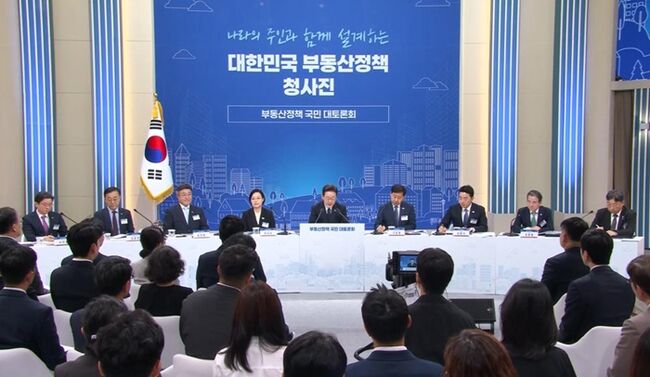 [Liberal Democratic Party Statement] Calling it a Grand Real Estate Debate… It Was Nothing More Than a Private Party Among Themselves
The 'National Grand Debate on Real Estate Policy' held on July 23rd and 27th. [Photo=Yonhap News]The 'National Grand Debate on Real Estate Policy,' hosted by the Lee Jae-myung administration under the
[Liberal Democratic Party Statement] Calling it a Grand Real Estate Debate… It Was Nothing More Than a Private Party Among Themselves
The 'National Grand Debate on Real Estate Policy' held on July 23rd and 27th. [Photo=Yonhap News]The 'National Grand Debate on Real Estate Policy,' hosted by the Lee Jae-myung administration under the
 [Photo] Evidence of Election Fraud Flooding U.S. Media… Trump Had 2.7 Million Votes Stolen
 [Video] U.S. Semiquincentennial Air Show... 'Art in the Sky' streaks across New York
 [Editorial Cartoon] A Draconian Law That Undermines Freedom of Expression

 List
List