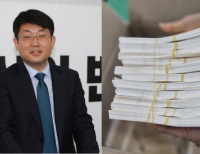
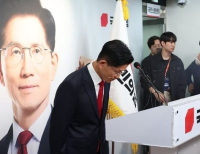
Pyeonggang-gun, a North Korean POW from the Russia-Ukraine war, reads a letter sent from Korea. [Photo=Gyeore-eol Tongil Yeon-dae]
A short video of North Korean prisoners of war detained in Ukraine is rapidly spreading on social media.
In the video, the prisoners (born in 1999 and 2005) expressed concerns that if they are repatriated to North Korea, not only they but also their third generation would face extermination.
In response, netizens are strongly calling for the young prisoners not to be sent back to North Korea.
While international human rights law generally mandates the repatriation of prisoners of war to their home countries after the end of hostilities, the principle of non-refoulement prohibits their forced return if there is a reasonable fear of severe persecution upon repatriation.
However, the stance of 'Gyeore-eol Tongil Yeon-dae' (a group that interviewed North Korean POWs in Ukraine) is not optimistic. The organization doubts whether international humanitarian law will be effectively applied.
In a statement sent to this publication on the 31st of last month, the organization expressed concern, stating, "International organizations are merely repeating the general principle that 'prisoners of war can be exchanged.' In the face of the specific reality of North Korean prisoners of war, this principle is fatal."
The statement further explained that North Korea is a regime that punishes and eliminates repatriated prisoners, meaning repatriation equates to persecution, and in some cases, death. This fact, they claim, has already been sufficiently proven to the international community.
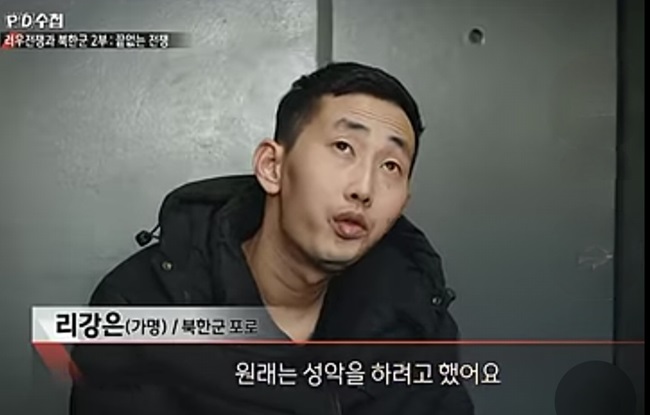 North Korean POW Ri Gang-eun sings a song missing his mother. [Photo=MBC PD Notebook capture]
Regarding the delay in the North Korean prisoners' journey to South Korea, a political commentator suggested, "It seems President Zelensky is hesitating, calculating what he can demand from South Korea by using them as leverage." He added, "The current Lee Jae-myung administration, which is very cautious about North Korea, cannot entirely welcome the prisoners' arrival in South Korea either."
He continued, "However, the previous Yoon Suk-yeol administration had already expressed its willingness to welcome North Korean POWs to South Korea, which is why they are now gauging the situation with various excuses." He emphasized, "Beyond South Korea, the international community must take an interest and voice their opinions on this matter."
Below is the full statement from 'Gyeore-eol Tongil Yeon-dae':
International Attention is Hope! ... North Korean POWs Must Reach South Korea
International humanitarian law exists to protect human dignity even in the extreme circumstances of war. However, the current attitude of international organizations surrounding the North Korean prisoners of war detained in Ukraine raises fundamental questions about whether these noble principles are actually being applied.
The law exists, but protection is not visible.
International organizations repeatedly cite the Third Geneva Convention, stating that "prisoners of war can be exchanged" as a general principle. This statement is correct in abstract terms. However, in the specific reality of North Korean prisoners of war, this principle is fatal to them.
This is because North Korea is a regime that punishes and eliminates repatriated prisoners. Repatriation is persecution, and in some cases, death. This fact has already been sufficiently proven to the international community.
Nevertheless, if international organizations choose silence in the name of 'neutrality,' it is not neutrality but an evasion of responsibility. While repeating legal provisions may seem safe, the price of such silence is always paid by the most vulnerable individuals.
Exchange May Be an Option, but Forced Repatriation is a Crime
The exchange of prisoners of war itself is not the issue. The problem is that the concept of 'exchange' is being used as a shield to obscure the risk of forced repatriation.
International law clearly prohibits repatriation to countries where torture, execution, or enforced disappearance can be reasonably predicted after repatriation. This is not a matter of policy choice but a prohibitive norm.
Despite this, international organizations do not foreground this core principle. Instead, they retreat behind the ambiguous phrase "judgment of the detaining country."
As a result, the international community, which should be the subject of protection, disappears, and all ethical and legal burdens are shifted to the warring nation alone. Is this truly the human rights protection that international organizations speak of?
'Protection from Public Scrutiny' – A Clause for Whom?
Another phrase that international organizations repeatedly use is the provision that "prisoners of war must be protected from public scrutiny." However, the purpose of this provision is to ensure the safety of the prisoners, not to compel silence.
In the case of North Korean prisoners of war, this non-disclosure is not protection but a danger. It merely increases the possibility that they will be quietly sent back to North Korea, unknown to anyone.
Conversely, the scrutiny and attention of the international community are the most realistic protective measures to deter forced repatriation. Despite this, international organizations interpret this provision literally, not according to its purpose, and ignore reality. The paradox of abandoning humans to uphold the law arises here.
Protection that prevents the expression of free will is not protection.
The most serious problem is that the expression of the prisoners' free will is being treated as a risk factor.
The starting point of the non-refoulement principle is always the individual's free and genuine will. Discussing protection without asking for their will, or preventing them from speaking, is logically and ethically untenable.
The reason why the defector community is outraged lies here. They have experienced firsthand what kind of results a system that compels silence produces. Yet, the moment international organizations say, "You are protected by being quiet," that logic dangerously resembles the logic of the North Korean regime.
International Organizations' Silence Leads to a Void in Protection
Ukraine, as the detaining country, has disclosed the existence and free will of the North Korean prisoners of war. This was not a choice to abandon its duty of protection but a signal requesting immediate intervention from the international community. They judged that this issue could not be managed through confidential consultations and quiet diplomacy alone.
However, the reality is the opposite. Formal protection interviews by the International Committee of the Red Cross and UN human rights bodies have not yet taken place, and no registration procedures for protection under the non-refoulement principle have been initiated. There was disclosure, but protection did not follow.
While international organizations recognize the North Korean prisoners of war as a 'case of unprecedented risk,' they are avoiding the exceptional protective decisions that correspond to that risk.
The focus of protection is increasingly shifting away from the prisoners' lives and freedom towards controversy management and public opinion control. As a result, protection is delayed, and a bizarre situation where raising the issue itself becomes problematic is repeated.
The Anger and Despair Felt by the Defector Community
For the defector community, international organizations are the last resort for protection. However, when these international organizations remain silent, all that is left is despair.
They do not remember cases where confidential interventions improved China's forced repatriation of defectors or human rights violations within North Korea. Instead, memories of experiencing greater tragedies because things were not disclosed remain as trauma.
Therefore, the defector community turns to Ukraine once again. The cry, "What parent would stand by if their child were imprisoned?" is not an emotional rhetoric but the language of last resort responsibility, emerging from the vacuum left by the state and international organizations.
Silence Cannot Be Neutral
The issue of North Korean prisoners of war is no longer a 'matter under review.' It is a test for the international community to decide whether to know and neglect, or to intervene.
What the defector community demands is not special treatment. It is simply a demand to actually implement the principles that international organizations themselves have promised: respect for free will and the prohibition of forced repatriation.
Silence is not neutrality. This silence is now contributing to sending someone to death behind bars once again.
The time for international organizations to answer has long passed.
Gyeore-eol Tongil Yeon-dae Secretariat

 [Statement by the Seo-beo-kka Korea Military Academy Save-the-Nation Comrades Association] ㉛ Recount the Votes Publicly, as the Previous Recount Concealed Election Fraud
Tongyeong Mayoral Election Recount [Photo=Yonhap News]South Korea's liberal democracy is dying. The National Election Commission (NEC) and the judiciary, which have plummeted into criminal syndicates
[Statement by the Seo-beo-kka Korea Military Academy Save-the-Nation Comrades Association] ㉛ Recount the Votes Publicly, as the Previous Recount Concealed Election Fraud
Tongyeong Mayoral Election Recount [Photo=Yonhap News]South Korea's liberal democracy is dying. The National Election Commission (NEC) and the judiciary, which have plummeted into criminal syndicates
 What is the significance of the "Trump 2028" red hats that keep making a comeback?
It is noteworthy that President Donald Trump is "intentionally" fueling controversy over whether he can actually run in the 2028 presidential election, even though it is "highly likely he is seriously
What is the significance of the "Trump 2028" red hats that keep making a comeback?
It is noteworthy that President Donald Trump is "intentionally" fueling controversy over whether he can actually run in the 2028 presidential election, even though it is "highly likely he is seriously
 Jin Cummings: "North Korea says it will increase the number of spies, so what is the government doing?"
U.S. political columnist Gene Cummings has publicly questioned the South Korean government, asking, "North Korea is announcing plans to increase its number of spies, yet what is the South Korean
Jin Cummings: "North Korea says it will increase the number of spies, so what is the government doing?"
U.S. political columnist Gene Cummings has publicly questioned the South Korean government, asking, "North Korea is announcing plans to increase its number of spies, yet what is the South Korean
 Attorney Do Tae-woo: “Discrepancies in Voter Count and Improper Sealing Confirmed in Tongyeong Mayoral Recount… Official Request for Further Verification Filed with Gyeongnam Election Commission”
A bundle of out-of-district early voting ballots photographed by attorney Do Tae-woo at the Tongyeong mayoral election recount site. A clear, solid line visible on the side of the ballots raises suspi
Attorney Do Tae-woo: “Discrepancies in Voter Count and Improper Sealing Confirmed in Tongyeong Mayoral Recount… Official Request for Further Verification Filed with Gyeongnam Election Commission”
A bundle of out-of-district early voting ballots photographed by attorney Do Tae-woo at the Tongyeong mayoral election recount site. A clear, solid line visible on the side of the ballots raises suspi
 Stock Market Crash 'Black Tuesday'… KOSPI down 10.8%, KOSDAQ down 7.7%
The KOSPI fell by more than 5% in early trading on the 28th, triggering a sell-side sidecar.On the 28th, the KOSPI plunged by more than 10%.Due to the sharp decline, a sell-side sidecar—a temporary
Stock Market Crash 'Black Tuesday'… KOSPI down 10.8%, KOSDAQ down 7.7%
The KOSPI fell by more than 5% in early trading on the 28th, triggering a sell-side sidecar.On the 28th, the KOSPI plunged by more than 10%.Due to the sharp decline, a sell-side sidecar—a temporary
 [World Heritage Committee] 25 New World Heritage Sites Inscribed in Busan… South Korea Successfully Expands 'Getbol' Listing
The Chairperson of the World Heritage Committee speaks at the plenary session of the 48th session of the World Heritage Committee, held at BEXCO in Busan on the 20th. [Photo: Yonhap News]A total of 25
[World Heritage Committee] 25 New World Heritage Sites Inscribed in Busan… South Korea Successfully Expands 'Getbol' Listing
The Chairperson of the World Heritage Committee speaks at the plenary session of the 48th session of the World Heritage Committee, held at BEXCO in Busan on the 20th. [Photo: Yonhap News]A total of 25
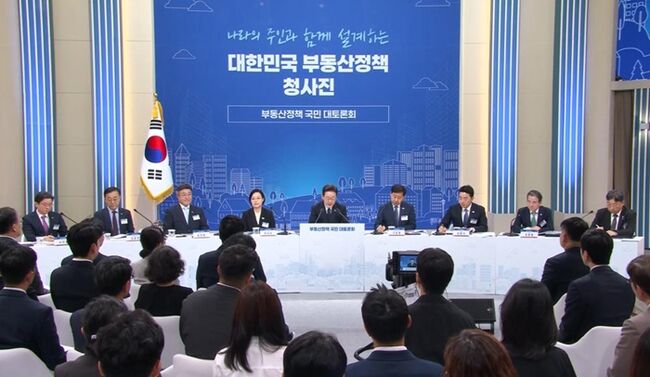 [Liberal Democratic Party Statement] Calling it a Grand Real Estate Debate… It Was Nothing More Than a Private Party Among Themselves
The 'National Grand Debate on Real Estate Policy' held on July 23rd and 27th. [Photo=Yonhap News]The 'National Grand Debate on Real Estate Policy,' hosted by the Lee Jae-myung administration under the
[Liberal Democratic Party Statement] Calling it a Grand Real Estate Debate… It Was Nothing More Than a Private Party Among Themselves
The 'National Grand Debate on Real Estate Policy' held on July 23rd and 27th. [Photo=Yonhap News]The 'National Grand Debate on Real Estate Policy,' hosted by the Lee Jae-myung administration under the
 [Photo] Evidence of Election Fraud Flooding U.S. Media… Trump Had 2.7 Million Votes Stolen
 [Video] U.S. Semiquincentennial Air Show... 'Art in the Sky' streaks across New York
 [Editorial Cartoon] A Draconian Law That Undermines Freedom of Expression

 List
List