Martial law troops deployed to the National Assembly building in Yeouido, Seoul, in the early morning of December 4, 2024, after President Yoon Suk-yeol declared martial law. [Yonhap News]
As of now, the Ministry of National Defense Disciplinary Committee has dismissed six generals and four colonels, including Colonel Kim Hyun-tae, the commander of the 707th Special Mission Group, in connection with the December 3 martial law incident. The reason for their disciplinary action is 'offense of engaging in important duties for rebellion.' Those with military experience or legal backgrounds raise their eyebrows upon hearing this charge. These individuals were not dreaming of overthrowing the state, nor did they mobilize troops for personal gain. They were simply soldiers who followed superior orders.
The fundamental principle of the military command system is "chain of command," where superiors' orders are followed by subordinates, and responsibility increases with rank. However, the current disciplinary structure directly contradicts this principle. While Kwak Jong-geun, the highest-ranking officer of the Special Warfare Command, received a less severe punishment of "dismissal" than "termination," Colonel Kim Hyun-tae, who followed his orders, was "terminated." The reality that the Special Warfare Commander, who violated security regulations and continued political remarks, receives a lesser punishment fuels suspicion of political intervention rather than adherence to principles.
A decision that shifts responsibility solely to subordinates is bound to damage military discipline and fairness, and it is difficult to avoid criticism that the impartial blade has been tilted. It is akin to a coachman losing his way and the carriage falling into a swamp, but instead of blaming the driver who held the reins and led to a dead end, the scapegoat is blamed, and the carriage is dismantled and disposed of.
Obedience to command is vital in the military; if commanders begin to question the "constitutional validity of an order" in a combat situation, combat cannot be established. The legality of an order is a matter for laws and systems to address retrospectively, and demanding immediate judgment on the spot is unrealistic. Nevertheless, the current measure has focused responsibility on those who carried out the orders, not those who issued them, leading to their termination. This shakes the military's command system and endangers the very purpose of the military's existence.
If the command system is shaken, the military cannot perform its duties properly. The commander-in-chief, who is supposed to lead that military, must also exercise their command based on a weakened system. If they were unaware of such consequences, it is ignorance; if they were aware, it can be criticized as an act of treason that harms national security. Decisions that weaken the military ultimately benefit the enemy.
A more significant problem left by this disciplinary action is the damage to the military's political neutrality. Soldiers are beings who move according to the state's orders, not beings who act based on their own political interpretations. However, this action leaves the message that "following superior orders can lead to termination." This brings distrust and inhibition to the entire military organization, leading to the negative consequence of commanders hesitating to make decisions. As trials are ongoing, the military's disciplinary action will set a precedent for double punishment, affecting the final verdict.
The court will ultimately make the legal judgment. If administrative litigation proceeds, the appropriateness and procedures of the disciplinary action, as well as the scope of responsibility, will be re-examined. While the possibility of reinstatement is high, the judicial process is harsh for those who have already received severe disciplinary action of termination. This is because it will leave deep scars not only on their military careers and honor but also on their personal lives and spirits. Separate from the legal judgment, the damage this incident has left on the entire military organization is also not insignificant.
While there are symbolic accusations that the martial law troops aimed their guns at the citizens, some actions aimed at disarming the martial law troops are not being scrutinized. In international law and military law, "manifest illegality" on the battlefield is clearly defined as civilian massacres, torture, execution of prisoners of war, looting and arson, and attacks prohibited by international law. The actions of the December 3 martial law troops do not fall under any of these criteria. Holding subordinates responsible when the illegality of an order was not manifest is also a subject of legal debate.
Even in the post-World War II war crimes trials, soldiers who followed their superior's orders were granted mitigating circumstances, even if they committed manifest illegal acts. Is the current Ministry of National Defense Disciplinary Committee disregarding even that basic principle?
All responsibility lies with the one who issued the order. The method of making soldiers who followed orders into scapegoats undermines the military's trust, weakens the command system, and makes conditioned reflex combat difficult, thus jeopardizing national security. What is needed now is not to find political scapegoats among soldiers, but to restore the military's chain of command and to establish a readiness posture that matches the ever-changing geopolitical landscape of the Korean Peninsula. There is no room for error when it comes to life-and-death security matters.

◆ Park Pil-kyu
Editor, Hankook Ilbo
40th graduating class, Korea Military Academy

 [Statement by the Seo-beo-kka Korea Military Academy Save-the-Nation Comrades Association] ㉛ Recount the Votes Publicly, as the Previous Recount Concealed Election Fraud
Tongyeong Mayoral Election Recount [Photo=Yonhap News]South Korea's liberal democracy is dying. The National Election Commission (NEC) and the judiciary, which have plummeted into criminal syndicates
[Statement by the Seo-beo-kka Korea Military Academy Save-the-Nation Comrades Association] ㉛ Recount the Votes Publicly, as the Previous Recount Concealed Election Fraud
Tongyeong Mayoral Election Recount [Photo=Yonhap News]South Korea's liberal democracy is dying. The National Election Commission (NEC) and the judiciary, which have plummeted into criminal syndicates
 What is the significance of the "Trump 2028" red hats that keep making a comeback?
It is noteworthy that President Donald Trump is "intentionally" fueling controversy over whether he can actually run in the 2028 presidential election, even though it is "highly likely he is seriously
What is the significance of the "Trump 2028" red hats that keep making a comeback?
It is noteworthy that President Donald Trump is "intentionally" fueling controversy over whether he can actually run in the 2028 presidential election, even though it is "highly likely he is seriously
 Jin Cummings: "North Korea says it will increase the number of spies, so what is the government doing?"
U.S. political columnist Gene Cummings has publicly questioned the South Korean government, asking, "North Korea is announcing plans to increase its number of spies, yet what is the South Korean
Jin Cummings: "North Korea says it will increase the number of spies, so what is the government doing?"
U.S. political columnist Gene Cummings has publicly questioned the South Korean government, asking, "North Korea is announcing plans to increase its number of spies, yet what is the South Korean
 Attorney Do Tae-woo: “Discrepancies in Voter Count and Improper Sealing Confirmed in Tongyeong Mayoral Recount… Official Request for Further Verification Filed with Gyeongnam Election Commission”
A bundle of out-of-district early voting ballots photographed by attorney Do Tae-woo at the Tongyeong mayoral election recount site. A clear, solid line visible on the side of the ballots raises suspi
Attorney Do Tae-woo: “Discrepancies in Voter Count and Improper Sealing Confirmed in Tongyeong Mayoral Recount… Official Request for Further Verification Filed with Gyeongnam Election Commission”
A bundle of out-of-district early voting ballots photographed by attorney Do Tae-woo at the Tongyeong mayoral election recount site. A clear, solid line visible on the side of the ballots raises suspi
 Stock Market Crash 'Black Tuesday'… KOSPI down 10.8%, KOSDAQ down 7.7%
The KOSPI fell by more than 5% in early trading on the 28th, triggering a sell-side sidecar.On the 28th, the KOSPI plunged by more than 10%.Due to the sharp decline, a sell-side sidecar—a temporary
Stock Market Crash 'Black Tuesday'… KOSPI down 10.8%, KOSDAQ down 7.7%
The KOSPI fell by more than 5% in early trading on the 28th, triggering a sell-side sidecar.On the 28th, the KOSPI plunged by more than 10%.Due to the sharp decline, a sell-side sidecar—a temporary
 [World Heritage Committee] 25 New World Heritage Sites Inscribed in Busan… South Korea Successfully Expands 'Getbol' Listing
The Chairperson of the World Heritage Committee speaks at the plenary session of the 48th session of the World Heritage Committee, held at BEXCO in Busan on the 20th. [Photo: Yonhap News]A total of 25
[World Heritage Committee] 25 New World Heritage Sites Inscribed in Busan… South Korea Successfully Expands 'Getbol' Listing
The Chairperson of the World Heritage Committee speaks at the plenary session of the 48th session of the World Heritage Committee, held at BEXCO in Busan on the 20th. [Photo: Yonhap News]A total of 25
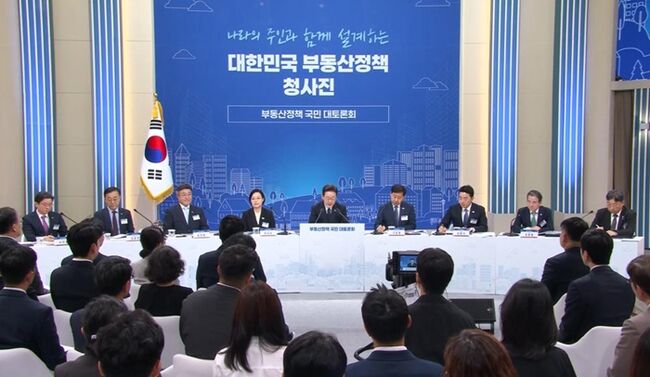 [Liberal Democratic Party Statement] Calling it a Grand Real Estate Debate… It Was Nothing More Than a Private Party Among Themselves
The 'National Grand Debate on Real Estate Policy' held on July 23rd and 27th. [Photo=Yonhap News]The 'National Grand Debate on Real Estate Policy,' hosted by the Lee Jae-myung administration under the
[Liberal Democratic Party Statement] Calling it a Grand Real Estate Debate… It Was Nothing More Than a Private Party Among Themselves
The 'National Grand Debate on Real Estate Policy' held on July 23rd and 27th. [Photo=Yonhap News]The 'National Grand Debate on Real Estate Policy,' hosted by the Lee Jae-myung administration under the
 [Photo] Evidence of Election Fraud Flooding U.S. Media… Trump Had 2.7 Million Votes Stolen
 [Video] U.S. Semiquincentennial Air Show... 'Art in the Sky' streaks across New York
 [Editorial Cartoon] A Draconian Law That Undermines Freedom of Expression

 List
List