Press Release from the U.S. House Judiciary Committee Regarding Coupang
The U.S. House of Representatives will launch an investigation on the 23rd (local time), citing concerns over remarks made by the Korean President.
The focus of this investigation is not on the legality of a specific company or a trade dispute. It concerns whether a public statement by a person in power unduly influenced government enforcement and corporate decision-making, in other words, whether there was undue government interference.
The U.S. House Judiciary Committee is proceeding with procedures to request documents and testimony from Coupang, and plans to investigate whether President Lee Jae-myung's so-called 'Coupang remarks' violated 'the First Amendment of the U.S. Constitution'.
The reason this investigation is noteworthy is that the U.S. House of Representatives has categorized this issue as a constitutional matter, rather than an administrative or trade issue.
The First Amendment of the U.S. Constitution not only guarantees freedom of the press and expression, but also considers situations where the judgment of individuals or corporations is suppressed due to the pressure or signals from those in power, even without direct censorship or punishment by the government, as a violation of the Constitution. This is known as the 'chilling effect'.
According to documents released by the Judiciary Committee on the 5th (local time), there are points that suggest President Lee Jae-myung suspected the background of unjust sanctions.
"For example, after the incident of a former employee leaking customer information, President Lee Jae-myung demanded strong sanctions and heavy fines, and the Korea Fair Trade Commission (KFTC) mentioned the possibility of suspending business operations."
"The Korean government deployed 11 agencies and 400 investigators, demanding extensive investigations and document submissions. Despite this being a case where non-sensitive information of approximately 3,000 customers was stored for a limited period and subsequently retrieved, excessive enforcement was carried out."
President Lee Jae-myung's name is mentioned in official U.S. House of Representatives documents as the entity that demanded sanctions and fines against Coupang. Furthermore, given the clear difference in perception regarding customer information leakage, concerns of diplomatic repercussions and potential U.S. tariffs are also being raised.
From this perspective, the question the U.S. House of Representatives is asking is simple.
Did the President's public remarks act as a policy signal that determined the direction of enforcement by regulatory agencies, and as a result, did they deter corporate responses and decisions?
What matters more than the content or tone of the remarks is what changed after the remarks were made.
The reason President Lee Jae-myung was specifically named in the disclosed committee documents, instead of using the general term 'Korean government,' lies here.
To determine whether the enforcement was an independent judgment or a result of political intent, it is impossible not to identify the sender of the policy signal.
To assess whether the President's remarks served as a de facto directive, it is presupposed who sent that signal.
The expansion of the scope of document requests beyond regulatory agencies to include the Presidential Office, the government, and the National Assembly is in the same vein.
The documents the U.S. Congress has requested from Coupang are not mere official letters or directives.
They are requesting documents that can confirm whether the 'intent of the administration' was conveyed through informal contacts, dialogues, and communications containing political context, and whether that signal influenced enforcement and corporate decisions.
This is an approach to examine the entire structure of pressure, rather than seeking a single piece of evidence.
The subject of this investigation is not the appropriateness of the remarks themselves.
The criteria for judgment will be whether regulatory enforcement was intensified based on the political atmosphere, whether companies hesitated to pursue normal legal disputes or raise issues, and whether internal decision-making was altered considering political risks.
In the U.S. Constitution, freedom of expression includes not only the freedom to speak, but also the freedom not to be forced into silence, and the freedom not to be pressured into not contesting.
While domestic media coverage has primarily addressed this issue as platform regulation or personal information leakage, the U.S. House documents clearly point to a specific issue.
The reason for identifying the subject of the pressure and requesting extensive communication materials is singular: to confirm whether undue government interference actually took place.
This investigation extends beyond the company Coupang.
It is a case where the U.S. Congress is asking whether a public statement by a person in power determined the direction of enforcement and whether that signal deterred free corporate decision-making.
Therefore, the starting point of this matter is not trade or regulation, but the First Amendment of the U.S. Constitution.
Link to the U.S. House Judiciary Committee Press Release
https://judiciary.house.gov/sites/evo-subsites/republicans-judiciary.house.gov/files/evo-media-document/2026-02-05-jdj-sf-to-coupang-cover-leter.pdf

 [Statement by the Seo-beo-kka Korea Military Academy Save-the-Nation Comrades Association] ㉛ Recount the Votes Publicly, as the Previous Recount Concealed Election Fraud
Tongyeong Mayoral Election Recount [Photo=Yonhap News]South Korea's liberal democracy is dying. The National Election Commission (NEC) and the judiciary, which have plummeted into criminal syndicates
[Statement by the Seo-beo-kka Korea Military Academy Save-the-Nation Comrades Association] ㉛ Recount the Votes Publicly, as the Previous Recount Concealed Election Fraud
Tongyeong Mayoral Election Recount [Photo=Yonhap News]South Korea's liberal democracy is dying. The National Election Commission (NEC) and the judiciary, which have plummeted into criminal syndicates
 What is the significance of the "Trump 2028" red hats that keep making a comeback?
It is noteworthy that President Donald Trump is "intentionally" fueling controversy over whether he can actually run in the 2028 presidential election, even though it is "highly likely he is seriously
What is the significance of the "Trump 2028" red hats that keep making a comeback?
It is noteworthy that President Donald Trump is "intentionally" fueling controversy over whether he can actually run in the 2028 presidential election, even though it is "highly likely he is seriously
 Jin Cummings: "North Korea says it will increase the number of spies, so what is the government doing?"
U.S. political columnist Gene Cummings has publicly questioned the South Korean government, asking, "North Korea is announcing plans to increase its number of spies, yet what is the South Korean
Jin Cummings: "North Korea says it will increase the number of spies, so what is the government doing?"
U.S. political columnist Gene Cummings has publicly questioned the South Korean government, asking, "North Korea is announcing plans to increase its number of spies, yet what is the South Korean
 Attorney Do Tae-woo: “Discrepancies in Voter Count and Improper Sealing Confirmed in Tongyeong Mayoral Recount… Official Request for Further Verification Filed with Gyeongnam Election Commission”
A bundle of out-of-district early voting ballots photographed by attorney Do Tae-woo at the Tongyeong mayoral election recount site. A clear, solid line visible on the side of the ballots raises suspi
Attorney Do Tae-woo: “Discrepancies in Voter Count and Improper Sealing Confirmed in Tongyeong Mayoral Recount… Official Request for Further Verification Filed with Gyeongnam Election Commission”
A bundle of out-of-district early voting ballots photographed by attorney Do Tae-woo at the Tongyeong mayoral election recount site. A clear, solid line visible on the side of the ballots raises suspi
 Stock Market Crash 'Black Tuesday'… KOSPI down 10.8%, KOSDAQ down 7.7%
The KOSPI fell by more than 5% in early trading on the 28th, triggering a sell-side sidecar.On the 28th, the KOSPI plunged by more than 10%.Due to the sharp decline, a sell-side sidecar—a temporary
Stock Market Crash 'Black Tuesday'… KOSPI down 10.8%, KOSDAQ down 7.7%
The KOSPI fell by more than 5% in early trading on the 28th, triggering a sell-side sidecar.On the 28th, the KOSPI plunged by more than 10%.Due to the sharp decline, a sell-side sidecar—a temporary
 [World Heritage Committee] 25 New World Heritage Sites Inscribed in Busan… South Korea Successfully Expands 'Getbol' Listing
The Chairperson of the World Heritage Committee speaks at the plenary session of the 48th session of the World Heritage Committee, held at BEXCO in Busan on the 20th. [Photo: Yonhap News]A total of 25
[World Heritage Committee] 25 New World Heritage Sites Inscribed in Busan… South Korea Successfully Expands 'Getbol' Listing
The Chairperson of the World Heritage Committee speaks at the plenary session of the 48th session of the World Heritage Committee, held at BEXCO in Busan on the 20th. [Photo: Yonhap News]A total of 25
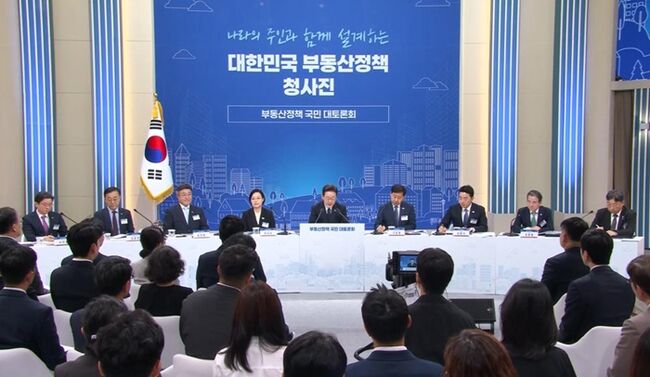 [Liberal Democratic Party Statement] Calling it a Grand Real Estate Debate… It Was Nothing More Than a Private Party Among Themselves
The 'National Grand Debate on Real Estate Policy' held on July 23rd and 27th. [Photo=Yonhap News]The 'National Grand Debate on Real Estate Policy,' hosted by the Lee Jae-myung administration under the
[Liberal Democratic Party Statement] Calling it a Grand Real Estate Debate… It Was Nothing More Than a Private Party Among Themselves
The 'National Grand Debate on Real Estate Policy' held on July 23rd and 27th. [Photo=Yonhap News]The 'National Grand Debate on Real Estate Policy,' hosted by the Lee Jae-myung administration under the
 [Photo] Evidence of Election Fraud Flooding U.S. Media… Trump Had 2.7 Million Votes Stolen
 [Video] U.S. Semiquincentennial Air Show... 'Art in the Sky' streaks across New York
 [Editorial Cartoon] A Draconian Law That Undermines Freedom of Expression

 List
List