President Yoon Suk Yeol [Photo=Yonhap News]
The fate of the Republic of Korea now rests upon a courtroom. This trial regarding former President Yoon Suk Yeol is not merely a proceeding to determine an individual's guilt or innocence. It is a national judgment that will decide whether to restore South Korea’s collapsed rule of law, or to reveal the pathetic state of a judiciary already fallen under the blade of politics.
The courts overseeing the cases of former Prime Minister Han Duck-soo and Minister Lee Sang-min have already convicted their subordinates of "engaging in major duties of insurrection." However, the guilt of the primary culprit—the very premise upon which these convictions rest—has yet to be determined. This bizarre reality, where legal procedures are inverted and the foundations of common sense are shaken, lays bare the fact that the judiciary has already been captured by political framing.
Will the judiciary remain silent, complicit, or subservient to politics that undermine the law?
Today, the South Korean courtroom is a grotesque battlefield where politics intervenes like a shadow. Political attacks disguised as the law are shaking the gates of judicial independence, and waves of manufactured public opinion are battering the walls of legal principles.
Verdicts that declare accomplices guilty before the principal offender’s guilt is confirmed, and logic that prioritizes political interpretation over facts—these are all classic symptoms that emerge when the rule of law crumbles.
The law is a fortress of legal principles and logic. The moment politics crosses the boundaries of the law, that fortress collapses. Once the gates of judicial independence and the walls of the law fall, the courtroom ceases to be a space for justice and transforms into a puppet stage where political interpretation dances at will.
Insurrection charges must be judged by 'essence,' not 'form'
While the appropriateness of declaring martial law may be subject to debate, the primary authority for that judgment is the "final discretion" granted to the President by the Constitution. In times of national emergency, immediate decision-making is necessary; even if judicial control is possible in retrospect, a much stricter legal standard is required to directly link such actions to the crime of insurrection.
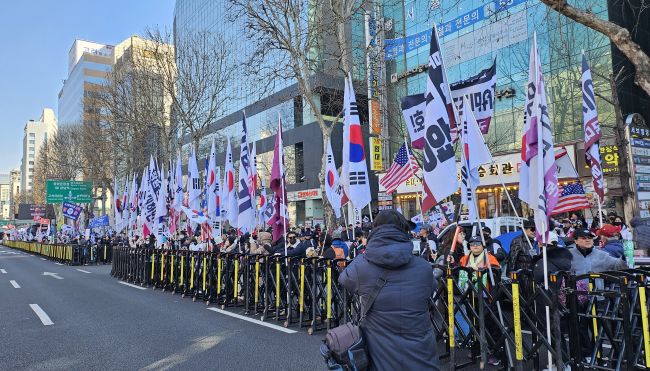 Patriotic conservative citizens call for the ‘innocence of Yoon Suk Yeol’ in front of the Seoul Central District Court in Seocho-gu, Seoul. [Photo=Hwarangdan]
This is precisely why the Criminal Act defines insurrection as the highest level of crime and sets extremely rigorous requirements for it. For insurrection to be established, two conditions must be met: ① the intent to disrupt the constitutional order, and ② the execution of an insurrectionary riot. If these criteria are not met, the charge of insurrection cannot stand.
The moment these legal standards and interpretations are dismantled by political power, the judiciary is reduced to a tool of politics, and the rule of law loses its essence.
Was the National Assembly forcibly dissolved? Were constitutional institutions neutralized? Were political opponents arrested? Was there any substantive move to establish a new system?
The facts are clear. There was no such execution, nor any such preparation. Therefore, a charge of insurrection cannot be sustained. If, despite this, the court rules that the martial law was an insurrection, it will be an act of betrayal—sacrificing the rule of law at the altar of political blades.
The ruling that the court must now deliver is not just about interpreting a few legal provisions. It must be a declaration of judicial independence, where the judiciary upholds its own conscience even amidst political pressure and the tides of public opinion.
If Judge Ji Gwi-yeon’s bench delivers a verdict faithful to the law, it will be a landmark ruling that saves and normalizes the Republic of Korea, rather than one serving a specific individual. It will become the epic story of judicial heroes reviving a dead rule of law.
Demanding the final conscience and courage of the judiciary
This verdict will serve as a crucial milestone indicating the direction in which the Republic of Korea is heading. Both domestically and internationally, the Western world and the global community are watching this decision closely.
The judges issuing the verdict will not be able to escape the cold, harsh judgment of the international community. The first step the judiciary must take now is a landmark ruling to protect the nation. We demand that the judiciary not shirk its responsibility, and that it make a decision it will not be ashamed of before the court of history—thereby resetting the milestone to save and normalize the Republic of Korea.
We believe that the righteous court of our democratic republic will reset the collapsed milestone. However, even if that milestone is wrongly set due to blatant pressure on Judge Ji Gwi-yeon’s bench, the journey of our democratic republic will not stop.
Even if our expectations are betrayed, we will not waver, for our history has always grown stronger in the face of crisis. The power to overcome national hardship and restore the collapsed rule of law ultimately lies with an awakened citizenry.
Now we ask: If the law is alive and the judiciary has the strength to protect its own conscience, then deliver a verdict of "not guilty" and "dismissal of the indictment." We hope that Judge Ji Gwi-yeon’s bench will normalize and save the Republic of Korea with this one line of judgment.

◆ Commissioner Park Pil-kyu
Editorial Commissioner, Han-Mi Ilbo (Korea-U.S. Daily)
Korea Military Academy, 40th Class

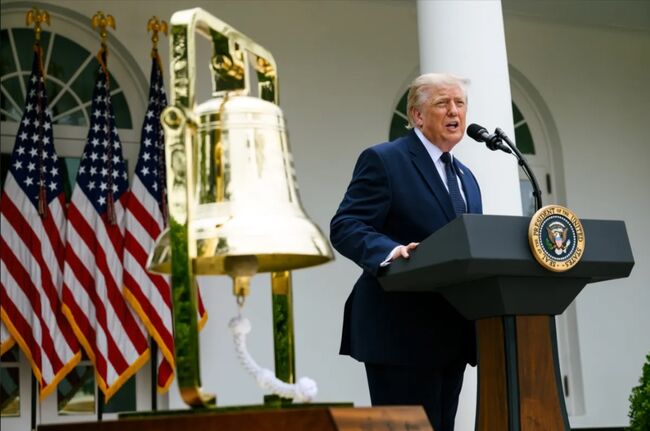 Trump pressures for rate cut again ahead of FOMC... "Should be the lowest in the world"
U.S. President Donald Trump. [Photo = The White House] U.S. President Donald Trump once again pressured the Federal Reserve, the U.S. central bank, to lower interest rates on the 27th (local time
Trump pressures for rate cut again ahead of FOMC... "Should be the lowest in the world"
U.S. President Donald Trump. [Photo = The White House] U.S. President Donald Trump once again pressured the Federal Reserve, the U.S. central bank, to lower interest rates on the 27th (local time
 “Ignoring crisp ballots and damaged seals”… Tongyeong mayoral recount concludes with ‘no change in outcome,’ leaving suspicions and public outrage behind
Suspected counterfeit ballots discovered in Tongyeong [GIF from social media of Representative Hwang Kyo-ahn / Attorney Park Joo-hyun]During a recount of the Tongyeong mayoral election in South Gyeong
“Ignoring crisp ballots and damaged seals”… Tongyeong mayoral recount concludes with ‘no change in outcome,’ leaving suspicions and public outrage behind
Suspected counterfeit ballots discovered in Tongyeong [GIF from social media of Representative Hwang Kyo-ahn / Attorney Park Joo-hyun]During a recount of the Tongyeong mayoral election in South Gyeong
 President Yoon, regarding the first-instance ruling on the Public Official Election Act: “An excessive political verdict that distorts the facts… We will appeal immediately.”
The first-instance sentencing hearing for President Yoon Suk Yeol regarding violations of the Public Official Election Act is being broadcast live at Seoul Station on the 27th. [Photo=Yonhap News]Pres
President Yoon, regarding the first-instance ruling on the Public Official Election Act: “An excessive political verdict that distorts the facts… We will appeal immediately.”
The first-instance sentencing hearing for President Yoon Suk Yeol regarding violations of the Public Official Election Act is being broadcast live at Seoul Station on the 27th. [Photo=Yonhap News]Pres
 WSJ: "SK Hynix ADR Premium Is a Sign of AI Trading Overheat"
Advertisement for SK Hynix ADR listing in New York's Times Square [Reuters=Yonhap News file photo]The Wall Street Journal (WSJ) has pointed out that the price of SK Hynix’s American Depositary Recei
WSJ: "SK Hynix ADR Premium Is a Sign of AI Trading Overheat"
Advertisement for SK Hynix ADR listing in New York's Times Square [Reuters=Yonhap News file photo]The Wall Street Journal (WSJ) has pointed out that the price of SK Hynix’s American Depositary Recei
 'Godfather of Japanese Mystery Novels' Keigo Higashino Passes Away After Battle with Cancer at 68
Famous Japanese mystery novelist Keigo Higashino [AFP=Yonhap News]It has been belatedly reported that Keigo Higashino, the "godfather of Japanese mystery novels" and author of bestsellers such as "The
'Godfather of Japanese Mystery Novels' Keigo Higashino Passes Away After Battle with Cancer at 68
Famous Japanese mystery novelist Keigo Higashino [AFP=Yonhap News]It has been belatedly reported that Keigo Higashino, the "godfather of Japanese mystery novels" and author of bestsellers such as "The
 [Park Pil-kyu Security Column] To the Ignorant Trying to Clothe a Beast in Sheep's Clothing
Rep. Kim Byung-joo of the Democratic Party of Korea [Photo=Yonhap News]“The Air Force Academy doesn't teach you how to fly a plane!” “The Army, Navy, and Air Force academies are exactly the
[Park Pil-kyu Security Column] To the Ignorant Trying to Clothe a Beast in Sheep's Clothing
Rep. Kim Byung-joo of the Democratic Party of Korea [Photo=Yonhap News]“The Air Force Academy doesn't teach you how to fly a plane!” “The Army, Navy, and Air Force academies are exactly the
 [Issue Diagnosis] Two Effects of the Election Petition Review
 [Photo] Evidence of Election Fraud Flooding U.S. Media… Trump Had 2.7 Million Votes Stolen
 [Video] U.S. Semiquincentennial Air Show... 'Art in the Sky' streaks across New York
 [Editorial Cartoon] A Draconian Law That Undermines Freedom of Expression

 List
List