President Trump announcing reciprocal tariff policy at the White House last April [AFP=Yonhap News]
Although the U.S. Supreme Court invalidated the reciprocal tariffs imposed by President Donald Trump on major trading partners based on the International Emergency Economic Powers Act (IEEPA), the 'tariff war' initiated by Trump is not expected to stop.
Immediately after the ruling, President Trump deployed a flat 15% tariff as a workaround and declared a direct confrontation, vowing to "do everything to collect more money than before."
For this reason, the U.S. is already initiating 'Plan B,' which combines various provisions scattered throughout U.S. trade law to achieve an effect identical to or stronger than existing global tariffs.
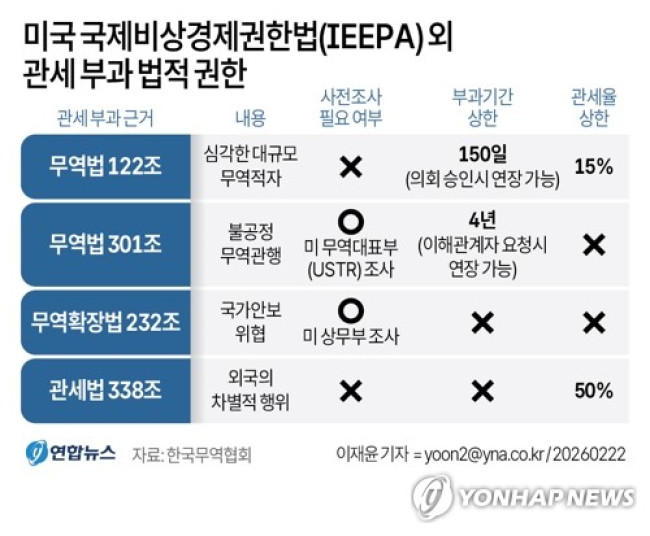
The first card President Trump mobilized to fill the void left by the IEEPA tariffs is Section 122 of the Trade Act. Section 122 grants the president the authority to address a 'large and serious' trade deficit through tariffs of up to 15%.
In a press conference held at the White House after the Supreme Court ruling, President Trump announced his intention to impose an additional 10% tariff worldwide based on Section 122 of the Trade Act, and immediately issued a proclamation making these tariffs effective from 12:01 AM Eastern Time on the 24th.
Furthermore, he announced the following day that the global new tariff would be increased from 10% to 15%, indicating that uncertainty surrounding tariffs will continue.
U.S. Customs and Border Protection (CBP) stated that it plans to suspend the collection of IEEPA-based tariffs, which were deemed unlawful by the Supreme Court, starting at 12:01 AM Eastern Time on the 24th.
Previously, Section 122 had not been used to impose tariffs on a global scale. However, it can be invoked immediately without separate investigation, making it suitable for immediate deployment as a temporary measure.
However, Section 122 is a 'universal' tariff provision that does not allow for differentiation by country and can only be applied for 150 days. The period can be extended with congressional approval, but given the negative public opinion in the U.S. regarding Trump's tariffs, an extension is unlikely to be easy.
Consequently, the Trump administration is expected to design a new tariff system during this 150-day period. Sections 301 and 232 of the Trade Expansion Act are being discussed as key components.
Section 301 is a tool that allows for the imposition of tariffs in response to foreign 'unfair and discriminatory trade practices.' It served as the legal basis for the high tariffs imposed on China during Trump's first term.
It has no upper limit on tariff rates and includes a four-year sunset provision, but since it can be extended, it can function as a permanent alternative tariff.
 There is no better tool for the U.S. to pressure specific countries it views with suspicion through tariffs.
The drawback is that as these tariffs are strongly retaliatory in nature, they must undergo procedures such as proving the target country's unfair practices and holding public hearings. In past cases where it was applied to a single country, it took a year from the announcement of the measure to its actual implementation.
The Trump administration is already moving quickly by identifying investigation targets.
In a media interview on the 22nd (local time), Jamie Gorelick, Deputy U.S. Trade Representative (USTR), stated that investigations into China and Brazil under Section 301 have already begun.
She added that investigations would also be conducted on "several Asian countries with excess production capacity."
China, Brazil, and many Southeast Asian countries have been identified as the primary beneficiaries of the tariff rate reduction following the Supreme Court's ruling that reciprocal tariffs were illegal.
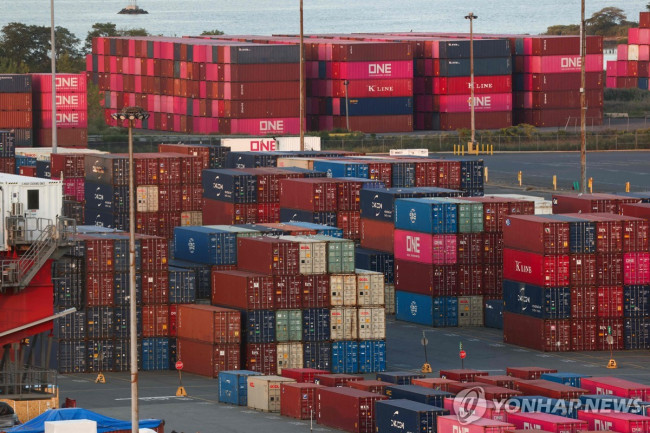 Container terminal in New York, USA [AFP=Yonhap News]Another alternative, Section 232 of the Trade Expansion Act, allows for tariffs to be imposed on specific industries based on national security threats.
The Trump administration's second term imposed tariffs on steel, aluminum, automobiles, and lumber based on Section 232, and is also considering imposing item-specific tariffs on advanced technology products such as pharmaceuticals and semiconductors.
However, Section 232 also requires prior investigation to determine if the relevant products pose a national security threat.
The Tariff Act of 1930, Section 338, is also being mentioned. Section 338 allows for tariffs of up to 50% to be imposed on countries that discriminate against U.S. companies.
It does not require investigation and has no time limit. While U.S. negotiators have traditionally favored measures under Section 301, leading to no actual implementation cases, Treasury Secretary Scott Bessant stated last year that this provision would be considered as an alternative if the Supreme Court invalidated reciprocal tariffs.
Based on these discussions, it appears the U.S. is pursuing a strategy of creating a 'multi-layered structure' by using Section 122 of the Trade Act (short-term, comprehensive) to buy time, and then reorganizing tariffs through Section 301 (country-specific, medium-to-long-term) and Section 232 of the Trade Expansion Act (item-specific, national security justification) for a more detailed approach. Despite the Supreme Court's intervention, there are numerous options available.
However, it remains uncertain whether this tariff drive will proceed smoothly.
According to the Wall Street Journal (WSJ), legal experts believe that the immediate imposition of a 15% tariff using Section 122 of the Trade Act is likely to face litigation.
President Trump argues that the U.S. trade deficit and the risk of dollar depreciation constitute a 'fundamental international payment problem' that Section 122 aims to resolve. However, lawsuits could be filed to determine whether the current trade deficit meets the 'large and serious' level defined by Section 122.
The biggest hurdle is speed. The 150 days guaranteed by Section 122 of the Trade Act is short. The success or failure of Trump's tariff war may depend on whether the U.S. can transition to a 'permanent tariff system' by simultaneously conducting investigations under Sections 301 and 232 within that timeframe.

 [Statement by the Seo-beo-kka Korea Military Academy Save-the-Nation Comrades Association] ㉛ Recount the Votes Publicly, as the Previous Recount Concealed Election Fraud
Tongyeong Mayoral Election Recount [Photo=Yonhap News]South Korea's liberal democracy is dying. The National Election Commission (NEC) and the judiciary, which have plummeted into criminal syndicates
[Statement by the Seo-beo-kka Korea Military Academy Save-the-Nation Comrades Association] ㉛ Recount the Votes Publicly, as the Previous Recount Concealed Election Fraud
Tongyeong Mayoral Election Recount [Photo=Yonhap News]South Korea's liberal democracy is dying. The National Election Commission (NEC) and the judiciary, which have plummeted into criminal syndicates
 What is the significance of the "Trump 2028" red hats that keep making a comeback?
It is noteworthy that President Donald Trump is "intentionally" fueling controversy over whether he can actually run in the 2028 presidential election, even though it is "highly likely he is seriously
What is the significance of the "Trump 2028" red hats that keep making a comeback?
It is noteworthy that President Donald Trump is "intentionally" fueling controversy over whether he can actually run in the 2028 presidential election, even though it is "highly likely he is seriously
 Jin Cummings: "North Korea says it will increase the number of spies, so what is the government doing?"
U.S. political columnist Gene Cummings has publicly questioned the South Korean government, asking, "North Korea is announcing plans to increase its number of spies, yet what is the South Korean
Jin Cummings: "North Korea says it will increase the number of spies, so what is the government doing?"
U.S. political columnist Gene Cummings has publicly questioned the South Korean government, asking, "North Korea is announcing plans to increase its number of spies, yet what is the South Korean
 Attorney Do Tae-woo: “Discrepancies in Voter Count and Improper Sealing Confirmed in Tongyeong Mayoral Recount… Official Request for Further Verification Filed with Gyeongnam Election Commission”
A bundle of out-of-district early voting ballots photographed by attorney Do Tae-woo at the Tongyeong mayoral election recount site. A clear, solid line visible on the side of the ballots raises suspi
Attorney Do Tae-woo: “Discrepancies in Voter Count and Improper Sealing Confirmed in Tongyeong Mayoral Recount… Official Request for Further Verification Filed with Gyeongnam Election Commission”
A bundle of out-of-district early voting ballots photographed by attorney Do Tae-woo at the Tongyeong mayoral election recount site. A clear, solid line visible on the side of the ballots raises suspi
 Stock Market Crash 'Black Tuesday'… KOSPI down 10.8%, KOSDAQ down 7.7%
The KOSPI fell by more than 5% in early trading on the 28th, triggering a sell-side sidecar.On the 28th, the KOSPI plunged by more than 10%.Due to the sharp decline, a sell-side sidecar—a temporary
Stock Market Crash 'Black Tuesday'… KOSPI down 10.8%, KOSDAQ down 7.7%
The KOSPI fell by more than 5% in early trading on the 28th, triggering a sell-side sidecar.On the 28th, the KOSPI plunged by more than 10%.Due to the sharp decline, a sell-side sidecar—a temporary
 [World Heritage Committee] 25 New World Heritage Sites Inscribed in Busan… South Korea Successfully Expands 'Getbol' Listing
The Chairperson of the World Heritage Committee speaks at the plenary session of the 48th session of the World Heritage Committee, held at BEXCO in Busan on the 20th. [Photo: Yonhap News]A total of 25
[World Heritage Committee] 25 New World Heritage Sites Inscribed in Busan… South Korea Successfully Expands 'Getbol' Listing
The Chairperson of the World Heritage Committee speaks at the plenary session of the 48th session of the World Heritage Committee, held at BEXCO in Busan on the 20th. [Photo: Yonhap News]A total of 25
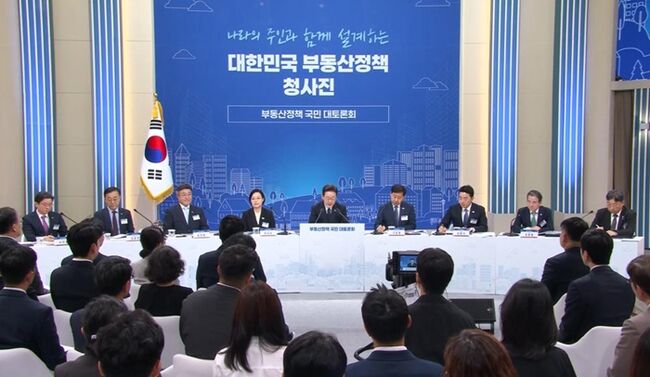 [Liberal Democratic Party Statement] Calling it a Grand Real Estate Debate… It Was Nothing More Than a Private Party Among Themselves
The 'National Grand Debate on Real Estate Policy' held on July 23rd and 27th. [Photo=Yonhap News]The 'National Grand Debate on Real Estate Policy,' hosted by the Lee Jae-myung administration under the
[Liberal Democratic Party Statement] Calling it a Grand Real Estate Debate… It Was Nothing More Than a Private Party Among Themselves
The 'National Grand Debate on Real Estate Policy' held on July 23rd and 27th. [Photo=Yonhap News]The 'National Grand Debate on Real Estate Policy,' hosted by the Lee Jae-myung administration under the
 [Photo] Evidence of Election Fraud Flooding U.S. Media… Trump Had 2.7 Million Votes Stolen
 [Video] U.S. Semiquincentennial Air Show... 'Art in the Sky' streaks across New York
 [Editorial Cartoon] A Draconian Law That Undermines Freedom of Expression

 List
List