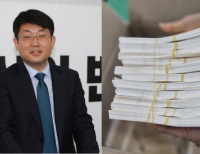
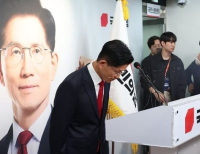
A proposed amendment to the National Pension Act, introduced by Democratic Party lawmaker Ahn Do-geul, is stirring up controversy. [Photo=Yonhap News]
As a bill has been introduced to allow for the issuance of foreign currency bonds and currency swaps—intended to mitigate exchange rate shocks during the National Pension Service’s (NPS) overseas investments—a fierce debate has erupted regarding the pension fund's role and the neutrality of its asset management.
While superficially designed as a mechanism for managing exchange rate risk, some interpret it as a structural change that incorporates the pension fund as a variable in macroeconomic policy.
In particular, with the bill coinciding with "New Framework" discussions involving government ministries, some in political circles view this legislation as more than a simple motion by a lawmaker, suspecting it may be a trial balloon for future policy directions.
The core of the "Proposed Amendment to the National Pension Act" (hereinafter "Pension Foreign Exchange Response Amendment") introduced by Democratic Party lawmaker Ahn Do-geul is the diversification of foreign currency procurement methods.
The amendment would allow the NPS to issue dollar-denominated bonds or incur foreign currency debt to secure the foreign currency necessary for overseas investments more stably, and also paves the way for currency swaps with foreign pension funds and financial institutions.
It further includes provisions for the establishment of affiliated or invested agencies for the purpose of raising foreign currency. The market is closely watching this shift, as it moves the pension fund from a structure centered on managing existing assets to one that can directly create foreign currency liabilities.
The crux of the debate lies in the changing role of the pension fund.
Legally, the National Pension must balance profitability, stability, and public interest, but in practice, management principles have long focused on securing long-term returns.
However, concerns are emerging that if the amendment is implemented, the policy goal of stabilizing the foreign exchange market could overlap with pension investment decisions.
Critics argue that if the criteria for investment decisions expand from return-focused to include macroeconomic impacts, the pension fund would effectively function as a policy tool.
Recent remarks by Bank of Korea Governor Rhee Chang-yong have also fueled the controversy.
Governor Rhee has recently emphasized the need to consider macroeconomic ripple effects, noting the influence of the NPS's expanding overseas investments on the foreign exchange market.
While this is interpreted as a general critique of pension management rather than a direct evaluation of the bill itself, the fact that his remarks are being cited alongside articles about the legislation has led some to point out that it could be perceived as the central bank endorsing the direction of this amendment.
The legislative approach is also drawing attention.
Issuing foreign currency bonds and executing currency swaps are matters that typically carry significant political burden if promoted directly by the government.
This is because they could trigger debates over the independence of the pension fund and allegations of foreign exchange intervention simultaneously.
For this reason, political observers interpret this as a "policy experiment-style" legislative structure, where the government leads the policy discussions while a ruling party lawmaker initiates the legislation.
Ahn’s background as a finance expert and former bureaucrat further reinforces this perspective.
The market holds mixed views on the amendment, reflecting both expectation and concern.
Some argue that as the pension fund has emerged as a "big player" in the domestic foreign exchange market through its expansion of overseas investments, institutional mechanisms to reduce exchange rate volatility are necessary.
Conversely, there is significant pushback, with critics warning that expanding foreign currency procurement tools could structurally pressure the won to depreciate in the long term or blur the lines between the roles of the central bank and the pension fund.
In particular, there is speculation that the provision for establishing affiliated or invested agencies could even lead to debates over the transformation of the pension fund into a financial group.
Ultimately, the issue extends beyond mere technical responses to exchange rates and touches upon the identity of the pension fund itself.
The debate centers on whether the fund should maintain its independence as an investment institution or align its goals with macroeconomic management.
Analysts suggest that depending on how the "Pension Foreign Exchange Response Amendment" is modified and supplemented during the National Assembly's deliberative process, the very definition of the National Pension Service’s role may be subject to a fundamental rewrite.

 [Statement by the Seo-beo-kka Korea Military Academy Save-the-Nation Comrades Association] ㉛ Recount the Votes Publicly, as the Previous Recount Concealed Election Fraud
Tongyeong Mayoral Election Recount [Photo=Yonhap News]South Korea's liberal democracy is dying. The National Election Commission (NEC) and the judiciary, which have plummeted into criminal syndicates
[Statement by the Seo-beo-kka Korea Military Academy Save-the-Nation Comrades Association] ㉛ Recount the Votes Publicly, as the Previous Recount Concealed Election Fraud
Tongyeong Mayoral Election Recount [Photo=Yonhap News]South Korea's liberal democracy is dying. The National Election Commission (NEC) and the judiciary, which have plummeted into criminal syndicates
 What is the significance of the "Trump 2028" red hats that keep making a comeback?
It is noteworthy that President Donald Trump is "intentionally" fueling controversy over whether he can actually run in the 2028 presidential election, even though it is "highly likely he is seriously
What is the significance of the "Trump 2028" red hats that keep making a comeback?
It is noteworthy that President Donald Trump is "intentionally" fueling controversy over whether he can actually run in the 2028 presidential election, even though it is "highly likely he is seriously
 Jin Cummings: "North Korea says it will increase the number of spies, so what is the government doing?"
U.S. political columnist Gene Cummings has publicly questioned the South Korean government, asking, "North Korea is announcing plans to increase its number of spies, yet what is the South Korean
Jin Cummings: "North Korea says it will increase the number of spies, so what is the government doing?"
U.S. political columnist Gene Cummings has publicly questioned the South Korean government, asking, "North Korea is announcing plans to increase its number of spies, yet what is the South Korean
 Attorney Do Tae-woo: “Discrepancies in Voter Count and Improper Sealing Confirmed in Tongyeong Mayoral Recount… Official Request for Further Verification Filed with Gyeongnam Election Commission”
A bundle of out-of-district early voting ballots photographed by attorney Do Tae-woo at the Tongyeong mayoral election recount site. A clear, solid line visible on the side of the ballots raises suspi
Attorney Do Tae-woo: “Discrepancies in Voter Count and Improper Sealing Confirmed in Tongyeong Mayoral Recount… Official Request for Further Verification Filed with Gyeongnam Election Commission”
A bundle of out-of-district early voting ballots photographed by attorney Do Tae-woo at the Tongyeong mayoral election recount site. A clear, solid line visible on the side of the ballots raises suspi
 Stock Market Crash 'Black Tuesday'… KOSPI down 10.8%, KOSDAQ down 7.7%
The KOSPI fell by more than 5% in early trading on the 28th, triggering a sell-side sidecar.On the 28th, the KOSPI plunged by more than 10%.Due to the sharp decline, a sell-side sidecar—a temporary
Stock Market Crash 'Black Tuesday'… KOSPI down 10.8%, KOSDAQ down 7.7%
The KOSPI fell by more than 5% in early trading on the 28th, triggering a sell-side sidecar.On the 28th, the KOSPI plunged by more than 10%.Due to the sharp decline, a sell-side sidecar—a temporary
 [World Heritage Committee] 25 New World Heritage Sites Inscribed in Busan… South Korea Successfully Expands 'Getbol' Listing
The Chairperson of the World Heritage Committee speaks at the plenary session of the 48th session of the World Heritage Committee, held at BEXCO in Busan on the 20th. [Photo: Yonhap News]A total of 25
[World Heritage Committee] 25 New World Heritage Sites Inscribed in Busan… South Korea Successfully Expands 'Getbol' Listing
The Chairperson of the World Heritage Committee speaks at the plenary session of the 48th session of the World Heritage Committee, held at BEXCO in Busan on the 20th. [Photo: Yonhap News]A total of 25
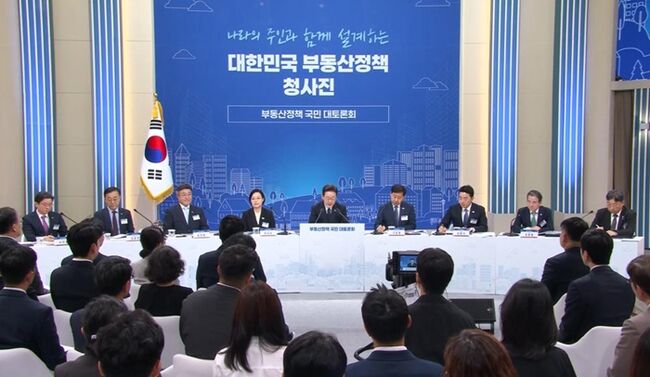 [Liberal Democratic Party Statement] Calling it a Grand Real Estate Debate… It Was Nothing More Than a Private Party Among Themselves
The 'National Grand Debate on Real Estate Policy' held on July 23rd and 27th. [Photo=Yonhap News]The 'National Grand Debate on Real Estate Policy,' hosted by the Lee Jae-myung administration under the
[Liberal Democratic Party Statement] Calling it a Grand Real Estate Debate… It Was Nothing More Than a Private Party Among Themselves
The 'National Grand Debate on Real Estate Policy' held on July 23rd and 27th. [Photo=Yonhap News]The 'National Grand Debate on Real Estate Policy,' hosted by the Lee Jae-myung administration under the
 [Photo] Evidence of Election Fraud Flooding U.S. Media… Trump Had 2.7 Million Votes Stolen
 [Video] U.S. Semiquincentennial Air Show... 'Art in the Sky' streaks across New York
 [Editorial Cartoon] A Draconian Law That Undermines Freedom of Expression

 List
List