 Members of the first cabinet of the Democratic People's Republic of Korea, 1948. From left in the front row: △Chairman of the State Planning Commission Jong Jun-taek △Vice Premier and Minister of Industry Kim Chaek (died under suspicious circumstances) △Vice Premier Hong Myong-hui △Premier Kim Il-sung △Vice Premier and Foreign Minister Pak Hon-yong (purged and executed) △Minister of National Defense Choe Yong-gon △Minister of Culture and Propaganda Ho Jong-suk. From left in the second row: △Minister of Health Ri Byong-nam △Minister of State Inspection Kim Won-bong (purged and executed) △Minister of Education Paek Nam-un △Minister of Transportation Ju Yong-ha (purged) △Minister of Commerce Jang Si-u (purged and executed) △Minister of Finance Choe Chang-ik (purged and executed) △Minister of Internal Affairs Pak Il-u (purged and executed). From left in the third row: △Minister of Agriculture and Forestry Pak Mun-gyu △Minister without Portfolio Ri Guk-ro △Minister of City Management Ri Yong △Minister of Communications Kim Jong-ju (purged) △Minister of Justice Ri Sung-yop (purged and executed) △Minister of Labor Ho Song-taek (purged and executed).
Pyongyang was quiet in 1958. However, that silence was not the result of order; it was a stillness left behind after opposition forces had been eliminated. The Armistice Agreement was signed on July 27, 1953. While the war had stopped, the restructuring of power had only just begun.
1953: "Pak Hon-yong is a U.S. Imperialist Spy and Sectarian"
At the time, four factions coexisted within the North Korean power structure.
First, the Soviet faction, represented by figures such as Pak Chang-ok, Ho Ka-i (who died in 1953), and other cadres educated in the Soviet Union.
Second, the Yan'an faction, which included those who had been active in Yan'an, China, such as Choe Chang-ik, Kim Tu-bong, and Yun Gong-hum.
Third, the domestic faction, centered around members of the South Workers' Party like Pak Hon-yong and Ri Sung-yop.
Fourth, the anti-Japanese guerrilla group from Manchuria, known as the Kapsan faction or the anti-Japanese partisan group, which included Kim Il-sung, Choe Hyon, and Kim Chaek (who died in 1951).
Immediately after the war, Kim Il-sung had not yet consolidated absolute power. Pak Hon-yong served as Vice Premier and Foreign Minister, and Kim Tu-bong was Chairman of the Standing Committee of the Supreme People's Assembly. Power remained a multi-polar structure.
The first large-scale purge began at the 6th Plenary Session of the Central Committee of the Workers' Party of Korea, held on August 5–6, 1953. Pak Hon-yong was labeled a "U.S. imperialist spy and sectarian" and was stripped of his position.
On December 15, 1955, the Supreme Court of North Korea sentenced Pak Hon-yong, Ri Sung-yop, and others to death. Although presented as a public trial, it was essentially a political purge. At this point, the domestic faction was effectively dismantled.
1956 marked the decisive turning point. On February 25, 1956, at the 20th Congress of the Communist Party of the Soviet Union in Moscow, Nikita Khrushchev delivered a secret speech criticizing Stalin’s cult of personality and the Great Purge.
This speech shocked the entire Eastern Bloc. In the same year, the Poznań protests occurred in Poland in June, the Hungarian Revolution followed in October, and Soviet troops re-entered Budapest in November. The socialist world was in turmoil.
Amid this international climate, a plenary session of the Central Committee of the Workers' Party of Korea was held on August 30, 1956—an event later known as the "August Faction Incident."
Pak Chang-ok criticized Kim Il-sung’s economic policies, pointing out that the priority given to heavy industry was worsening shortages of consumer goods and causing hardship for the people. Choe Chang-ik raised the issue of the cult of personality and demanded the introduction of a collective leadership system. Similar concerns were raised by others, including Yun Gong-hum and So Hwi.
There were two core issues: first, the modification of the economic line, specifically the shortages of daily necessities caused by the focus on heavy industry during the 1954–1956 Three-Year Plan; and second, the structure of the leadership, with demands to restore collective decision-making in the Political Committee and the Central Committee.
This was not mere policy criticism; it was a demand to institutionally limit the power of the supreme leader. Kim Il-sung labeled it a "sectarian conspiracy." The term "sectarian" was used to denote anti-party elements damaging the party's unity. During the meeting, speech after speech supported Kim Il-sung, and the critics were isolated.
However, the incident soon escalated into an international issue. In September 1956, Soviet Politburo member Anastas Mikoyan and Chinese Minister of Defense Peng Dehuai visited Pyongyang.
The Soviet Union and China were concerned that excessive purges could lead to instability similar to that in the Eastern Bloc. Consequently, some officials were temporarily reinstated, but this proved to be merely a tactical retreat.
1957: The Ousting of Pak Chang-ok and Choe Chang-ik
Beginning in 1957, through the Organization and Guidance Department (which would later become the core tool of Kim Il-sung's power), figures such as Pak Chang-ok and Choe Chang-ik were transferred to the provinces or stripped of their positions. A gradual removal replaced public execution.
They were finally ousted at the plenary session in August 1958. Pak Chang-ok is reported to have died in the early 1960s, while Choe Chang-ik disappeared after being sent to a political prison camp. Kim Tu-bong was also purged after 1958, and the Yan'an faction was effectively extinguished.
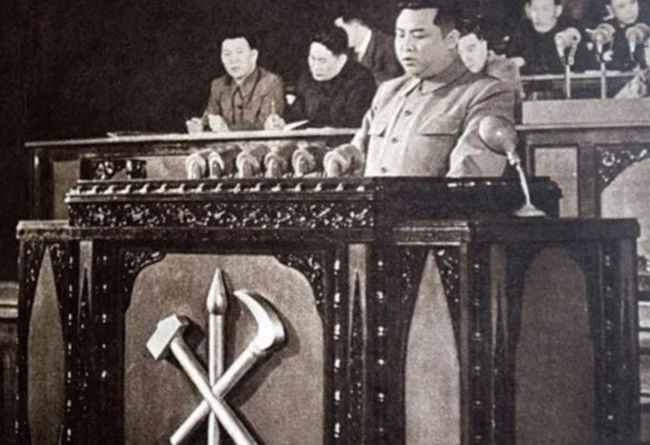 Kim Il-sung speaking at a North Korean plenary session on August 30, 1956.
On August 13, 1958, North Korea officially announced that it had achieved 100% agricultural collectivization. They claimed that the rate of collectivization, which was at 5% in 1953, had exceeded 80% by 1956 and that full collectivization was complete by the end of 1958.
This signified the establishment of a system of complete collective ownership of land. The landlord class had been removed via land reform in 1946, and the nationalization of industry and commerce was completed by 1956. 1958 was the year in which both political power and the means of production were simultaneously centralized.
In October 1958, the Chinese People's Volunteer Army withdrew, roughly eight years after entering the war in October 1950. The withdrawal of Chinese troops meant the removal of an external variable in North Korea’s internal power structure.
Subsequently, the "Ten Principles for the Establishment of the Party's Monolithic Ideological System" were adopted in 1967, and the Socialist Constitution, enacted on December 27, 1972, introduced the presidency. Kim Il-sung was elected President.
To summarize:
△Elimination of the domestic faction (1953–1955): The purge of the South Workers' Party began with the ousting of Pak Hon-yong in August 1953. With the death sentence and execution in December 1955, the domestic faction was effectively dismantled.
△Neutralization of the Soviet and Yan'an factions (1956–1958): Following the August Faction Incident in 1956, critics like Pak Chang-ok and Choe Chang-ik were gradually removed. Following the 1958 plenary session, any possibility of collective leadership vanished.
△Total economic collectivization (1958): The declaration of 100% agricultural collectivization in August 1958 meant that land and the means of production were fully collectivized, completing economic control.
△Withdrawal of Chinese troops (October 1958): The Chinese People's Volunteer Army departed. With external checks removed, Kim Il-sung’s power base became independently secured even in military terms. These four stages combined to structure a one-man regime.
The silence in Pyongyang in 1958 was, therefore, not simple stability; it was the result of the elimination of factions rather than the end of factional politics. After that, the possibility of collective leadership disappeared from North Korean politics. Power converged toward a single axis, and that structure has been maintained for decades.
This leads to a question: How was this viewed in South Korea?
Pro-North Leftists Explain the Great Purge as a Stage of Socialist Construction
In the late 1950s, South Korea was under a strong anti-communist regime. However, in universities and among some intellectual groups, there existed a perception that interpreted North Korea as a "nationally independent state."
While the 1953 uprising in East Germany and the 1956 suppression in Hungary were subjects of criticism, the purges within Pyongyang were not subjected to structural analysis.
It was not due to a lack of information. The Pak Hon-yong trial was public, and the August Faction Incident was an international issue significant enough to involve the Soviet and Chinese leadership. The signs of power concentration were clear.
Nevertheless, some pro-North leftist discourse interpreted these events as "anti-sectarian struggles" or the "rectification of the revolutionary line." Demands for collective leadership were translated as divisive acts, and the strengthening of the leader's authority as the defense of the regime.
The fact that collective leadership disappeared inside North Korea and personalistic rule took hold is a matter that defines the nature of the political system. Yet, in South Korean pro-North leftist discourse, this was explained not as the deepening of a dictatorship, but as a stage in socialist construction. The monopolization of power was absorbed into the rhetoric of anti-imperialist struggle. Criticism was defined as a denial of the system, and silence was disguised as an attitude of solidarity.
This attitude becomes clearer when looking at specific cases. During the Hungarian crisis of 1956, some leftist intellectuals openly criticized the intervention of the Soviet military. However, when the demand for collective leadership was removed and critics were ousted in Pyongyang in August of the same year, the same standards were not applied.
While discussions on reform in the Eastern Bloc were introduced in academic journals and small study groups, analysis of the North Korean power structure was almost impossible to find. The phrase "ideological struggle within socialism" was repeated, but the concept of power concentration was never brought to the forefront.
The same applies to the execution of Pak Hon-yong. He was not just an individual, but a core figure in the domestic communist movement. Even though he was executed after a public trial, discourse interpreting this as a signal of the rigidity of the North Korean power structure was limited.
Instead, some explained it as "settling responsibility for the war" or avoided mentioning it altogether. Political elimination was reinterpreted as a process of regime stabilization.
A similar pattern appeared regarding the declaration of the completion of collectivization in 1958. Full collectivization of land and the means of production meant the state centralization of economic power, yet some pro-North discourse described this positively with expressions like "liquidation of colonial remnants" or "dissolution of class structures." The fact that political purging and economic control were happening simultaneously was not at the center of the discussion.
This attitude goes beyond a simple difference in interpretation. While criticizing authoritarianism in the Eastern Bloc, a double standard was at work, softening the authoritarianism of North Korea as a "national peculiarity."
Choosing not to label the concentration of power as a dictatorship is a political judgment. Silence is not neutrality. The act of withholding analysis is no different from accepting reality as it is.
◆ Songsan
A poet and researcher of history and philosophy. A former board member of the Syngman Rhee Institute. Currently, he serves as a research advisor to the Korea Modern and Contemporary History Research Association and represents the philosophy forum "Lyceum." He has published four volumes of poetry, co-translated *Heroes of Hook Ridge*, and authored the historical psychology commentary *Joseon Become Myth* (2026). He is actively engaged in the research and practice of liberal cultural movements. "Songsan" is his pen name.

 Iranian Foreign Ministry: "Continuing Message Exchanges with the U.S. and Activities of Mediating Countries"
Esmaeil Baghaei, Spokesperson for the Iranian Ministry of Foreign Affairs [Xinhua, Yonhap News file photo]Esmaeil Baghaei, spokesperson for the Iranian Ministry of Foreign Affairs, stated on the 26th
Iranian Foreign Ministry: "Continuing Message Exchanges with the U.S. and Activities of Mediating Countries"
Esmaeil Baghaei, Spokesperson for the Iranian Ministry of Foreign Affairs [Xinhua, Yonhap News file photo]Esmaeil Baghaei, spokesperson for the Iranian Ministry of Foreign Affairs, stated on the 26th
 President Yoon: "Do You Think You Are Safe from the Special Counsel?"... Final Statement Video Released
President Yoon Suk Yeol rebuking the special prosecutor on the 24th. [Court video / @birds_justice X account subtitle GIF] A video of President Yoon Suk Yeol's closing statement at his trial rega
President Yoon: "Do You Think You Are Safe from the Special Counsel?"... Final Statement Video Released
President Yoon Suk Yeol rebuking the special prosecutor on the 24th. [Court video / @birds_justice X account subtitle GIF] A video of President Yoon Suk Yeol's closing statement at his trial rega
 President Yoon, regarding the first-instance ruling on the Public Official Election Act: “An excessive political verdict that distorts the facts… We will appeal immediately.”
The first-instance sentencing hearing for President Yoon Suk Yeol regarding violations of the Public Official Election Act is being broadcast live at Seoul Station on the 27th. [Photo=Yonhap News]Pres
President Yoon, regarding the first-instance ruling on the Public Official Election Act: “An excessive political verdict that distorts the facts… We will appeal immediately.”
The first-instance sentencing hearing for President Yoon Suk Yeol regarding violations of the Public Official Election Act is being broadcast live at Seoul Station on the 27th. [Photo=Yonhap News]Pres
 WSJ: "SK Hynix ADR Premium Is a Sign of AI Trading Overheat"
Advertisement for SK Hynix ADR listing in New York's Times Square [Reuters=Yonhap News file photo]The Wall Street Journal (WSJ) has pointed out that the price of SK Hynix’s American Depositary Recei
WSJ: "SK Hynix ADR Premium Is a Sign of AI Trading Overheat"
Advertisement for SK Hynix ADR listing in New York's Times Square [Reuters=Yonhap News file photo]The Wall Street Journal (WSJ) has pointed out that the price of SK Hynix’s American Depositary Recei
 'Godfather of Japanese Mystery Novels' Keigo Higashino Passes Away After Battle with Cancer at 68
Famous Japanese mystery novelist Keigo Higashino [AFP=Yonhap News]It has been belatedly reported that Keigo Higashino, the "godfather of Japanese mystery novels" and author of bestsellers such as "The
'Godfather of Japanese Mystery Novels' Keigo Higashino Passes Away After Battle with Cancer at 68
Famous Japanese mystery novelist Keigo Higashino [AFP=Yonhap News]It has been belatedly reported that Keigo Higashino, the "godfather of Japanese mystery novels" and author of bestsellers such as "The
 [Park Pil-kyu Security Column] To the Ignorant Trying to Clothe a Beast in Sheep's Clothing
Rep. Kim Byung-joo of the Democratic Party of Korea [Photo=Yonhap News]“The Air Force Academy doesn't teach you how to fly a plane!” “The Army, Navy, and Air Force academies are exactly the
[Park Pil-kyu Security Column] To the Ignorant Trying to Clothe a Beast in Sheep's Clothing
Rep. Kim Byung-joo of the Democratic Party of Korea [Photo=Yonhap News]“The Air Force Academy doesn't teach you how to fly a plane!” “The Army, Navy, and Air Force academies are exactly the
 [Issue Diagnosis] Two Effects of the Election Petition Review
 [Photo] Evidence of Election Fraud Flooding U.S. Media… Trump Had 2.7 Million Votes Stolen
 [Video] U.S. Semiquincentennial Air Show... 'Art in the Sky' streaks across New York
 [Editorial Cartoon] A Draconian Law That Undermines Freedom of Expression

 List
List









