 High school students protesting during the April 19 Revolution [Photo=Busan Democracy Park]
On March 15, 1960, the fourth presidential and vice-presidential elections were held. The Rhee Syngman administration brazenly committed electoral fraud. Tactics such as ballot box stuffing, ghost voters, and coerced open voting were employed. In particular, the manipulation to ensure the election of vice-presidential candidate Lee Ki-poong was severe.
That day, protests by students and citizens took place in Masan. The police responded with a brutal crackdown. On April 11, the body of high school student Kim Ju-yul was discovered in the waters off Masan, with a tear gas canister embedded in his eye. The photo was published in newspapers, and the entire nation was in an uproar.
186 Killed by Police Gunfire on April 19
On April 18, about 3,000 Korea University students held a protest in front of the National Assembly. On their way back, they were attacked by political thugs.
The following day, April 19, students from Seoul National University, Yonsei University, Korea University, Hanyang University, and Dongguk University, as well as high school students, poured into the streets. They marched all the way to the Gyeongmudae (presidential residence). The police opened fire. The official death toll was 186, with about 6,000 injured.
Martial law was declared. However, the protests did not stop. On April 25, a declaration of the national situation was issued by the faculty. On April 26, Rhee Syngman resigned. The 12-year rule collapsed.
The core of this event was a protest against electoral fraud. It was a demand for the restoration of constitutional order. Indeed, a constitutional amendment was enacted on June 15, 1960, changing the presidential system to a parliamentary cabinet system. A general election was held on July 29, Yun Bo-seon was elected president on August 12, and Chang Myon was inaugurated as prime minister on August 19.
The system moved in a more liberal direction. The multi-party system was strengthened, and freedom of the press was greatly expanded.
This is the basic structure of the April 19 Revolution.
However, immediately afterward, certain groups began to change the interpretation. They defined April 19 not as a simple protest against electoral fraud, but as a "people's revolution." The expression "unfinished revolution" became popular on college campuses. They argued that the revolution had not yet ended and that the socio-economic system itself needed to be changed.
Rapidly Politicized Campuses
In the second half of 1960, college campuses became rapidly politicized. In October 1960, the "National Student Federation for National Unification" was formed. Proposals for inter-Korean student talks also emerged.
In February 1961, students from the College of Liberal Arts and Sciences at Seoul National University proposed a public debate on the issue of unification. At the first-anniversary rally on April 19, 1961, "autonomous peaceful unification" emerged as a major slogan.
The problem was the timing. North Korea had already purged opposition factions following the August 1956 factional incident and fully solidified its power base at the 1958 plenum. A Kim Il-sung-centered monolithic system had been firmly established—a system where no political freedom existed.
In the discourse of some South Korean intellectuals, this fact was not sufficiently addressed. While there were loud voices criticizing the anti-communist order, criticism of the North Korean power structure was weak. Anti-American slogans escalated, and demands to re-examine the ROK-US alliance followed.
In protests that took place in Seoul in November and December 1960, "anti-imperialism" and "national autonomy" were repeated. A movement that began as a protest against electoral fraud had expanded into arguments that shook the very foundation of foreign policy.
The labor front was also shaken. The formation of labor unions surged in the second half of 1960. The number of strikes increased significantly compared to 1959. Social discontent erupted. As a free space opened up, suppressed demands burst out simultaneously. The problem was that there was a trend where the direction of these demands shifted from institutional reform to the complete denial of the system itself.
On March 22, 1961, a large-scale rally urging unification was held in Seoul. At some gatherings, demands for the withdrawal of US forces in Korea also appeared. The starting point of April 19 as a civil uprising demanding free elections gradually faded. "Overthrow the dictatorship" was replaced by "systemic transformation." These two phrases represent completely different agendas.
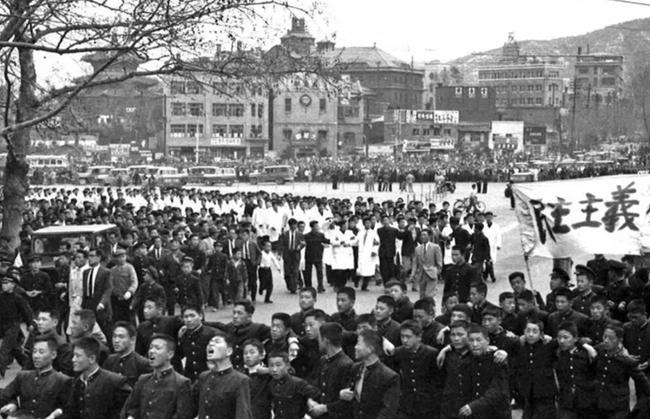 Protesters heading toward Gyeongmudae on April 19. On this day, 186 people were killed by police gunfire.
The Chang Myon government allowed broad freedom of the press and assembly. It released political prisoners. However, the government had to manage economic instability and social chaos simultaneously. Rising prices, unemployment, and conflicts between political parties overlapped. Opposition and new parties proliferated, and the political landscape was unstable. In this gap, radical slogans gained momentum.
Radical Slogans of the Pro-North Left Provided a Pretext for the Military
On May 16, 1961, a military coup occurred. The military forces led by Park Chung-hee used the pretext of "restoring social order." They attacked the fact that the free space opened by April 19 had failed to establish order.
The radical slogans of the pro-North left and social instability provided a pretext for the military. Therein lies the paradox: the result of a liberal civil uprising led to a military regime.
The pro-North left incorporates April 19 into their own history, portraying it as the starting point of anti-American and anti-capitalist struggles. However, the majority of the people on the streets at the time were students and citizens angry about electoral fraud. They did not shout for a North Korean-style system. April 19 was a resistance within the constitutional order of the Republic of Korea. It was not a socialist revolution.
Historical interpretation must be accurate. The cries of April 1960 were for free elections. However, some groups reinterpreted those cries as a signal for systemic transformation. They pushed for unification and anti-Americanism without a cold-headed examination of the realities of the North Korean system. They used the power of citizens who demanded freedom as a springboard for ideological expansion.
The confusion of routes immediately after April 19 was not a mere theoretical debate. It was a problem of real-world politics concerning the direction of the Republic of Korea. The attitude of transforming a liberal civil uprising into a prelude to system overthrow obscures the essence of the event.
April 1960 was a month when freedom was reclaimed. However, in deciding how to use that freedom, some went astray. That was the starting point of the confusion in the pro-North leftist route.
◆ SONG-SAN
A poet and researcher of history and philosophy. Former board member of the Syngman Rhee Institute. Currently serving as a research advisor to the Korea Modern and Contemporary History Research Association and representative of the philosophy forum "Lyceum." He has published four volumes of poetry, co-translated "Heroes of Hook Ridge," and published the historical psychology commentary "Joseon as a Myth" (2026). He is actively engaged in the research and practice of the liberal cultural movement. Song-san is his pen name.

 Iranian Foreign Ministry: "Continuing Message Exchanges with the U.S. and Activities of Mediating Countries"
Esmaeil Baghaei, Spokesperson for the Iranian Ministry of Foreign Affairs [Xinhua, Yonhap News file photo]Esmaeil Baghaei, spokesperson for the Iranian Ministry of Foreign Affairs, stated on the 26th
Iranian Foreign Ministry: "Continuing Message Exchanges with the U.S. and Activities of Mediating Countries"
Esmaeil Baghaei, Spokesperson for the Iranian Ministry of Foreign Affairs [Xinhua, Yonhap News file photo]Esmaeil Baghaei, spokesperson for the Iranian Ministry of Foreign Affairs, stated on the 26th
 President Yoon: "Do You Think You Are Safe from the Special Counsel?"... Final Statement Video Released
President Yoon Suk Yeol rebuking the special prosecutor on the 24th. [Court video / @birds_justice X account subtitle GIF] A video of President Yoon Suk Yeol's closing statement at his trial rega
President Yoon: "Do You Think You Are Safe from the Special Counsel?"... Final Statement Video Released
President Yoon Suk Yeol rebuking the special prosecutor on the 24th. [Court video / @birds_justice X account subtitle GIF] A video of President Yoon Suk Yeol's closing statement at his trial rega
 President Yoon, regarding the first-instance ruling on the Public Official Election Act: “An excessive political verdict that distorts the facts… We will appeal immediately.”
The first-instance sentencing hearing for President Yoon Suk Yeol regarding violations of the Public Official Election Act is being broadcast live at Seoul Station on the 27th. [Photo=Yonhap News]Pres
President Yoon, regarding the first-instance ruling on the Public Official Election Act: “An excessive political verdict that distorts the facts… We will appeal immediately.”
The first-instance sentencing hearing for President Yoon Suk Yeol regarding violations of the Public Official Election Act is being broadcast live at Seoul Station on the 27th. [Photo=Yonhap News]Pres
 WSJ: "SK Hynix ADR Premium Is a Sign of AI Trading Overheat"
Advertisement for SK Hynix ADR listing in New York's Times Square [Reuters=Yonhap News file photo]The Wall Street Journal (WSJ) has pointed out that the price of SK Hynix’s American Depositary Recei
WSJ: "SK Hynix ADR Premium Is a Sign of AI Trading Overheat"
Advertisement for SK Hynix ADR listing in New York's Times Square [Reuters=Yonhap News file photo]The Wall Street Journal (WSJ) has pointed out that the price of SK Hynix’s American Depositary Recei
 'Godfather of Japanese Mystery Novels' Keigo Higashino Passes Away After Battle with Cancer at 68
Famous Japanese mystery novelist Keigo Higashino [AFP=Yonhap News]It has been belatedly reported that Keigo Higashino, the "godfather of Japanese mystery novels" and author of bestsellers such as "The
'Godfather of Japanese Mystery Novels' Keigo Higashino Passes Away After Battle with Cancer at 68
Famous Japanese mystery novelist Keigo Higashino [AFP=Yonhap News]It has been belatedly reported that Keigo Higashino, the "godfather of Japanese mystery novels" and author of bestsellers such as "The
 [Park Pil-kyu Security Column] To the Ignorant Trying to Clothe a Beast in Sheep's Clothing
Rep. Kim Byung-joo of the Democratic Party of Korea [Photo=Yonhap News]“The Air Force Academy doesn't teach you how to fly a plane!” “The Army, Navy, and Air Force academies are exactly the
[Park Pil-kyu Security Column] To the Ignorant Trying to Clothe a Beast in Sheep's Clothing
Rep. Kim Byung-joo of the Democratic Party of Korea [Photo=Yonhap News]“The Air Force Academy doesn't teach you how to fly a plane!” “The Army, Navy, and Air Force academies are exactly the
 [Issue Diagnosis] Two Effects of the Election Petition Review
 [Photo] Evidence of Election Fraud Flooding U.S. Media… Trump Had 2.7 Million Votes Stolen
 [Video] U.S. Semiquincentennial Air Show... 'Art in the Sky' streaks across New York
 [Editorial Cartoon] A Draconian Law That Undermines Freedom of Expression

 List
List










