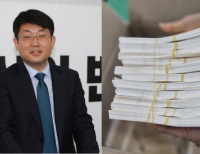
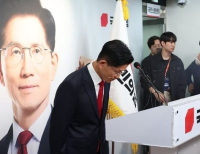
People Power Party lawmaker Cho Jung-hoon is continuing unlimited debate on the comprehensive amendment bill for the Referendum Act (alternative bill) at the plenary session of the National Assembly on the 1st. 2026.3.1 [Photo=Yonhap News]
The National Assembly has collectively passed the so-called ‘Law Distortion Crime Act (amendment to the Criminal Act)’, the ‘Trial Petition Act (amendment to the Constitutional Court Act)’, and the ‘Chief Justice Increase Act (amendment to the Court Organization Act)’ without a bipartisan agreement.
While each is an amendment to an individual law, they form a legislative package that affects the entire judicial structure when operating simultaneously.
The core of this legislation lies in its simultaneous adjustment of the standards, pathways, and composition of the judiciary.
Criminal Control over Judgments, the ‘Law Distortion Crime Act’
The amendment to the Criminal Act stipulates that judges can be criminally punished if they distort legal principles in their rulings. The intention is to strengthen judicial accountability.
However, judgments are inherently an area of legal interpretation. Interpretations can differ on the same matter, and cases are not infrequently overturned by higher courts.
The structure of imposing criminal responsibility by retroactively judging differences in interpretation as “distortion” places the act of judgment itself within the realm of potential punishment.
Judicial control is already exercised through institutional mechanisms such as appeals and final appeals.
Control through criminal penalties should be a last resort. If the boundaries are unclear, this could lead not to strengthened accountability but to the inhibition of judgments. This affects the standards for judicial decisions.
Change in the Final Adjudication Structure, the ‘Trial Petition Act’
The amendment to the Constitutional Court Act expands and refines the system to allow for the filing of trial petitions with the Constitutional Court regarding judgments made by general courts.
This measure has the effect of duplicating the final adjudication structure of the judicial system. Previously, Supreme Court rulings functioned as the final judgment, but with the expansion of the trial petition system, the Constitutional Court would operate as another de facto final decision-making body.
The Constitutional Court is an institution formed through a political appointment process. As the authority for final decisions expands, it is possible that judicial decisions could become more closely intertwined with political debates.
This is a change that alters the pathway of adjudication.
Reorganization of Interpretive Power, the ‘Chief Justice Increase Act’
The amendment to the Court Organization Act significantly increases the number of Supreme Court justices.
The Supreme Court is not merely an institution that processes cases; it is an institution that shapes the direction of the national legal order through precedent.
With this amendment, the number of Supreme Court justices who can be appointed during the current president's term reaches a total of 22. When the increase and existing replacement personnel are combined, the structure allows for a significant portion of the Supreme Court's composition to be filled by a single administration.
This means that the landscape of judicial interpretation can change in a short period.
While resolving case backlog has been presented as the justification, many point out that the bottleneck causing trial delays primarily lies in the first and second instance lower courts.
The prioritization of expanding the upper echelons over strengthening the lower structure is a factor that amplifies political ripple effects, separate from policy effectiveness. This is a change that alters the composition of the judiciary itself.
Simultaneous Shift of the Three Pillars
The ‘Law Distortion Crime Act’ has added the possibility of criminal penalties to the standards for judgments, the ‘Trial Petition Act’ has expanded the pathway for final decisions, and the ‘Chief Justice Increase Act’ has reorganized the composition of interpretive power.
The standards, pathways, and composition have all shifted simultaneously.
This is why it is evaluated as legislation that does not merely amend a single law but simultaneously adjusts key pillars of the separation of powers structure.
Another point of contention is the procedure. While the judiciary requested public discussion and social consensus, the bills were passed without bipartisan agreement.
Given that reforms to the judicial structure have traditionally been predicated on cross-party consensus, this approach is likely to set a precedent.
The Guise of Legality and Historical Precedents
In modern times, the concentration of power often proceeds through legal procedures.
Venezuela, often cited as a prime example, also systematically altered its judicial structure through elections and legislation. The number of Supreme Court justices was increased, the structure of constitutional interpretation was adjusted, and control mechanisms over the judiciary were strengthened.
All processes were formally legal.
However, as the checks and balances weakened, the institutional mechanisms for correcting policy errors collapsed, and ultimately, a resource-rich nation with the world's largest oil reserves experienced a severe economic crisis and institutional collapse.
The key was not the seizure of power but the weakening of the checks and balances.
Democracy Rests on Restraint
The judiciary is the last safeguard for controlling power.
Legislation that simultaneously alters the standards, pathways, and composition of that safeguard is difficult to view as mere institutional improvement.
Legality is the starting point of democracy, but it is not the entirety of it.
It is the restraint of the majority, not the power of the majority, that sustains democracy.
The passage of these three judicial bills signifies a shift in the power structure, not just a simple amendment of laws.
The extent of that shift will depend on the attitudes of politics and the judiciary going forward.
The door opened quietly.
Whether to close it or widen it further is now a matter of choice.

 [Statement by the Seo-beo-kka Korea Military Academy Save-the-Nation Comrades Association] ㉛ Recount the Votes Publicly, as the Previous Recount Concealed Election Fraud
Tongyeong Mayoral Election Recount [Photo=Yonhap News]South Korea's liberal democracy is dying. The National Election Commission (NEC) and the judiciary, which have plummeted into criminal syndicates
[Statement by the Seo-beo-kka Korea Military Academy Save-the-Nation Comrades Association] ㉛ Recount the Votes Publicly, as the Previous Recount Concealed Election Fraud
Tongyeong Mayoral Election Recount [Photo=Yonhap News]South Korea's liberal democracy is dying. The National Election Commission (NEC) and the judiciary, which have plummeted into criminal syndicates
 What is the significance of the "Trump 2028" red hats that keep making a comeback?
It is noteworthy that President Donald Trump is "intentionally" fueling controversy over whether he can actually run in the 2028 presidential election, even though it is "highly likely he is seriously
What is the significance of the "Trump 2028" red hats that keep making a comeback?
It is noteworthy that President Donald Trump is "intentionally" fueling controversy over whether he can actually run in the 2028 presidential election, even though it is "highly likely he is seriously
 Jin Cummings: "North Korea says it will increase the number of spies, so what is the government doing?"
U.S. political columnist Gene Cummings has publicly questioned the South Korean government, asking, "North Korea is announcing plans to increase its number of spies, yet what is the South Korean
Jin Cummings: "North Korea says it will increase the number of spies, so what is the government doing?"
U.S. political columnist Gene Cummings has publicly questioned the South Korean government, asking, "North Korea is announcing plans to increase its number of spies, yet what is the South Korean
 Attorney Do Tae-woo: “Discrepancies in Voter Count and Improper Sealing Confirmed in Tongyeong Mayoral Recount… Official Request for Further Verification Filed with Gyeongnam Election Commission”
A bundle of out-of-district early voting ballots photographed by attorney Do Tae-woo at the Tongyeong mayoral election recount site. A clear, solid line visible on the side of the ballots raises suspi
Attorney Do Tae-woo: “Discrepancies in Voter Count and Improper Sealing Confirmed in Tongyeong Mayoral Recount… Official Request for Further Verification Filed with Gyeongnam Election Commission”
A bundle of out-of-district early voting ballots photographed by attorney Do Tae-woo at the Tongyeong mayoral election recount site. A clear, solid line visible on the side of the ballots raises suspi
 Stock Market Crash 'Black Tuesday'… KOSPI down 10.8%, KOSDAQ down 7.7%
The KOSPI fell by more than 5% in early trading on the 28th, triggering a sell-side sidecar.On the 28th, the KOSPI plunged by more than 10%.Due to the sharp decline, a sell-side sidecar—a temporary
Stock Market Crash 'Black Tuesday'… KOSPI down 10.8%, KOSDAQ down 7.7%
The KOSPI fell by more than 5% in early trading on the 28th, triggering a sell-side sidecar.On the 28th, the KOSPI plunged by more than 10%.Due to the sharp decline, a sell-side sidecar—a temporary
 [World Heritage Committee] 25 New World Heritage Sites Inscribed in Busan… South Korea Successfully Expands 'Getbol' Listing
The Chairperson of the World Heritage Committee speaks at the plenary session of the 48th session of the World Heritage Committee, held at BEXCO in Busan on the 20th. [Photo: Yonhap News]A total of 25
[World Heritage Committee] 25 New World Heritage Sites Inscribed in Busan… South Korea Successfully Expands 'Getbol' Listing
The Chairperson of the World Heritage Committee speaks at the plenary session of the 48th session of the World Heritage Committee, held at BEXCO in Busan on the 20th. [Photo: Yonhap News]A total of 25
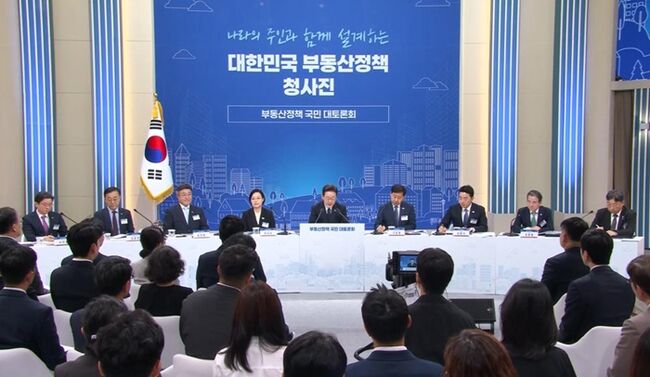 [Liberal Democratic Party Statement] Calling it a Grand Real Estate Debate… It Was Nothing More Than a Private Party Among Themselves
The 'National Grand Debate on Real Estate Policy' held on July 23rd and 27th. [Photo=Yonhap News]The 'National Grand Debate on Real Estate Policy,' hosted by the Lee Jae-myung administration under the
[Liberal Democratic Party Statement] Calling it a Grand Real Estate Debate… It Was Nothing More Than a Private Party Among Themselves
The 'National Grand Debate on Real Estate Policy' held on July 23rd and 27th. [Photo=Yonhap News]The 'National Grand Debate on Real Estate Policy,' hosted by the Lee Jae-myung administration under the
 [Photo] Evidence of Election Fraud Flooding U.S. Media… Trump Had 2.7 Million Votes Stolen
 [Video] U.S. Semiquincentennial Air Show... 'Art in the Sky' streaks across New York
 [Editorial Cartoon] A Draconian Law That Undermines Freedom of Expression

 List
List