On November 1, students participating in a nationwide rally to crush labor repression, stop the dispatch of troops to Iraq, and condemn the Roh Moo-hyun administration demand an end to troop deployment and labor oppression, among other things, at the Seoul Station Plaza. 2003.11.01 [Photo=Yonhap News]
There is a recurring question in South Korean politics these days.
“Why hasn’t the administration's approval rating wavered despite the difficult economy?”
The exchange rate is approaching 1,500 won to the dollar, and volatility in the financial markets has increased. Analyses suggest that corporate investment sentiment is also shrinking. However, the political landscape remains largely stable.
Where does this discrepancy, where economic instability and political stability coexist, come from?
From a political perspective, this phenomenon is not unfamiliar.
When the economic situation deteriorates, if the political sphere deflects responsibility to external factors, the support base tends to rally even more. This is a structure where economic instability does not immediately translate into political accountability.
It can be seen that South Korean politics is currently in a phase that reflects this to some extent.
However, this structure has a weakness: external shocks.
External variables can instantly dismantle a political frame. And one of the external variables that is now emerging before South Korean politics is the issue of troop deployment.
Amidst its conflict with Iran, the United States has begun demanding military participation from its allies, citing the need to secure the safety of the Strait of Hormuz.
U.S. President Donald Trump has already publicly mentioned the necessity for key oil-importing nations, including South Korea, to dispatch warships to protect maritime routes. The South Korean government has also indicated a willingness to discuss the matter, leaving the possibility open.
This issue is not a simple diplomatic matter. In South Korean politics, overseas troop deployment has always been a political variable that has created rifts within factions.
The Roh Moo-hyun administration's decision to deploy troops to Iraq in 2003 is a prime example. The conflict at the time was not a confrontation between conservatives and progressives, but rather exploded more intensely within the progressive camp.
While the government decided to deploy troops citing the ROK-U.S. alliance, civic groups and intellectual circles strongly opposed it. This was a collision between "realpolitik" and "anti-war principles" within the progressive camp.
A similar structure is likely to emerge in the current situation.
From the government's perspective, it is difficult to ignore the U.S. request, considering the ROK-U.S. alliance and energy security. The Strait of Hormuz is a crucial route for South Korea's oil imports.
However, from a political standpoint, a decision to deploy troops is likely to trigger a rift within the left-wing camp. This is because anti-war movements, civic groups, and some progressive intellectuals could strongly object to intervention in the war itself.
The more critical issue is that this matter cannot be postponed indefinitely.
In a state of war, military operations do not adhere to political schedules. Once an operation begins, allies must quickly decide whether to participate. It is difficult to maintain a "under review" status for months.
Ultimately, the government will have to make a choice at some point. Will it participate, or will it refuse?
Either way, the political repercussions will be significant.
If they participate, an anti-war debate could erupt within the left-wing camp. Conversely, if they refuse, issues related to the ROK-U.S. alliance and security debates are likely to be raised simultaneously.
The issue of troop deployment is a high-explosive political issue intertwined with ideology, diplomacy, and security.
Perhaps the real variable in South Korean politics right now is not the exchange rate.
The exchange rate shakes the economy, but war shakes politics. And war shakes the political landscape much faster than the economy.
The biggest variable that could erupt in South Korean politics in March may not be the financial markets, but the decision on troop deployment.
The exchange rate shakes markets, but troop deployment shakes factions.

 [Statement by the Seo-beo-kka Korea Military Academy Save-the-Nation Comrades Association] ㉛ Recount the Votes Publicly, as the Previous Recount Concealed Election Fraud
Tongyeong Mayoral Election Recount [Photo=Yonhap News]South Korea's liberal democracy is dying. The National Election Commission (NEC) and the judiciary, which have plummeted into criminal syndicates
[Statement by the Seo-beo-kka Korea Military Academy Save-the-Nation Comrades Association] ㉛ Recount the Votes Publicly, as the Previous Recount Concealed Election Fraud
Tongyeong Mayoral Election Recount [Photo=Yonhap News]South Korea's liberal democracy is dying. The National Election Commission (NEC) and the judiciary, which have plummeted into criminal syndicates
 What is the significance of the "Trump 2028" red hats that keep making a comeback?
It is noteworthy that President Donald Trump is "intentionally" fueling controversy over whether he can actually run in the 2028 presidential election, even though it is "highly likely he is seriously
What is the significance of the "Trump 2028" red hats that keep making a comeback?
It is noteworthy that President Donald Trump is "intentionally" fueling controversy over whether he can actually run in the 2028 presidential election, even though it is "highly likely he is seriously
 Jin Cummings: "North Korea says it will increase the number of spies, so what is the government doing?"
U.S. political columnist Gene Cummings has publicly questioned the South Korean government, asking, "North Korea is announcing plans to increase its number of spies, yet what is the South Korean
Jin Cummings: "North Korea says it will increase the number of spies, so what is the government doing?"
U.S. political columnist Gene Cummings has publicly questioned the South Korean government, asking, "North Korea is announcing plans to increase its number of spies, yet what is the South Korean
 Attorney Do Tae-woo: “Discrepancies in Voter Count and Improper Sealing Confirmed in Tongyeong Mayoral Recount… Official Request for Additional Verification Submitted to Gyeongnam Election Commission”
A bundle of mail-in early voting ballots captured by lawyer Do Tae-woo at the Tongyeong mayoral election recount site. A clear solid line, raising suspicions of election fraud, is visible on the side
Attorney Do Tae-woo: “Discrepancies in Voter Count and Improper Sealing Confirmed in Tongyeong Mayoral Recount… Official Request for Additional Verification Submitted to Gyeongnam Election Commission”
A bundle of mail-in early voting ballots captured by lawyer Do Tae-woo at the Tongyeong mayoral election recount site. A clear solid line, raising suspicions of election fraud, is visible on the side
 Stock Market Crash 'Black Tuesday'… KOSPI down 10.8%, KOSDAQ down 7.7%
The KOSPI fell by more than 5% in early trading on the 28th, triggering a sell-side sidecar.On the 28th, the KOSPI plunged by more than 10%.Due to the sharp decline, a sell-side sidecar—a temporary
Stock Market Crash 'Black Tuesday'… KOSPI down 10.8%, KOSDAQ down 7.7%
The KOSPI fell by more than 5% in early trading on the 28th, triggering a sell-side sidecar.On the 28th, the KOSPI plunged by more than 10%.Due to the sharp decline, a sell-side sidecar—a temporary
 [World Heritage Committee] 25 New World Heritage Sites Inscribed in Busan… South Korea Successfully Expands 'Getbol' Listing
The Chairperson of the World Heritage Committee speaks at the plenary session of the 48th session of the World Heritage Committee, held at BEXCO in Busan on the 20th. [Photo: Yonhap News]A total of 25
[World Heritage Committee] 25 New World Heritage Sites Inscribed in Busan… South Korea Successfully Expands 'Getbol' Listing
The Chairperson of the World Heritage Committee speaks at the plenary session of the 48th session of the World Heritage Committee, held at BEXCO in Busan on the 20th. [Photo: Yonhap News]A total of 25
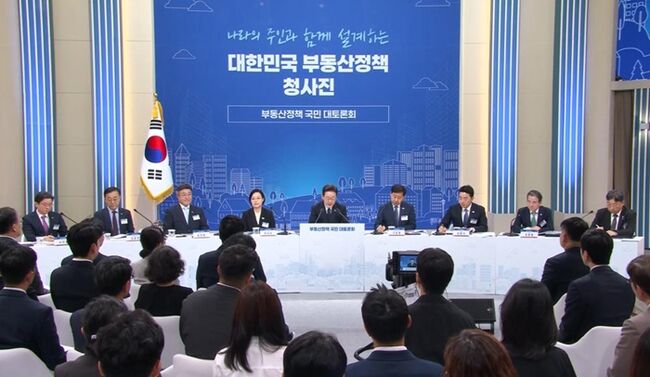 [Liberal Democratic Party Statement] Calling it a Grand Real Estate Debate… It Was Nothing More Than a Private Party Among Themselves
The 'National Grand Debate on Real Estate Policy' held on July 23rd and 27th. [Photo=Yonhap News]The 'National Grand Debate on Real Estate Policy,' hosted by the Lee Jae-myung administration under the
[Liberal Democratic Party Statement] Calling it a Grand Real Estate Debate… It Was Nothing More Than a Private Party Among Themselves
The 'National Grand Debate on Real Estate Policy' held on July 23rd and 27th. [Photo=Yonhap News]The 'National Grand Debate on Real Estate Policy,' hosted by the Lee Jae-myung administration under the
 [Photo] Evidence of Election Fraud Flooding U.S. Media… Trump Had 2.7 Million Votes Stolen
 [Video] U.S. Semiquincentennial Air Show... 'Art in the Sky' streaks across New York
 [Editorial Cartoon] A Draconian Law That Undermines Freedom of Expression

 List
List