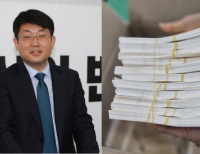
U.S. President Donald Trump responded to the significant gift offered by Iran during a press conference on the 24th (local time), stating it was "related to the passage through the (Hormuz) Strait." [Photo=Yonhap News]
The Middle East conflict is entering a new phase. As the United States proposes a "one-month ceasefire followed by negotiations" by presenting Iran with 15 conditions for peace, the international community simultaneously expresses both hope and doubt about whether peace can come to the Strait of Hormuz.
However, the premise of this question may be flawed from the outset.
This is because the Strait of Hormuz is not a space that operates on the premise of peace, but rather a strategic chokepoint governed by a structure of tension management.
The Strait of Hormuz is a critical artery for global energy flow. Approximately 20% of the world's crude oil and over 20% of LNG trade pass through this narrow strait.
It is not merely a logistical route but a concentrated space of energy, military, and diplomatic interests. Clashes here immediately ripple into international oil prices, financial markets, and the security strategies of nations.
Therefore, peace in this strait is less a matter of diplomatic achievement and more about who can control the tension, and to what extent.
The proposed one-month ceasefire should also be interpreted in this context.
While it appears on the surface to be a measure for ceasing hostilities and initiating negotiations, it is more akin to a "means of securing time" to regulate the temperature of the battlefield rather than a mechanism to end the war.
The United States is in a position where it must maintain freedom of navigation through the Strait of Hormuz.
This is because it is directly linked to the stability of the global energy market. Conversely, Iran has used the strait as a strategic lever. Simply raising tensions can shake oil prices, which in turn translates into negotiation leverage.
Israel's calculations are also added to this.
Israel perceives Iran's nuclear and missile capabilities as an "existential threat" and views the delay itself as a risk. This is why they wish to maintain military options if negotiations are prolonged or conditions are eased.
Ultimately, the structure surrounding Hormuz can be summarized as a conflict of three interests.
The United States must ensure passage, Iran must maintain control, and Israel seeks to eliminate the threat. A "state of peace" where these three pillars are simultaneously satisfied is structurally difficult to achieve.
For this reason, the current ceasefire proposal is more realistically viewed as a "device to extend the intervals of conflict" rather than a "start of peace."
The Core Structure of the U.S.'s '15-Point Proposal for Iran'
— Exchange of Nuclear Disarmament, Missile Restrictions, and Sanctions Relief
The 15 points proposed by the United States are largely structured as an exchange between "abandoning nuclear and military capabilities" and "sanctions relief." Iran is demanded to: ▲ dismantle its nuclear capabilities ▲ pledge to abandon nuclear weapons ▲ completely prohibit uranium enrichment ▲ transfer 450 kg of 60% enriched uranium to the International Atomic Energy Agency (IAEA) ▲ dismantle nuclear facilities in Natanz, Isfahan, and Fordow ▲ allow full IAEA inspections ▲ limit the range and scale of ballistic missiles ▲ cease support for regional proxies ▲ guarantee free passage through the Strait of Hormuz.
In return, the United States is reportedly offering: ▲ complete lifting of sanctions against Iran ▲ support for civilian nuclear programs ▲ abolition of automatic sanctions snapback clauses in case of agreement violations.
This negotiation proposal extends beyond the nuclear issue to encompass military and diplomatic aspects comprehensively, and is assessed as essentially reshaping Iran's strategic assets. |
The demands included in the 15 points comprehensively restrict Iran's nuclear program, missile capabilities, and regional influence. This is akin to reshaping Iran's strategic assets, rather than simply alleviating conflict.
This is why it is assessed that Iran is unlikely to fully accept these terms. Instead, Iran is likely to use the framework of a ceasefire to enter negotiations while seeking to buy time to preserve its core assets.
In this scenario, the one-month ceasefire will function not as an end to the war, but as a "strategic adjustment of breath" to prepare for the next phase.
The problem is that this interval can lead to renewed conflict at any moment.
If negotiations fail, or if Iran maintains its existing stance on the nuclear issue, airstrikes by the United States and Israel could resume at any time. Given that Israel views delays as a risk, the possibility of independent military action cannot be ruled out.
In such a structure, the longer the ceasefire lasts, the less it brings peace and paradoxically creates conditions for the next conflict.
Ultimately, the question needs to be rephrased.
It is not whether peace can come to Hormuz, but how stably the tension in this strait can be managed.
Even if this ceasefire is achieved, it is highly likely to be a device to buy time until the next conflict, rather than the arrival of peace.
Hormuz is not a space for creating peace.
It is a place where tension exists as a constant, and where the global order is shaken depending on who controls that tension and how.
In that sense, this one month is closer to a time to prepare for the next choice than a time of peace.

 [Statement by the Seo-beo-kka Korea Military Academy Save-the-Nation Comrades Association] ㉛ Recount the Votes Publicly, as the Previous Recount Concealed Election Fraud
Tongyeong Mayoral Election Recount [Photo=Yonhap News]South Korea's liberal democracy is dying. The National Election Commission (NEC) and the judiciary, which have plummeted into criminal syndicates
[Statement by the Seo-beo-kka Korea Military Academy Save-the-Nation Comrades Association] ㉛ Recount the Votes Publicly, as the Previous Recount Concealed Election Fraud
Tongyeong Mayoral Election Recount [Photo=Yonhap News]South Korea's liberal democracy is dying. The National Election Commission (NEC) and the judiciary, which have plummeted into criminal syndicates
 What is the significance of the "Trump 2028" red hats that keep making a comeback?
It is noteworthy that President Donald Trump is "intentionally" fueling controversy over whether he can actually run in the 2028 presidential election, even though it is "highly likely he is seriously
What is the significance of the "Trump 2028" red hats that keep making a comeback?
It is noteworthy that President Donald Trump is "intentionally" fueling controversy over whether he can actually run in the 2028 presidential election, even though it is "highly likely he is seriously
 Jin Cummings: “North Korea says it will increase the number of spies, so what is the government doing?”
U.S. political columnist Gene Cummings has publicly questioned the South Korean government, asking, "North Korea is declaring that it will increase its number of spies, so what is the South Kore
Jin Cummings: “North Korea says it will increase the number of spies, so what is the government doing?”
U.S. political columnist Gene Cummings has publicly questioned the South Korean government, asking, "North Korea is declaring that it will increase its number of spies, so what is the South Kore
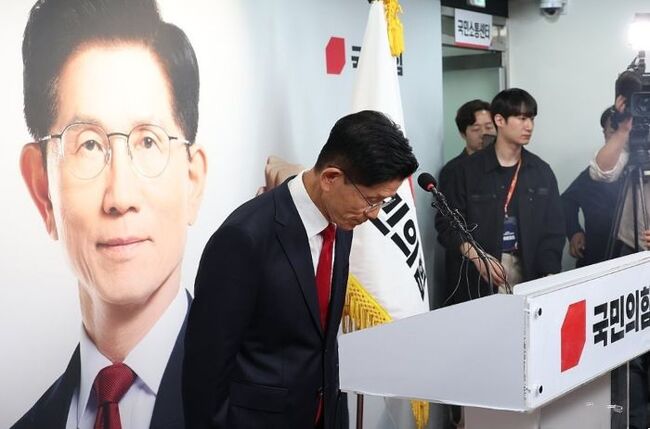 “Too little, too late?…” Kim Moon-soo, who previously conceded his presidential election defeat, now demands a special counsel investigation into ‘allegations of election fraud in the 2025 presidential election’
People Power Party presidential candidate Kim Moon-soo concedes defeat during a press conference at the party headquarters in Yeouido, Seoul, on June 4, 2025. [Joint Press Corps]As allegations emerge
“Too little, too late?…” Kim Moon-soo, who previously conceded his presidential election defeat, now demands a special counsel investigation into ‘allegations of election fraud in the 2025 presidential election’
People Power Party presidential candidate Kim Moon-soo concedes defeat during a press conference at the party headquarters in Yeouido, Seoul, on June 4, 2025. [Joint Press Corps]As allegations emerge
 Stock Market Crash 'Black Tuesday'… KOSPI down 10.8%, KOSDAQ down 7.7%
The KOSPI fell by more than 5% in early trading on the 28th, triggering a sell-side sidecar.On the 28th, the KOSPI plunged by more than 10%.Due to the sharp decline, a sell-side sidecar—a temporary
Stock Market Crash 'Black Tuesday'… KOSPI down 10.8%, KOSDAQ down 7.7%
The KOSPI fell by more than 5% in early trading on the 28th, triggering a sell-side sidecar.On the 28th, the KOSPI plunged by more than 10%.Due to the sharp decline, a sell-side sidecar—a temporary
 [World Heritage Committee] 25 New World Heritage Sites Inscribed in Busan… South Korea Successfully Expands 'Getbol' Listing
The Chairperson of the World Heritage Committee speaks at the plenary session of the 48th session of the World Heritage Committee, held at BEXCO in Busan on the 20th. [Photo: Yonhap News]A total of 25
[World Heritage Committee] 25 New World Heritage Sites Inscribed in Busan… South Korea Successfully Expands 'Getbol' Listing
The Chairperson of the World Heritage Committee speaks at the plenary session of the 48th session of the World Heritage Committee, held at BEXCO in Busan on the 20th. [Photo: Yonhap News]A total of 25
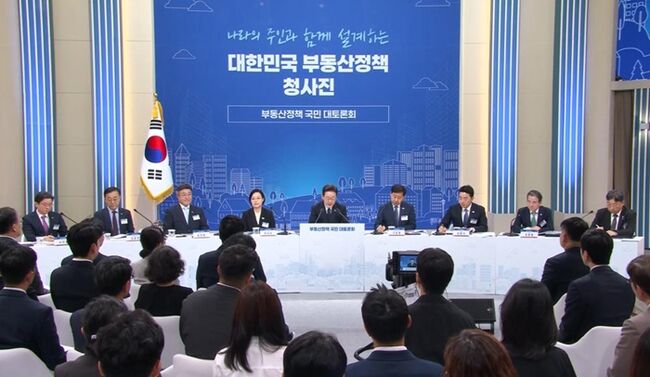 [Liberal Democratic Party Statement] Calling it a Grand Real Estate Debate… It Was Nothing More Than a Private Party Among Themselves
The 'National Grand Debate on Real Estate Policy' held on July 23rd and 27th. [Photo=Yonhap News]The 'National Grand Debate on Real Estate Policy,' hosted by the Lee Jae-myung administration under the
[Liberal Democratic Party Statement] Calling it a Grand Real Estate Debate… It Was Nothing More Than a Private Party Among Themselves
The 'National Grand Debate on Real Estate Policy' held on July 23rd and 27th. [Photo=Yonhap News]The 'National Grand Debate on Real Estate Policy,' hosted by the Lee Jae-myung administration under the
 [Photo] Evidence of Election Fraud Flooding U.S. Media… Trump Had 2.7 Million Votes Stolen
 [Video] U.S. Semiquincentennial Air Show... 'Art in the Sky' streaks across New York
 [Editorial Cartoon] A Draconian Law That Undermines Freedom of Expression

 List
List