President Lee Jae-myung delivers a commemorative address on the day of the West Sea Defense on March 27 at the National Daejeon Memorial Cemetery. [Photo=Yonhap News]
What a president must say at a national memorial ceremony is not beautiful words, but accurate words.
It is the dignity of a president to clearly state who provoked, who was sacrificed, what the nation remembers, and how it will respond.
However, it is difficult to say that President Lee Jae-myung's commemorative address at the 11th Day of the West Sea Defense ceremony held at the National Daejeon Memorial Cemetery on March 27, 2026, met this standard.
The theme of this year's ceremony was "Our West Sea, Towards Peace and Prosperity." Even before the event, this phrase raised questions as to whether it prioritized a message of peace over the original purpose of remembrance.
In his commemorative address on this day, President Lee Jae-myung expressed his respect and remembrance for the heroes of the West Sea Defense and pledged to honor the bereaved families and participating soldiers.
However, the sentence that was more strongly highlighted was, "Peace is food, peace is the people's livelihood, and peace is the best security." He also said, "It is important to fight and win. It is even more important to win without fighting. But more important than that is peace, where there is no need to fight."
There is no problem with the president speaking of peace itself. The problem lies in the context in which those words were placed.
The Day of the West Sea Defense is not a place to sing about abstract peace, but a place for the nation to remember the sacrifices of soldiers who died in North Korean provocations.
There is a bigger problem.
This commemorative address lacked an apology for his past remarks regarding the Cheonan sinking.
During the Lee Kyung-jae controversy in 2023, President Lee Jae-myung stated, "The government's announcement about the Cheonan incident is an official announcement, and I trust that announcement."
On the Day of the West Sea Defense in 2025, he also said, "We remember the heroes who defended the West Sea against North Korea's surprise attacks and provocations." The expression was different from before.
However, in this commemorative address, there was no part where he directly addressed or apologized for his past controversies regarding the Cheonan sinking, nor did he express regret or apology to the bereaved families and soldiers. There was remembrance, but no apology.
In this regard, this commemorative address resembles the attitude shown at the commemorative event for the birthday of the founding president Syngman Rhee.
It is a method of adopting current symbolic actions without addressing past aggressive language and negative evaluations.
It is about borrowing symbols that fit current political needs without taking responsibility for past remarks. While he attended, there was no resolution; he showed respect, but no apology. This approach is closer to managing symbols than to a shift in perception.
Furthermore, the reality of West Sea security is not so leisurely as to accept the president's rhetoric of peace so lightly.
In recent years, North Korea has repeatedly carried out artillery shelling and various military provocations in the West Sea area. The premise for tension management has also been significantly shaken after the suspension of the inter-Korean military agreement. Not long ago, North Korea's Kim Jong Un called us the primary enemy.
In this situation, the language first needed in the president's speech on the Day of the West Sea Defense is not the moral statement "peace is the best security."
It is a statement from the nation that clearly assigns responsibility for provocation and confirms the will for deterrence and retaliation. Peace can be a goal, but it cannot be a premise. Peace in the West Sea is not maintained by prayer, but only on the basis of deterrence.
This is where the term "flattering words and deceitful appearance" comes from.
There were many pleasant-sounding words. The words about transforming the sea of conflict into a land of peace and prosperity, and that peace where there is no need to fight is more important, are difficult to find fault with on the surface.
However, at the scene of tragedy that the nation must remember, those words were too smooth and too safe. Instead of clearly engraving the subject of provocation and clarifying the nation's anger and responsibility in the face of sacrifice, the speech was filled with words that anyone could applaud.
This is closer to political evasion than to dignity.
A president's dignity does not come from soft expressions. It comes from not avoiding uncomfortable truths. This is especially true at national memorial ceremonies like the Day of the West Sea Defense.
What is needed in the face of the memories of the Cheonan and Yeonpyeong incidents is not flowery language. It is to clearly state who attacked, what was sacrificed, and what posture the nation will adopt to ensure that sacrifice is never repeated.
Peace must come after that. If the order is reversed, peace becomes rhetoric, not value.
Therefore, we cannot help but ask.
Was President Lee Jae-myung's commemorative address today truly a speech for the heroes of the West Sea Defense? Or was it political rhetoric to polish his image against the backdrop of their sacrifice?
Dignity is not proven by the total amount of good words spoken.
Dignity is proven by never avoiding the words that must be taken responsibility for.
What remained in this commemorative address was the formality of remembrance.
However, apology, responsibility, and the language of reality—the core elements that build the dignity of a national leader—were ultimately left as empty spaces.

 [Statement by the Seo-beo-kka Korea Military Academy Save-the-Nation Comrades Association] ㉛ Recount the Votes Publicly, as the Previous Recount Concealed Election Fraud
Tongyeong Mayoral Election Recount [Photo=Yonhap News]South Korea's liberal democracy is dying. The National Election Commission (NEC) and the judiciary, which have plummeted into criminal syndicates
[Statement by the Seo-beo-kka Korea Military Academy Save-the-Nation Comrades Association] ㉛ Recount the Votes Publicly, as the Previous Recount Concealed Election Fraud
Tongyeong Mayoral Election Recount [Photo=Yonhap News]South Korea's liberal democracy is dying. The National Election Commission (NEC) and the judiciary, which have plummeted into criminal syndicates
 What is the significance of the "Trump 2028" red hats that keep making a comeback?
It is noteworthy that President Donald Trump is "intentionally" fueling controversy over whether he can actually run in the 2028 presidential election, even though it is "highly likely he is seriously
What is the significance of the "Trump 2028" red hats that keep making a comeback?
It is noteworthy that President Donald Trump is "intentionally" fueling controversy over whether he can actually run in the 2028 presidential election, even though it is "highly likely he is seriously
 Jin Cummings: “North Korea says it will increase the number of spies, so what is the government doing?”
U.S. political columnist Gene Cummings has publicly questioned the South Korean government, asking, "North Korea is declaring that it will increase its number of spies, so what is the South Kore
Jin Cummings: “North Korea says it will increase the number of spies, so what is the government doing?”
U.S. political columnist Gene Cummings has publicly questioned the South Korean government, asking, "North Korea is declaring that it will increase its number of spies, so what is the South Kore
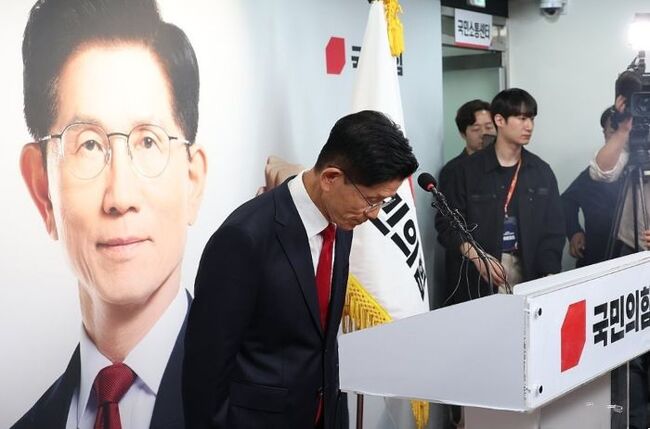 “Too little, too late?…” Kim Moon-soo, who previously conceded his presidential election defeat, now demands a special counsel investigation into ‘allegations of election fraud in the 2025 presidential election’
People Power Party presidential candidate Kim Moon-soo concedes defeat during a press conference at the party headquarters in Yeouido, Seoul, on June 4, 2025. [Joint Press Corps]As allegations emerge
“Too little, too late?…” Kim Moon-soo, who previously conceded his presidential election defeat, now demands a special counsel investigation into ‘allegations of election fraud in the 2025 presidential election’
People Power Party presidential candidate Kim Moon-soo concedes defeat during a press conference at the party headquarters in Yeouido, Seoul, on June 4, 2025. [Joint Press Corps]As allegations emerge
 Stock Market Crash 'Black Tuesday'… KOSPI down 10.8%, KOSDAQ down 7.7%
The KOSPI fell by more than 5% in early trading on the 28th, triggering a sell-side sidecar.On the 28th, the KOSPI plunged by more than 10%.Due to the sharp decline, a sell-side sidecar—a temporary
Stock Market Crash 'Black Tuesday'… KOSPI down 10.8%, KOSDAQ down 7.7%
The KOSPI fell by more than 5% in early trading on the 28th, triggering a sell-side sidecar.On the 28th, the KOSPI plunged by more than 10%.Due to the sharp decline, a sell-side sidecar—a temporary
 [World Heritage Committee] 25 New World Heritage Sites Inscribed in Busan… South Korea Successfully Expands 'Getbol' Listing
The Chairperson of the World Heritage Committee speaks at the plenary session of the 48th session of the World Heritage Committee, held at BEXCO in Busan on the 20th. [Photo: Yonhap News]A total of 25
[World Heritage Committee] 25 New World Heritage Sites Inscribed in Busan… South Korea Successfully Expands 'Getbol' Listing
The Chairperson of the World Heritage Committee speaks at the plenary session of the 48th session of the World Heritage Committee, held at BEXCO in Busan on the 20th. [Photo: Yonhap News]A total of 25
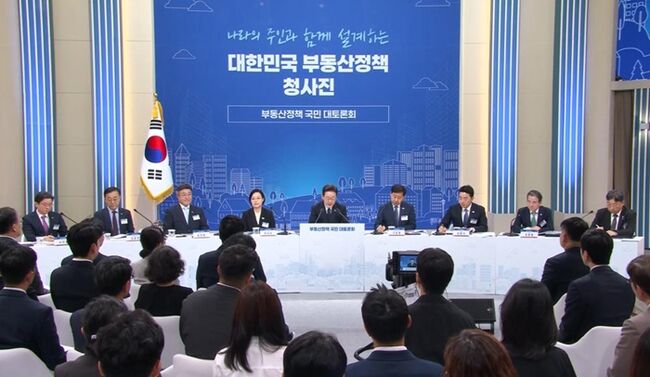 [Liberal Democratic Party Statement] Calling it a Grand Real Estate Debate… It Was Nothing More Than a Private Party Among Themselves
The 'National Grand Debate on Real Estate Policy' held on July 23rd and 27th. [Photo=Yonhap News]The 'National Grand Debate on Real Estate Policy,' hosted by the Lee Jae-myung administration under the
[Liberal Democratic Party Statement] Calling it a Grand Real Estate Debate… It Was Nothing More Than a Private Party Among Themselves
The 'National Grand Debate on Real Estate Policy' held on July 23rd and 27th. [Photo=Yonhap News]The 'National Grand Debate on Real Estate Policy,' hosted by the Lee Jae-myung administration under the
 [Photo] Evidence of Election Fraud Flooding U.S. Media… Trump Had 2.7 Million Votes Stolen
 [Video] U.S. Semiquincentennial Air Show... 'Art in the Sky' streaks across New York
 [Editorial Cartoon] A Draconian Law That Undermines Freedom of Expression

 List
List