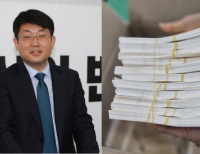
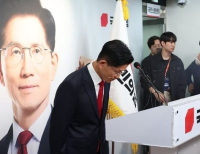
Hwang Kyo-ahn, leader of the Liberty and Innovation Party, delivers a speech on the main stage of the Conservative Political Action Conference (CPAC) annual general meeting in Texas, USA, on the morning of the 27th (local time). [Capture from Hwang Kyo-ahn TV]
Hwang Kyo-ahn, leader of the Liberty and Innovation Party, took the stage at CPAC USA 2026 (Conservative Political Action Conference) held in Grapevine, Texas, from March 25-28.
At the event, Hwang publicly called for a resolution to release former President Yoon Suk-yeol, an investigation into South Korea's election system, and U.S.-South Korea cooperation on suspicions of Chinese interference in South Korean elections.
This scene should not be reduced to a mere statement at an overseas political event. The fact that the crisis of distrust in elections and the order of liberal democracy in South Korea was brought onto the public stage of the American conservative movement carries political significance in itself.
A resolution from the same event also directly mentioned South Korea, raising issues of disinformation, economic coercion, abuse of judicial power, and the removal of leaders through politicized legal procedures.
The questions posed by Hwang and the issues highlighted by CPAC view South Korea's election fraud allegations and the erosion of the rule of law as the same threat. The wording may differ, but the essence is the same. Whether his demands were officially adopted as resolutions word for word is not the fundamental point.
What is important is the fact that the allegations of election fraud in South Korea, the issue of Chinese interference, and the erosion of the rule of law have entered the consciousness of the American conservative movement.
What deserves more attention is the change in the security paradigm of the South Korea-U.S. alliance.
The joint statement from the 2024 November South Korea-U.S. Foreign and Defense Ministers' Meeting officially confirmed that cyberattacks could constitute an armed attack under Article 3 of the Mutual Defense Treaty between the Republic of Korea and the United States under certain circumstances. While the wording of the treaty was not altered, it was a declaration that the alliance would no longer limit threats to just guns, cannons, and missiles.
This signifies that cyber intrusions, information warfare, and systemic disruption have now been incorporated into the security discourse of the South Korea-U.S. alliance. Therefore, the demand for the U.S. and South Korea to jointly investigate election issues where Chinese interference is suspected is not an overreach. It is an argument to utilize an already open institutional channel.
What makes this demand even more significant is the memory of the December 3rd martial law.
Then-President Yoon Suk-yeol has consistently cited the National Election Commission's verification process and allegations of election fraud as the core logic for sending troops to the National Election Commission. President Yoon's legal team has explained this by linking it to the National Election Commission's alleged Chinese spy case, the possibility of U.S. investigation results being released, and the judgment of a state of national emergency.
This suggests that the December 3rd martial law was not a mere incident of maintaining order. It was an event where distrust in elections, election commission verification, and concerns about information warfare exploded simultaneously.
What shook South Korean society was the suspicion of Chinese interference. The direction of questioning was already clear, with allegations of Chinese spy repatriation to the U.S., involvement in electronic manipulation, and claims of physical evidence and circumstances presented by civilian monitoring groups.
Of course, it cannot be definitively stated that all of this has undergone final national-level verification and is established fact. However, it is precisely for this reason that a joint investigation is necessary.
If it is true, it is a security incident at the alliance level. If it is not true, it can be concluded through official verification. The attitude of labeling without even attempting verification is merely the easiest way to evade and foster distrust.
Public opinion is already moving. Survey results indicate that the opinion that the government should establish a task force to investigate election fraud now exceeds the majority, and is around 80% among conservatives.
The debate on ending election fraud has recorded millions of views. At this point, this issue can no longer be dismissed as mere noise from some YouTube channels or the obsession of fringe groups.
What the public wants is not a command to believe. It is a demand to investigate and verify.
It is unlikely that the U.S. government will immediately treat this issue as a matter for the invocation of the South Korea-U.S. Mutual Defense Treaty. The threshold for invoking the treaty is high. However, that does not negate the necessity of South Korea-U.S. cooperation. Rather, it is the opposite.
South Korea and the U.S. have already officially confirmed that cyberattacks and information warfare can undermine alliance security. Therefore, if suspicions of Chinese interference in elections lead to issues of election system penetration, information manipulation, server access, communication routes, and human networks, it can no longer be handled solely as an internal political dispute.
At a minimum, it becomes a security issue that South Korea and the U.S. can jointly verify. It is cooperation for the defense of sovereignty, not the abandonment of sovereignty.
This is precisely why Hwang's participation in CPAC is significant.
Young Americans at the event chanted, "Free Yoon," and Mike Lindell expressed his intention to support the investigation into South Korean election fraud.
This does not mean that this will immediately become the official policy of the U.S. government. However, what moves before policy is the environment of perception.
If the distrust in South Korean elections and the suspicions of Chinese interference begin to be translated into the language of the American conservative movement, it could also influence the interpretive framework through which the U.S. political community views the situation in South Korea.
Democracy is not maintained by forcing people to believe. It is maintained by the ability to verify.
Elections are the core of a system, and trust in the system is the backbone of a nation. Repeatedly saying "there is no problem" while that backbone is shaking is not responsibility.
Furthermore, South Korea and the U.S. have already moved cyber and information warfare into the category of alliance security. Therefore, the demand for a joint South Korea-U.S. investigation into election fraud, where Chinese interference is suspected, is not an exaggeration. It is a demand for verification that is in line with the changes of the times.
Whether Hwang Kyo-ahn's agenda will succeed remains to be seen. However, the fact that there are grounds for U.S.-South Korea cooperation within that agenda is now undeniable.

 [Statement by the Seo-beo-kka Korea Military Academy Save-the-Nation Comrades Association] ㉛ Recount the Votes Publicly, as the Previous Recount Concealed Election Fraud
Tongyeong Mayoral Election Recount [Photo=Yonhap News]South Korea's liberal democracy is dying. The National Election Commission (NEC) and the judiciary, which have plummeted into criminal syndicates
[Statement by the Seo-beo-kka Korea Military Academy Save-the-Nation Comrades Association] ㉛ Recount the Votes Publicly, as the Previous Recount Concealed Election Fraud
Tongyeong Mayoral Election Recount [Photo=Yonhap News]South Korea's liberal democracy is dying. The National Election Commission (NEC) and the judiciary, which have plummeted into criminal syndicates
 What is the significance of the "Trump 2028" red hats that keep making a comeback?
It is noteworthy that President Donald Trump is "intentionally" fueling controversy over whether he can actually run in the 2028 presidential election, even though it is "highly likely he is seriously
What is the significance of the "Trump 2028" red hats that keep making a comeback?
It is noteworthy that President Donald Trump is "intentionally" fueling controversy over whether he can actually run in the 2028 presidential election, even though it is "highly likely he is seriously
 Jin Cummings: "North Korea says it will increase the number of spies, so what is the government doing?"
U.S. political columnist Gene Cummings has publicly questioned the South Korean government, asking, "North Korea is announcing plans to increase its number of spies, yet what is the South Korean
Jin Cummings: "North Korea says it will increase the number of spies, so what is the government doing?"
U.S. political columnist Gene Cummings has publicly questioned the South Korean government, asking, "North Korea is announcing plans to increase its number of spies, yet what is the South Korean
 Attorney Do Tae-woo: “Discrepancies in Voter Count and Improper Sealing Confirmed in Tongyeong Mayoral Recount… Official Request for Additional Verification Submitted to Gyeongnam Election Commission”
A bundle of mail-in early voting ballots captured by lawyer Do Tae-woo at the Tongyeong mayoral election recount site. A clear solid line, raising suspicions of election fraud, is visible on the side
Attorney Do Tae-woo: “Discrepancies in Voter Count and Improper Sealing Confirmed in Tongyeong Mayoral Recount… Official Request for Additional Verification Submitted to Gyeongnam Election Commission”
A bundle of mail-in early voting ballots captured by lawyer Do Tae-woo at the Tongyeong mayoral election recount site. A clear solid line, raising suspicions of election fraud, is visible on the side
 Stock Market Crash 'Black Tuesday'… KOSPI down 10.8%, KOSDAQ down 7.7%
The KOSPI fell by more than 5% in early trading on the 28th, triggering a sell-side sidecar.On the 28th, the KOSPI plunged by more than 10%.Due to the sharp decline, a sell-side sidecar—a temporary
Stock Market Crash 'Black Tuesday'… KOSPI down 10.8%, KOSDAQ down 7.7%
The KOSPI fell by more than 5% in early trading on the 28th, triggering a sell-side sidecar.On the 28th, the KOSPI plunged by more than 10%.Due to the sharp decline, a sell-side sidecar—a temporary
 [World Heritage Committee] 25 New World Heritage Sites Inscribed in Busan… South Korea Successfully Expands 'Getbol' Listing
The Chairperson of the World Heritage Committee speaks at the plenary session of the 48th session of the World Heritage Committee, held at BEXCO in Busan on the 20th. [Photo: Yonhap News]A total of 25
[World Heritage Committee] 25 New World Heritage Sites Inscribed in Busan… South Korea Successfully Expands 'Getbol' Listing
The Chairperson of the World Heritage Committee speaks at the plenary session of the 48th session of the World Heritage Committee, held at BEXCO in Busan on the 20th. [Photo: Yonhap News]A total of 25
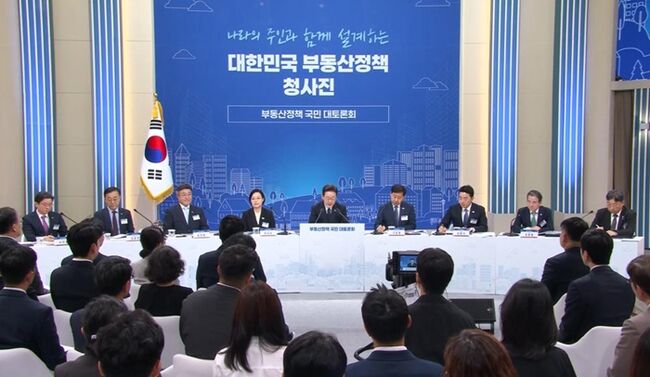 [Liberal Democratic Party Statement] Calling it a Grand Real Estate Debate… It Was Nothing More Than a Private Party Among Themselves
The 'National Grand Debate on Real Estate Policy' held on July 23rd and 27th. [Photo=Yonhap News]The 'National Grand Debate on Real Estate Policy,' hosted by the Lee Jae-myung administration under the
[Liberal Democratic Party Statement] Calling it a Grand Real Estate Debate… It Was Nothing More Than a Private Party Among Themselves
The 'National Grand Debate on Real Estate Policy' held on July 23rd and 27th. [Photo=Yonhap News]The 'National Grand Debate on Real Estate Policy,' hosted by the Lee Jae-myung administration under the
 [Photo] Evidence of Election Fraud Flooding U.S. Media… Trump Had 2.7 Million Votes Stolen
 [Video] U.S. Semiquincentennial Air Show... 'Art in the Sky' streaks across New York
 [Editorial Cartoon] A Draconian Law That Undermines Freedom of Expression

 List
List