Shin Hyun-song, the nominee for Governor of the Bank of Korea, answers reporters' questions as he arrives at the confirmation hearing preparation office set up at the Hanwha Financial Plaza in Jung-gu, Seoul, on the 31st. [Photo=Yonhap News]
The assessment of Shin Hyun-song, the nominee for Governor of the Bank of Korea, is clear from the outset. On March 22nd, President Lee Jae-myung nominated Shin, describing him as a "world-renowned authority in international finance and macroeconomics, possessing both academic depth and practical insight."
Indeed, Shin served as an Economic Advisor at the Bank for International Settlements (BIS) from May 2014 to March 2026, and concurrently held the position of Head of the Monetary and Economic Department from January 2025. Following the nomination, BIS also described him as a "thought leader" and "trusted adviser" respected within the central banking community.
The question is whether this illustrious career guarantees a 'good Bank of Korea Governor.'
The position of the Bank of Korea Governor is not one for expounding theories in international forums. It is a role that requires persuading markets and the public amidst the realities of high exchange rates, high oil prices, household debt, perceived inflation, and economic slowdown simultaneously pressing down.
The core of Shin's verification will ultimately focus not on "whether he is a globally recognized economist," but rather on "how he can address Korea's complex economic crises with what language and standards." This is consistent with the Blue House's emphasis at the time of the nomination announcement on international economic uncertainty due to the Middle East situation and the simultaneous response to inflation and growth.
The first verification point is his perception of the exchange rate.
Upon his first arrival at the confirmation hearing preparation office on the 31st, Shin commented on the won-dollar exchange rate nearing 1,530 won intra-day, stating, "I do not attach significant meaning to the exchange rate level itself. Given that dollar liquidity is currently ample, I don't think we need to directly link exchange rates and financial instability as we have in the past."
On the same day, Reuters reported that Shin had stated that "flexible monetary policy is needed amidst economic risks stemming from the Iran conflict," and assessed that "although the won has fallen to its lowest level since March 2009, liquidity conditions are stable."
While these remarks could be interpreted through the BIS lens, which prioritizes the potential for contagion within the financial system, they also raise questions about whether the pressure of a near-1530 won exchange rate on import prices, oil prices, and living costs was underestimated. The confirmation hearing is likely to begin here.
The second point is whether an international finance expert can also understand Korea's everyday economy.
Shin earned his bachelor's in Philosophy, Politics, and Economics (PPE) and master's and doctoral degrees in Economics from Oxford University, and taught as a professor at Oxford, LSE, and Princeton. He subsequently served as a Resident Scholar at the IMF, a Financial Advisory Committee member at the Federal Reserve Bank of New York, and a Presidential Economic Advisor for International Affairs.
Based on his resume, he is closer to an international organization/academic figure than a domestic bureaucratic type. His strengths are clear: he possesses rare strengths in areas such as global capital flows, dollar liquidity, and financial stability.
However, the reality for the Governor of the Bank of Korea is different. Issues such as the contraction of self-employment, the burden of household debt, the recession in regional economies, and perceived inflation cannot be explained solely by the language of international finance.
The confirmation hearing is likely to be an opportunity to test how concretely this global elite understands Korea's daily economy.
The third point is the substance of his monetary policy orientation.
Shin stated that dichotomously classifying himself as a hawk or a dove is undesirable, and that it is preferable to respond flexibly according to the situation after fully grasping the overall economic flow and the interactions between the financial structure and the real economy.
However, the market generally views him as a cautious hawk who prioritizes financial stability. Reuters pointed out that he is perceived as more of a hawk than a dove because he is known to hold a cautious stance on debt and real estate prices. In other words, while his self-description is one of balance, the market's interpretation is conservative.
In a situation where economic slowdown, inflationary pressures from the Middle East, exchange rate instability, and household debt burdens are all converging, he has not yet clearly stated which he will prioritize among inflation, growth, and financial stability. This is why the confirmation hearing is bound to become the stage for eliciting these priorities.
The fourth point is managing the distance from fiscal policy.
Shin assessed that a "wartime supplementary budget" would be necessary as a policy measure to ease economic difficulties exacerbated by the Middle East situation.
Reuters reported that he commented that the government's supplementary budget for supporting low-income households is carefully designed and not excessively large, so it is unlikely to significantly stimulate inflation. This is read as a message that, while being cautious about interest rate management, he is open to the cushioning role of fiscal policy.
However, the extent to which a nominee for the Bank of Korea Governor can send positive signals regarding fiscal expansion is a separate matter. This is because the Bank of Korea is an institution that must protect its monetary policy independence, not a subordinate partner in economic stimulus.
The fourth verification point will be the line Shin draws between policy cooperation with the government and the independence of the central bank.
The fifth point is crisis communication ability.
As a figure referred to as a "thought leader" by the BIS, there is no doubt about his reputation and network within the international finance community. However, the Governor of the Bank of Korea needs more than the language of academic papers and international conferences. They need a language that can calm the market without ignoring reality, and reassure the public without giving an impression of complacency.
Even with his remarks on the exchange rate on the 31st, experts can understand the structure, but for the general public, it could evoke the question, "The rate is 1,530 won, so why is it okay?"
Ultimately, the Governor is not an analyst but the final message custodian. The final test will be how naturally Shin can translate the language of academia and international organizations into Korea's policy language, and then into the language of the public.
In summary, Shin Hyun-song's strengths are clear. He has a solid reputation in international finance and financial stability, and his standing within the central banking community is high, as officially praised by the BIS.
However, the confirmation hearing is not a venue for confirming fame, but for verifying suitability. What Shin needs to prove is not "I am a world-class economist."
It is "I am the Governor of the Bank of Korea who can address the 1,530 won exchange rate, high oil prices, inflation and growth, and financial markets and the everyday economy in a single language." The essence of this confirmation hearing ultimately converges on that one sentence.

 [Statement by the Seo-beo-kka Korea Military Academy Save-the-Nation Comrades Association] ㉛ Recount the Votes Publicly, as the Previous Recount Concealed Election Fraud
Tongyeong Mayoral Election Recount [Photo=Yonhap News]South Korea's liberal democracy is dying. The National Election Commission (NEC) and the judiciary, which have plummeted into criminal syndicates
[Statement by the Seo-beo-kka Korea Military Academy Save-the-Nation Comrades Association] ㉛ Recount the Votes Publicly, as the Previous Recount Concealed Election Fraud
Tongyeong Mayoral Election Recount [Photo=Yonhap News]South Korea's liberal democracy is dying. The National Election Commission (NEC) and the judiciary, which have plummeted into criminal syndicates
 What is the significance of the "Trump 2028" red hats that keep making a comeback?
It is noteworthy that President Donald Trump is "intentionally" fueling controversy over whether he can actually run in the 2028 presidential election, even though it is "highly likely he is seriously
What is the significance of the "Trump 2028" red hats that keep making a comeback?
It is noteworthy that President Donald Trump is "intentionally" fueling controversy over whether he can actually run in the 2028 presidential election, even though it is "highly likely he is seriously
 Jin Cummings: “North Korea says it will increase the number of spies, so what is the government doing?”
U.S. political columnist Gene Cummings has publicly questioned the South Korean government, asking, "North Korea is declaring that it will increase its number of spies, so what is the South Kore
Jin Cummings: “North Korea says it will increase the number of spies, so what is the government doing?”
U.S. political columnist Gene Cummings has publicly questioned the South Korean government, asking, "North Korea is declaring that it will increase its number of spies, so what is the South Kore
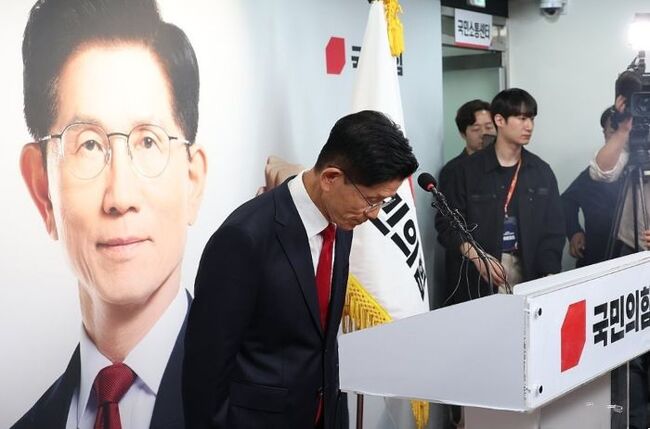 “Too little, too late?…” Kim Moon-soo, who previously conceded his presidential election defeat, now demands a special counsel investigation into ‘allegations of election fraud in the 2025 presidential election’
People Power Party presidential candidate Kim Moon-soo concedes defeat during a press conference at the party headquarters in Yeouido, Seoul, on June 4, 2025. [Joint Press Corps]As allegations emerge
“Too little, too late?…” Kim Moon-soo, who previously conceded his presidential election defeat, now demands a special counsel investigation into ‘allegations of election fraud in the 2025 presidential election’
People Power Party presidential candidate Kim Moon-soo concedes defeat during a press conference at the party headquarters in Yeouido, Seoul, on June 4, 2025. [Joint Press Corps]As allegations emerge
 Stock Market Crash 'Black Tuesday'… KOSPI down 10.8%, KOSDAQ down 7.7%
The KOSPI fell by more than 5% in early trading on the 28th, triggering a sell-side sidecar.On the 28th, the KOSPI plunged by more than 10%.Due to the sharp decline, a sell-side sidecar—a temporary
Stock Market Crash 'Black Tuesday'… KOSPI down 10.8%, KOSDAQ down 7.7%
The KOSPI fell by more than 5% in early trading on the 28th, triggering a sell-side sidecar.On the 28th, the KOSPI plunged by more than 10%.Due to the sharp decline, a sell-side sidecar—a temporary
 [World Heritage Committee] 25 New World Heritage Sites Inscribed in Busan… South Korea Successfully Expands 'Getbol' Listing
The Chairperson of the World Heritage Committee speaks at the plenary session of the 48th session of the World Heritage Committee, held at BEXCO in Busan on the 20th. [Photo: Yonhap News]A total of 25
[World Heritage Committee] 25 New World Heritage Sites Inscribed in Busan… South Korea Successfully Expands 'Getbol' Listing
The Chairperson of the World Heritage Committee speaks at the plenary session of the 48th session of the World Heritage Committee, held at BEXCO in Busan on the 20th. [Photo: Yonhap News]A total of 25
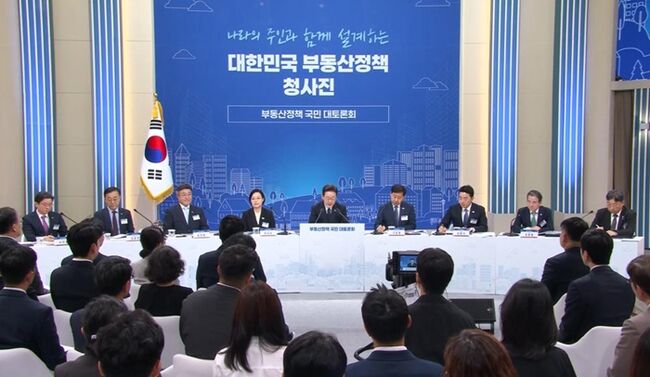 [Liberal Democratic Party Statement] Calling it a Grand Real Estate Debate… It Was Nothing More Than a Private Party Among Themselves
The 'National Grand Debate on Real Estate Policy' held on July 23rd and 27th. [Photo=Yonhap News]The 'National Grand Debate on Real Estate Policy,' hosted by the Lee Jae-myung administration under the
[Liberal Democratic Party Statement] Calling it a Grand Real Estate Debate… It Was Nothing More Than a Private Party Among Themselves
The 'National Grand Debate on Real Estate Policy' held on July 23rd and 27th. [Photo=Yonhap News]The 'National Grand Debate on Real Estate Policy,' hosted by the Lee Jae-myung administration under the
 [Photo] Evidence of Election Fraud Flooding U.S. Media… Trump Had 2.7 Million Votes Stolen
 [Video] U.S. Semiquincentennial Air Show... 'Art in the Sky' streaks across New York
 [Editorial Cartoon] A Draconian Law That Undermines Freedom of Expression

 List
List