Dubai's airport, which was severely impacted by Iran's airstrikes. [Photo=AP]Navigability in the Strait of Hormuz remains incomplete. The freedom of navigation system, which has been supported by U.S. naval power and international maritime order for decades, is being shaken as a means of hostage-taking against most of the world.
The two-week ceasefire that went into effect on the 7th (local time) merely paused full-scale conflict, not a resolution that restored freedom of navigation and regional order. Although follow-up negotiations were expected for two weeks, the ceasefire has been significantly shaken from the outset by Israel's offensive in Lebanon.
According to the Israeli interpretation, Lebanon was not included in the ceasefire terms from the beginning. The border in southern Lebanon (northern Israel) is a key battlefield for Hezbollah, one of Iran's proxy forces.
Trump's Gain is Not the Size of Concessions, but the Exposure of 'Iran's True Nature'
When assessing Trump's gains and losses in this situation, the first thing to consider is not 'what concessions were made immediately' but 'who revealed their true colors.' Iran is using control of the strait and its links to Lebanon as bargaining chips, without even reserving the complete opening of Hormuz, let alone abandoning nuclear weapons or reducing its proxy forces.
Trump, unlike previous U.S. administrations, has not embellished Tehran's threats as a "complex security reality" and has repeatedly clarified what constitutes negotiation and what constitutes coercion. While it is too early to confirm success, there is ample room to believe that the situation has at least shifted in his favor.
Loss of the 'Life Support' with UAE's Departure
Iran's most fatal misstep in the current situation is that it has alienated the Gulf Arab "gray zone" that had been sustaining its regime. The UAE's departure is particularly painful. For a long time, Dubai has not been merely an Islamic fraternity country to Iran. It was a channel through which money flowed, goods were rerouted, and even oil revenues were laundered amidst sanctions.
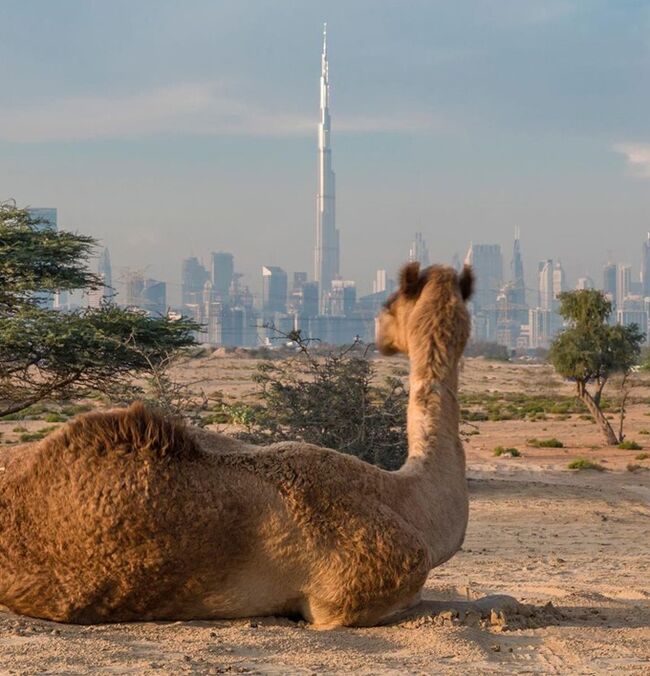 Dubai skyline. [Photo=Dubai Department of Tourism]
Reuters' commentary column Breakingviews has discussed the possibility of Iran-linked assets within the UAE totaling tens of billions of dollars, potentially up to about $50 billion, and has pointed out that many complex revenue streams have passed through Dubai's free trade zones and financial networks.
The U.S. Treasury Department has also repeatedly identified UAE-based companies, vessels, and networks in its sanctions announcements for 2025 and 2026, linking them to Iran's shadow banking, oil trading, phantom fleets, and procurement networks. It is no exaggeration to say that Dubai was Iran's "informal life support" for evading sanctions.
The UAE has directly raised the issue of Iranian responsibility, demanding the "unconditional reopening" of the strait. Saudi Arabia has also officially acknowledged a reduction in production capacity of 600,000 barrels per day and a processing capacity of 700,000 barrels per day through the East-West pipeline due to Iranian attacks.
Since the 1979 revolution, Iran has consistently framed itself in terms of "anti-Israel, anti-US sovereignty," but its true nature has finally become clear to the Gulf countries. Iran is a power that relies on Arab ports, finance, and logistics for regime survival, and is willing to control the lifelines of energy and maritime transport of its so-called "Islamic brethren" when necessary. What Iran is losing now is not "friendship," but the "tacit consent" of its neighbors, which has enabled its survival.
Why is Iran's Sentiment Towards Arab Nations Dual?
Iran's psychology, which harbors both a sense of superiority and inferiority towards the Arab world, has deep roots. It was conquered by the Arabs in the 7th century and adopted Islam, and modern Persian is written in Arabic script and contains numerous Arabic loanwords.
However, it has maintained its own distinct language and cultural identity. In short, Iran's identity is centered on the memory that while it adopted Arab religion and script, it was not completely absorbed into that world. This memory is the basis of its civilizational pride and also a long-standing wound of having been incorporated into the Arab order.
The Safavid dynasty solidified this contradiction into its national identity. The Safavid dynasty established Twelver Shia Islam as the state religion of Iran, which is known to have played a significant role in forming a unified national consciousness that bound together diverse ethnic and linguistic elements.
Therefore, today's Iranian consciousness of being the leader of Shia Islam is not solely a religious conviction as a guardian of doctrine. It is also a strategy to maintain its own national and civilizational position alongside the Arab and Sunni majority.
In the eyes of the ruling elite of the Islamic Republic of Iran, the Gulf Arab states are largely monarchies that only recently consolidated their state forms, and entities that have rapidly emerged with the backing of oil and the U.S. security umbrella. It is at this point that conflicting emotions, such as superiority and inferiority, are simultaneously conceived.
The Essence of Sunni vs. Shia Conflict is Power, Not Doctrine
Analysis from the Brookings Institution also understands the Sunni-Shia rivalry in the Middle East not as a pure theological debate, but as a regional competition between Arab nationalism and Iranian nationalism. The common view is that their division is difficult to categorize like the doctrinal differences between Catholicism and Protestantism. It is too political and overtly hegemonic. Iran's preoccupation with Lebanon, Syria, Iraq, and Yemen is as much about maintaining its sphere of influence and regime prestige as it is about religious kinship.
Precisely because of this, Iran's choice to antagonize its neighboring Arab countries is not just a diplomatic failure but an explosion of self-contradiction. The majority of the Gulf Arab states are monarchies, and among them, Saudi Arabia and Oman are strongly absolutist monarchies. While lecturing these countries with words and boasting about the legitimacy and rationale of the revolution, its economy has depended on Dubai's financial network and the Gulf's trade order.
Although it prides itself on being the heir to an empire, its livelihood and survival have depended on the openness and intermediary functions of the Arab world. With the UAE also turning its back, Iran now faces not just "enduring sanctions" but "feeling them with its entire being." This dynamic is by no means unfavorable to Trump. Instead of a face-saving agreement, he can exert pressure for the complete freedom of navigation in Hormuz and the blocking of sanction evasion channels as a package. If he pushes further here, Trump will be remembered as the president who shook the gray survival structure of Iran.

◆ Dr. Im Myeong-shin
Ph.D. in Chinese Studies, Northeast Asian Researcher
Former Deputy Director of International Affairs, Sky Daily

 [Statement by the Seo-beo-kka Korea Military Academy Save-the-Nation Comrades Association] ㉛ Recount the Votes Publicly, as the Previous Recount Concealed Election Fraud
Tongyeong Mayoral Election Recount [Photo=Yonhap News]South Korea's liberal democracy is dying. The National Election Commission (NEC) and the judiciary, which have plummeted into criminal syndicates
[Statement by the Seo-beo-kka Korea Military Academy Save-the-Nation Comrades Association] ㉛ Recount the Votes Publicly, as the Previous Recount Concealed Election Fraud
Tongyeong Mayoral Election Recount [Photo=Yonhap News]South Korea's liberal democracy is dying. The National Election Commission (NEC) and the judiciary, which have plummeted into criminal syndicates
 What is the significance of the "Trump 2028" red hats that keep making a comeback?
It is noteworthy that President Donald Trump is "intentionally" fueling controversy over whether he can actually run in the 2028 presidential election, even though it is "highly likely he is seriously
What is the significance of the "Trump 2028" red hats that keep making a comeback?
It is noteworthy that President Donald Trump is "intentionally" fueling controversy over whether he can actually run in the 2028 presidential election, even though it is "highly likely he is seriously
 Jin Cummings: “North Korea says it will increase the number of spies, so what is the government doing?”
U.S. political columnist Gene Cummings has publicly questioned the South Korean government, asking, "North Korea is declaring that it will increase its number of spies, so what is the South Kore
Jin Cummings: “North Korea says it will increase the number of spies, so what is the government doing?”
U.S. political columnist Gene Cummings has publicly questioned the South Korean government, asking, "North Korea is declaring that it will increase its number of spies, so what is the South Kore
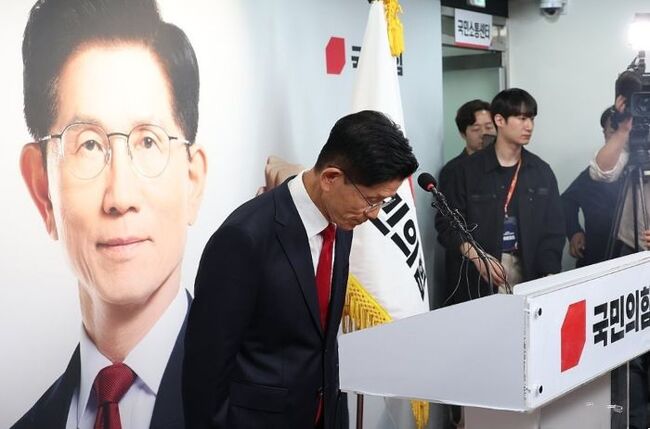 “Too little, too late?…” Kim Moon-soo, who previously conceded his presidential election defeat, now demands a special counsel investigation into ‘allegations of election fraud in the 2025 presidential election’
People Power Party presidential candidate Kim Moon-soo concedes defeat during a press conference at the party headquarters in Yeouido, Seoul, on June 4, 2025. [Joint Press Corps]As allegations emerge
“Too little, too late?…” Kim Moon-soo, who previously conceded his presidential election defeat, now demands a special counsel investigation into ‘allegations of election fraud in the 2025 presidential election’
People Power Party presidential candidate Kim Moon-soo concedes defeat during a press conference at the party headquarters in Yeouido, Seoul, on June 4, 2025. [Joint Press Corps]As allegations emerge
 Stock Market Crash 'Black Tuesday'… KOSPI down 10.8%, KOSDAQ down 7.7%
The KOSPI fell by more than 5% in early trading on the 28th, triggering a sell-side sidecar.On the 28th, the KOSPI plunged by more than 10%.Due to the sharp decline, a sell-side sidecar—a temporary
Stock Market Crash 'Black Tuesday'… KOSPI down 10.8%, KOSDAQ down 7.7%
The KOSPI fell by more than 5% in early trading on the 28th, triggering a sell-side sidecar.On the 28th, the KOSPI plunged by more than 10%.Due to the sharp decline, a sell-side sidecar—a temporary
 [World Heritage Committee] 25 New World Heritage Sites Inscribed in Busan… South Korea Successfully Expands 'Getbol' Listing
The Chairperson of the World Heritage Committee speaks at the plenary session of the 48th session of the World Heritage Committee, held at BEXCO in Busan on the 20th. [Photo: Yonhap News]A total of 25
[World Heritage Committee] 25 New World Heritage Sites Inscribed in Busan… South Korea Successfully Expands 'Getbol' Listing
The Chairperson of the World Heritage Committee speaks at the plenary session of the 48th session of the World Heritage Committee, held at BEXCO in Busan on the 20th. [Photo: Yonhap News]A total of 25
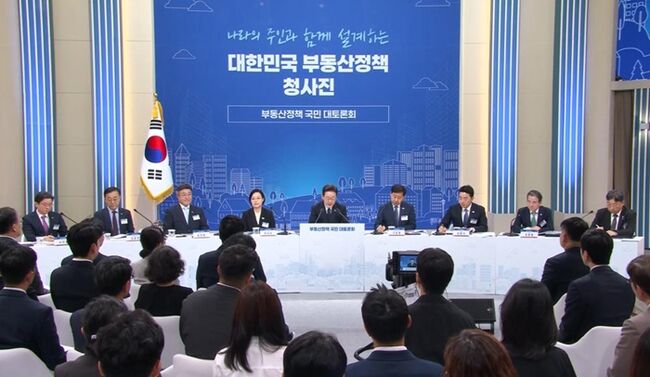 [Liberal Democratic Party Statement] Calling it a Grand Real Estate Debate… It Was Nothing More Than a Private Party Among Themselves
The 'National Grand Debate on Real Estate Policy' held on July 23rd and 27th. [Photo=Yonhap News]The 'National Grand Debate on Real Estate Policy,' hosted by the Lee Jae-myung administration under the
[Liberal Democratic Party Statement] Calling it a Grand Real Estate Debate… It Was Nothing More Than a Private Party Among Themselves
The 'National Grand Debate on Real Estate Policy' held on July 23rd and 27th. [Photo=Yonhap News]The 'National Grand Debate on Real Estate Policy,' hosted by the Lee Jae-myung administration under the
 [Photo] Evidence of Election Fraud Flooding U.S. Media… Trump Had 2.7 Million Votes Stolen
 [Video] U.S. Semiquincentennial Air Show... 'Art in the Sky' streaks across New York
 [Editorial Cartoon] A Draconian Law That Undermines Freedom of Expression

 List
List