Regulations Preceded Verification
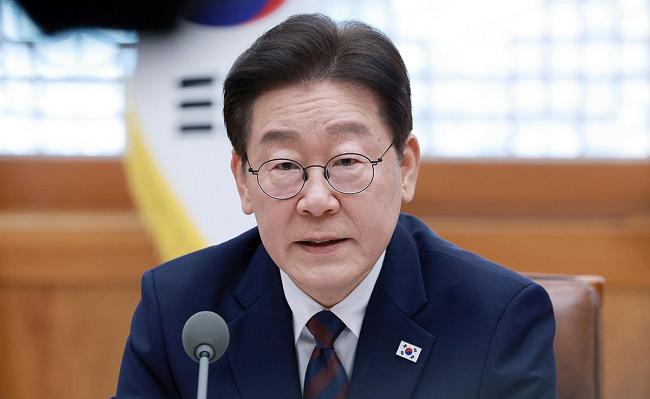
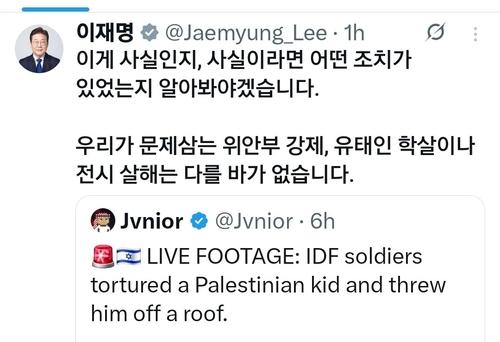
President Lee Jae-myung's act of sharing a video related to the Israeli military on his X account on the 10th and simultaneously mentioning "genocide of Jews" and "killing in wartime" was not a mere expression of concern.
Although President Lee wrote, "I need to find out if this is true, and if so, what measures were taken," he simultaneously elevated the scene with the language of "genocide of Jews" and "killing in wartime."
This means that the regulations were set before verification was even attempted.
However, the context of the original incident, which was subsequently verified, is much narrower and more specific.
According to a Reuters report, the scene in question is not a newly unfolding video from the current war, but was filmed in September 2024 in Qabatiya, West Bank, showing Israeli soldiers pushing the bodies of apparently deceased Palestinians under a roof and dropping them. The Israeli military stated at the time that it considered it a serious matter that went against its values and launched an investigation.
While it is indeed a controversy over inappropriate handling of bodies that deserves criticism, labeling it immediately as "killing in wartime" and further linking it to the language of "genocide of Jews" erases factual explanation and leaves only an imposed judgment.
A Different Level Than the Holocaust
This is precisely where the core criticism lies. The Holocaust was a systematic extermination of a specific group, with state power mobilizing all its institutions, administration, and military might. In contrast, this video concerns a controversy over the desecration of bodies by a single unit on a battlefield. Both may share an abstract commonality in offending human dignity.
However, the structure, scale, planning, and the nature of state intervention are entirely different. Despite this, President Lee Jae-myung erased those differences and immediately invoked the language of the Holocaust. This is not an expansion of human rights sensitivity, but a collapse of comparative judgment.
The expression "killing in wartime" is also problematic.
This term is not a neutral description. "Wartime" evokes the entire war, and "killing" virtually presupposes intent and responsibility. The moment these two are combined, the reader naturally recalls a planned war crime.
However, if the context revealed later was a controversy over the desecration of bodies from a 2024 incident, this expression can only be seen as an excessive judgment that imposes an impression rather than an objective description.
Why North Korea and Iran Come to Mind
North Korea and Iran are not direct comparison targets here. Rather, it is important why this incident brings those questions to mind together.
In March of this year, the UN Human Rights Office emphasized the need for continuous accountability and international cooperation regarding the human rights situation in North Korea. For Iran, it pointed out issues of arbitrary killing, torture, sexual violence, arbitrary detention, and forced confessions. Reuters also reported in April of this year on Iran's executions and controversies surrounding torture and unfair trials.
These are cases where the regime and power systematically trample on human beings. Therefore, it is not unreasonable for people who saw this scene to ask, "Why doesn't the president so readily use such immediate and strong language for these systemic human rights abuses?"
This question is the author's as well as a recurring theme in online comments and reactions to the article.
Late Explanations Are Insufficient
Furthermore, the explanation provided after the controversy did not change the essence of the issue. As reported by Yonhap News, President Lee later explained in an additional post that the video depicted a real situation that occurred in September 2024 and that the White House had also described it as "very shocking" at the time.
However, the initial post had already conveyed the most serious impressions of "killing in wartime" and "genocide of Jews." The belated explanation could not reverse the impact.
The president's SNS is not merely a space for personal sentiment but effectively a diplomatic channel. When moral outrage precedes fact-checking on such a channel, and an attempt is made to mitigate it with a belated supplementary explanation, it is easily read not as a cautious human rights statement, but as a weak excuse.
This is not the first time.
In late January, President Lee Jae-myung shared an article related to scam crimes in Cambodia and posted in Khmer, roughly meaning "If you mess with Koreans, you'll be ruined." Subsequently, in February, the post was deleted after the Cambodian side inquired about its meaning through the Korean ambassador to Cambodia.
While the Ministry of Foreign Affairs explained this as routine communication rather than a formal protest or demarche, it became clear that the president's SNS is a channel that generates diplomatic interpretations and repercussions. Both then and now, the president has lightly crossed the boundary between personal anger and national messaging.
Contradicts Even the Democratic Party's Standards
At this point, the Democratic Party's self-contradiction is also revealed.
If the same strict standard of "disinformation" applied to others' posts and remarks is not applied to the president's own communications, it is not principle but convenience.
The practice of attaching the most provocative interpretations and the most severe judgment terms to a video whose facts have not been confirmed, and then adding contextual explanations only after controversy arises, directly conflicts with the logic the Democratic Party has consistently espoused regarding the response to disinformation.
If what others do is fake news, but what one does is human rights sensitivity? If others' posts are problematic, but the president's excessive statements are held to a different standard, it is not principle but an exception for one's own side.
Ultimately, the essence of this controversy is simple.
What should be directly criticized is that President Lee Jae-myung appended the language of the Holocaust to an unverified video. And that scene naturally leaves another question: Why does such immediate and strong moral language not so readily appear for the systemic human rights abuses in North Korea and Iran?
To speak of human rights, the weight of comparison must be accurate. To speak of facts, the same standard must be applied to one's own side. What this incident has revealed is not only President Lee Jae-myung's recklessness but also the selective principle of the Democratic Party's approach to disinformation politics.

 [Statement by the Seo-beo-kka Korea Military Academy Save-the-Nation Comrades Association] ㉛ Recount the Votes Publicly, as the Previous Recount Concealed Election Fraud
Tongyeong Mayoral Election Recount [Photo=Yonhap News]South Korea's liberal democracy is dying. The National Election Commission (NEC) and the judiciary, which have plummeted into criminal syndicates
[Statement by the Seo-beo-kka Korea Military Academy Save-the-Nation Comrades Association] ㉛ Recount the Votes Publicly, as the Previous Recount Concealed Election Fraud
Tongyeong Mayoral Election Recount [Photo=Yonhap News]South Korea's liberal democracy is dying. The National Election Commission (NEC) and the judiciary, which have plummeted into criminal syndicates
 What is the significance of the "Trump 2028" red hats that keep making a comeback?
It is noteworthy that President Donald Trump is "intentionally" fueling controversy over whether he can actually run in the 2028 presidential election, even though it is "highly likely he is seriously
What is the significance of the "Trump 2028" red hats that keep making a comeback?
It is noteworthy that President Donald Trump is "intentionally" fueling controversy over whether he can actually run in the 2028 presidential election, even though it is "highly likely he is seriously
 Jin Cummings: “North Korea says it will increase the number of spies, so what is the government doing?”
U.S. political columnist Gene Cummings has publicly questioned the South Korean government, asking, "North Korea is declaring that it will increase its number of spies, so what is the South Kore
Jin Cummings: “North Korea says it will increase the number of spies, so what is the government doing?”
U.S. political columnist Gene Cummings has publicly questioned the South Korean government, asking, "North Korea is declaring that it will increase its number of spies, so what is the South Kore
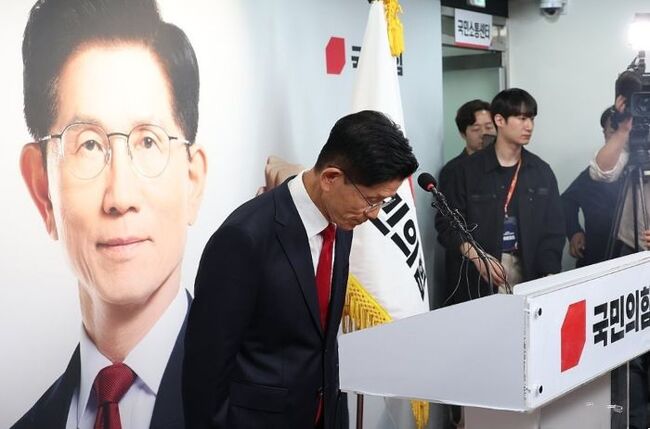 “Too little, too late?…” Kim Moon-soo, who previously conceded his presidential election defeat, now demands a special counsel investigation into ‘allegations of election fraud in the 2025 presidential election’
People Power Party presidential candidate Kim Moon-soo concedes defeat during a press conference at the party headquarters in Yeouido, Seoul, on June 4, 2025. [Joint Press Corps]As allegations emerge
“Too little, too late?…” Kim Moon-soo, who previously conceded his presidential election defeat, now demands a special counsel investigation into ‘allegations of election fraud in the 2025 presidential election’
People Power Party presidential candidate Kim Moon-soo concedes defeat during a press conference at the party headquarters in Yeouido, Seoul, on June 4, 2025. [Joint Press Corps]As allegations emerge
 Stock Market Crash 'Black Tuesday'… KOSPI down 10.8%, KOSDAQ down 7.7%
The KOSPI fell by more than 5% in early trading on the 28th, triggering a sell-side sidecar.On the 28th, the KOSPI plunged by more than 10%.Due to the sharp decline, a sell-side sidecar—a temporary
Stock Market Crash 'Black Tuesday'… KOSPI down 10.8%, KOSDAQ down 7.7%
The KOSPI fell by more than 5% in early trading on the 28th, triggering a sell-side sidecar.On the 28th, the KOSPI plunged by more than 10%.Due to the sharp decline, a sell-side sidecar—a temporary
 [World Heritage Committee] 25 New World Heritage Sites Inscribed in Busan… South Korea Successfully Expands 'Getbol' Listing
The Chairperson of the World Heritage Committee speaks at the plenary session of the 48th session of the World Heritage Committee, held at BEXCO in Busan on the 20th. [Photo: Yonhap News]A total of 25
[World Heritage Committee] 25 New World Heritage Sites Inscribed in Busan… South Korea Successfully Expands 'Getbol' Listing
The Chairperson of the World Heritage Committee speaks at the plenary session of the 48th session of the World Heritage Committee, held at BEXCO in Busan on the 20th. [Photo: Yonhap News]A total of 25
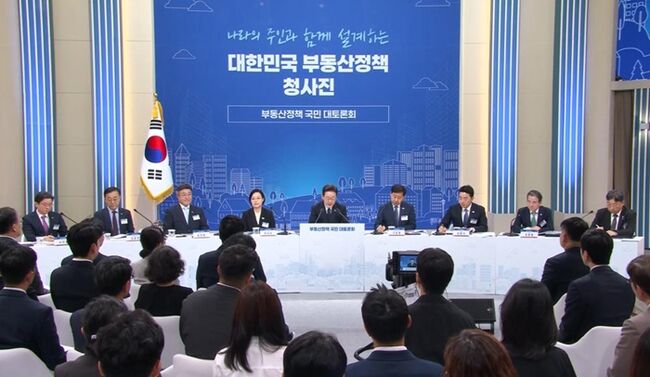 [Liberal Democratic Party Statement] Calling it a Grand Real Estate Debate… It Was Nothing More Than a Private Party Among Themselves
The 'National Grand Debate on Real Estate Policy' held on July 23rd and 27th. [Photo=Yonhap News]The 'National Grand Debate on Real Estate Policy,' hosted by the Lee Jae-myung administration under the
[Liberal Democratic Party Statement] Calling it a Grand Real Estate Debate… It Was Nothing More Than a Private Party Among Themselves
The 'National Grand Debate on Real Estate Policy' held on July 23rd and 27th. [Photo=Yonhap News]The 'National Grand Debate on Real Estate Policy,' hosted by the Lee Jae-myung administration under the
 [Photo] Evidence of Election Fraud Flooding U.S. Media… Trump Had 2.7 Million Votes Stolen
 [Video] U.S. Semiquincentennial Air Show... 'Art in the Sky' streaks across New York
 [Editorial Cartoon] A Draconian Law That Undermines Freedom of Expression

 List
List